Trump or the middle? Georgia Republicans test two paths to victory
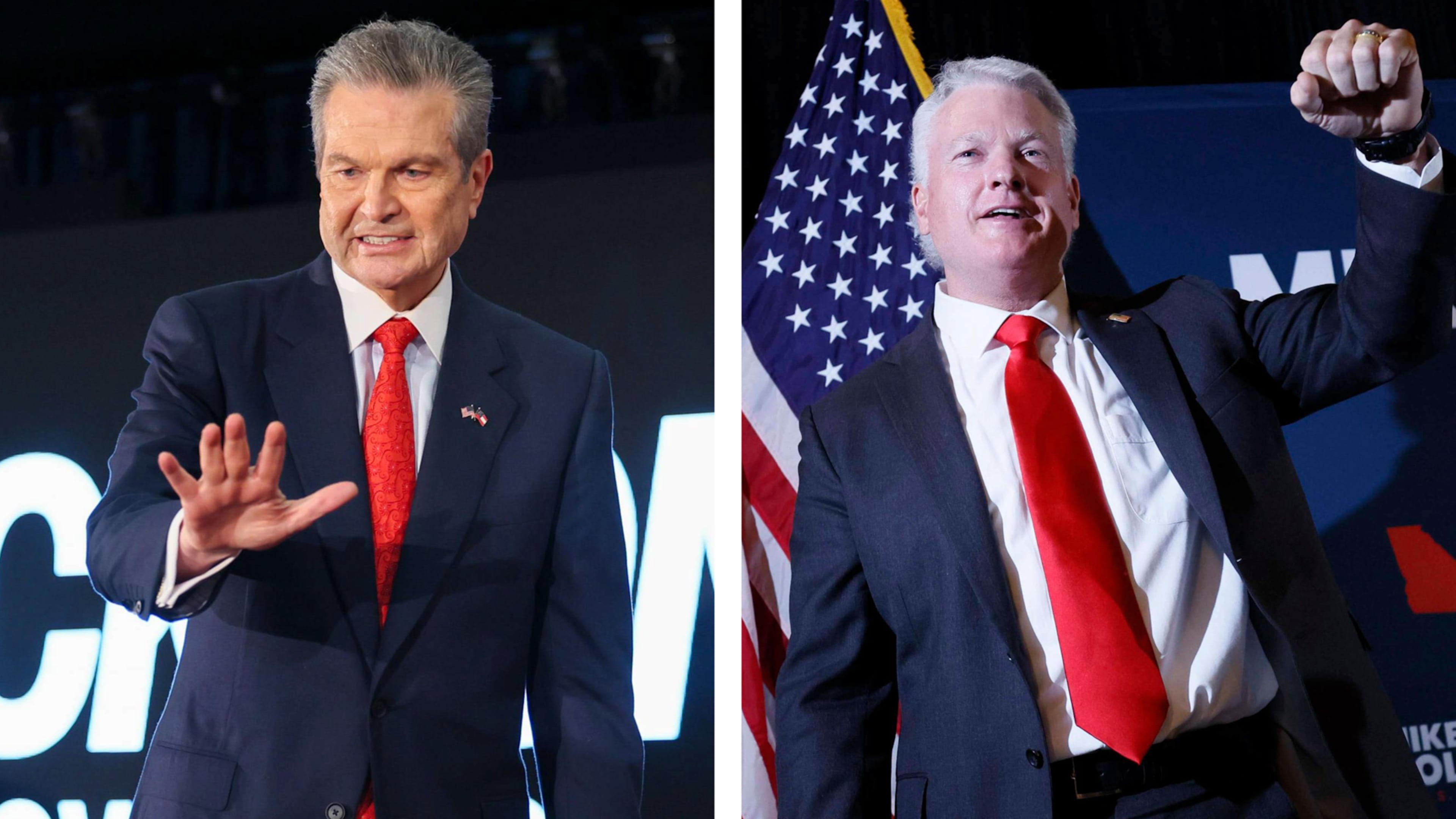
Nothing illustrated the stark divide in the Georgia Republican approach to November quite like what happened in the middle of a national GOP convention last week dominated by President Donald Trump.
Hours after U.S. Rep. Mike Collins addressed thousands of MAGA loyalists in Dallas, GOP nominee for governor Rick Jackson was back in Georgia, stumping in Madison before joining Gov. Brian Kemp for a fundraiser built around a message largely untethered from Trump.
The contrast reflects two competing theories taking shape inside the GOP over how to win a state that has seesawed between the parties for most of the decade — and where Republicans now face roaring headwinds tied to Trump’s sagging approval ratings.
Collins and other MAGA loyalists are leaning into the president and his policies, wagering that a surge of pro-Trump voters can overcome Democratic enthusiasm in November. He said Sunday he embraces the nickname “MAGA Mike.”
Jackson isn’t disavowing his pledge to become Trump’s “favorite governor.” But he’s bringing it up far less these days, instead emphasizing outreach to independents and split-ticket voters who helped Kemp win a landslide reelection four years ago.
Back in Dallas, Republicans were making the case for base politics. Collins and other speakers portrayed U.S. Sen. Jon Ossoff and other Democrats as dangerous left-wing ideologues, while Trump dismissed “fake” concerns about the cost of living.
He also gave Republicans a remarkably straightforward instruction for the midterms: “Please pretend that I am running.”
Some of Georgia’s most influential Republicans think that’s exactly what the party needs to win in November. Others worry it is the wrong lesson for a state where a small bloc of swing voters has decided elections.
The disagreement is becoming one of the defining tensions of Georgia’s 2026 campaign.
On one side are Collins’ allies and Georgia GOP Chair Josh McKoon, who see this year’s campaign primarily as a turnout contest. Their model is Trump’s 2024 victory, when Republicans identified infrequent conservative voters, drove them to the polls and overwhelmed Democratic gains elsewhere.

McKoon argued the election will not be decided by “some mythical group” of undecided voters but by making sure his core supporters still support the party’s ticket even though he isn’t on the ballot.
On the other are Republicans who see Kemp’s 2022 election as the model for this cycle. The governor unified the base, kept Trump at a distance and galvanized independents.
Attorney General Chris Carr, a Jackson supporter who finished fourth in the May primary, laid out the divide in unusually stark terms during an interview with the “Politically Georgia” podcast.
He warned that Republicans were ignoring political “canaries in the coal mine,” and said Republicans who don’t reach more swing voters misread how competitive the state truly is.
“One of the biggest hurdles we Republicans have is too many people think that this is 2016 or 2006 — and not 2026,” he said.
There is evidence for that argument in the polling. Jackson and Democratic nominee Keisha Lance Bottoms are locked in a neck-and-neck race, while Ossoff leads Collins in every major public poll.

And Democrats wary of Jackson’s shift are working to tie him back to the Trump-aligned positions he embraced during the primary. At a Sunday rally in Athens, Bottoms reminded supporters that Jackson promised to be like Trump but with a “southern tone.”
“Georgia, we deserve a governor who is working for our communities,” she said. “Not a governor who looks at everything as an opportunity to get rich while Georgians foot the bill.”
Two coalitions
The debate has taken on new urgency as Trump casts November as a referendum on his presidency, delighting Georgia Democrats who have long framed the race exactly that way.
“For the life of me, I can’t figure out why these GOP nominees feel possessed to keep hanging out with Donald Trump with less than two months to go,” said Democratic state Sen. Josh McLaurin, the party’s nominee for lieutenant governor. “It has moth-to-flame energy.”
Collins has leaned into that strategy. His Senate campaign has been built around a hard-edged MAGA identity, and he was among the most prominent Georgians at the national GOP gathering.
He said he’s not ignoring middle-of-the-road voters, a bloc he sometimes calls “Atlanta voters.” To him, they want a politician who can pass measures like the 2025 immigration crackdown he authored. His campaign, however, has focused more on energizing Trump supporters.
“The Republican Party has a MAGA base that only shows up when President Trump or a Trump candidate is on the ticket,” he said of his path to victory during the primary. “They know that’s me.”
Jackson is taking a strikingly different approach.
Since emerging from a bruising Republican primary, the healthcare executive has shifted his emphasis to affordability, government ethics and vows to expand Medicaid access while pummeling Bottoms over her record as mayor.
His campaign is making an explicit appeal to voters who might support Ossoff while backing Jackson for governor. And he has kept Collins, who has been dogged by controversies, at arm’s length.
“Focus is the way I’ve been successful,” Jackson said. “So I’m focusing on this race — period — from that standpoint. There’s no other agenda other than whatever it’s going to take to win.”
Shifting strategies
Georgia Republicans can find evidence for either strategy in their own recent history.
Kemp’s first campaign for governor in 2018 was largely a turnout operation.
After entering the race with a Trump-like “Georgia First” vow, he campaigned relentlessly in conservative rural and exurban communities on promises to enact abortion limits and expand gun rights to wring out as many Trump votes as he could.
Kemp described it as a “base-turnout election,” saying it was the smartest path available to him in a close contest against Stacey Abrams.
It worked. Barely.
Kemp won by roughly 55,000 votes even as fast-growing metro Atlanta counties continued their march toward Democrats, proving that Republicans could compensate for losses in the suburbs by running up the score in deep-red parts of the state.
It also showed how little margin for error remained. His advisers privately speculated at the time whether it was the last election where that approach would work in Georgia.
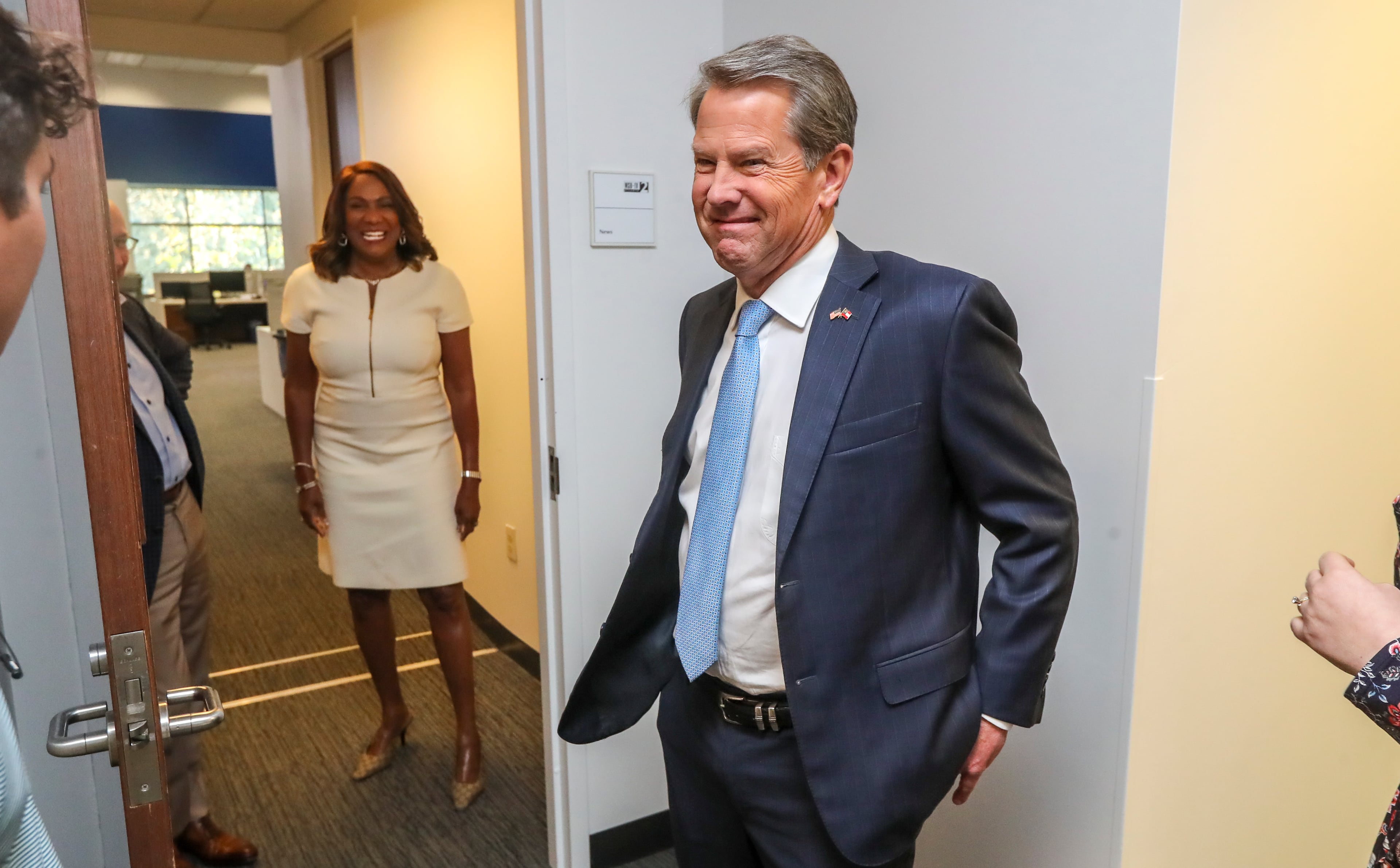
Four years later, Kemp ran a very different race.
With Republicans behind him after trouncing a Trump-backed primary challenger, Kemp devoted more energy to voters outside the GOP base in a rematch against Abrams. He campaigned in the suburbs, courted Black voters and focused heavily on fighting inflation.
Kemp defeated the Democrat by about 7 percentage points. Meanwhile, Republican U.S. Senate candidate Herschel Walker’s Trump-oriented campaign collapsed against Democratic U.S. Sen. Raphael Warnock.
Ryan Mahoney, a former top Kemp strategist, said that broader approach remains essential in today’s politics.
“To win Georgia, you have to earn the support of swing voters. That means focusing on the issues that matter most to them: cost of living, public safety, and education,” Mahoney said. “Ignore those voters, and you’re doomed to become the next GOP candidate who wins the nomination but loses the race that really matters.”
Still, Trump’s 2024 victory revived the case in some GOP circles for a turnout-heavy strategy.