In Gwinnett, Democrats try to turn a Supreme Court setback into momentum
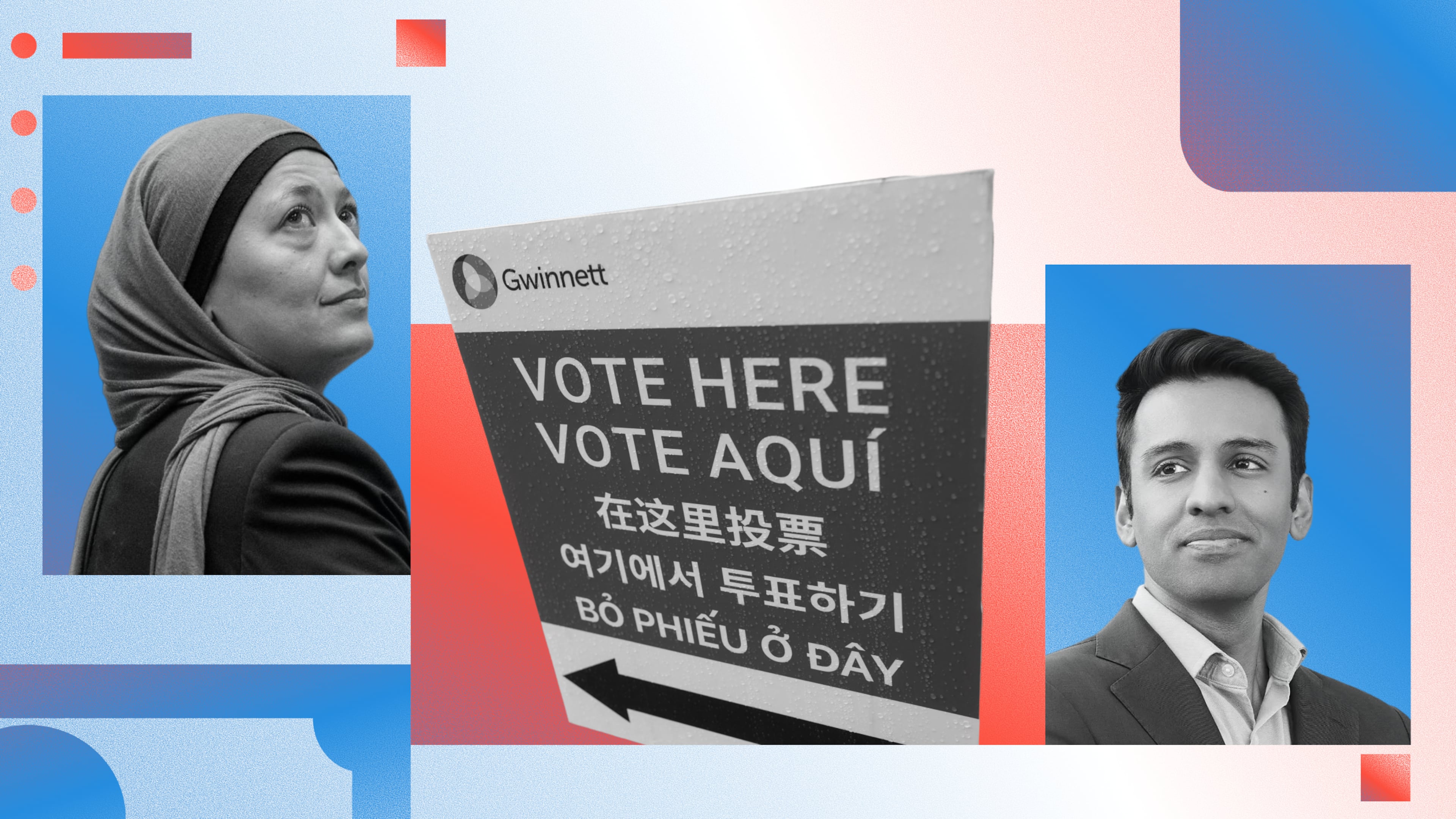

In a Gwinnett County state Senate runoff between two liberals, the battle over Georgia’s impending redistricting is no sideshow.
It’s a front-and-center fight that shows how Democrats aim to turn a potentially devastating U.S. Supreme Court ruling into a rallying cry.
One candidate, state Rep. Ruwa Romman, has crisscrossed the district denouncing Gov. Brian Kemp’s decision to call a June 17 special session — one day after the runoffs — to redraw Georgia’s political boundaries as a “cowardly” act.
The other, Rahul Garabadu, is a civil rights attorney who helped challenge previous Republican-drawn maps in court — arguing that experience makes him the strongest advocate to confront new GOP efforts to overhaul the lines.
Their contest offers a glimpse of how Georgia Democrats hope to use a U.S. Supreme Court ruling that weakened a key pillar of the Voting Rights Act as a motivating issue that reaches beyond their base.
Democrats know the ruling could weaken their political clout. They’ve watched neighboring GOP-controlled states leverage it to wipe out Democratic-held seats. And they expect Republicans later this month to redraw at least two U.S. House districts and several more legislative ones to favor them for the 2028 election cycle.

But in the short term, Democrats are betting anger over the decision can energize the voters they need most in 2026, particularly Black Georgians and other people of color who have long viewed voting rights as both a civil rights cause and a political call to action.
Their hope is that outrage over the ruling and the coming redistricting fight can boost turnout, helping Democrats compete for the Governor’s Mansion while cutting into the GOP’s legislative majorities before the new maps take effect in 2028.
“There is no middle ground here,” Romman said. “We have two candidates who have worked on voting rights. And you’ve got a county where communities have been packed and cracked every way possible.”
Party leaders see the Democratic-friendly district as an early test of whether that anger translates to votes.

“Redistricting is usually something so technical that it’s hard for people to understand,” Garabadu said. “But now they’re seeing the one-two punch of the Supreme Court ruling and Kemp’s decision. And people are furious.”
Kemp and his allies frame the coming special session as a practical response to the ruling, not the political earthquake Democrats are making it out to be.
“We’re going to have to redraw the maps. It’s not a matter of if, but when,” Kemp recently told The Atlanta Journal-Constitution, adding that Democrats shouldn’t overstate the impact. “They haven’t seen the maps yet, so they might want to wait and see what the Legislature does.”
Lt. Gov. Burt Jones, a Republican candidate for governor and the state Senate’s president, brushed aside suggestions that the issue could significantly energize Democrats.
“We’re talking about looking at strengthening, as a Republican Party, your numbers,” he said in an interview. “That’s what we’re looking at. We’re not telling people they can’t vote. Everybody will still have the opportunity to get out and vote.”
Ground zero
The battle is playing out in one of the state’s most diverse districts, stretching from Peachtree Corners to the outskirts of Lawrenceville, home to large Hispanic and Asian American populations and a growing concentration of progressive voters.
Many have already watched their political boundaries shift multiple times over the last five years.
Local Democrats were already organizing around issues such as preventing gun violence long before the redistricting fight erupted.
For activists like Vaisheshi Jalajam of Duluth, a leader with Ahimsa End Gun Violence, the movement traces back to the 2021 Atlanta-area spa shootings that killed eight people, including six Asian women, in an attack that galvanized many Asian American voters and community organizers.
Now, she worries some of that momentum could be undermined if political boundaries are redrawn.
“The way I see it, the more we organize and the more we show up, the more we can build partnerships,” she said. “And we could lose so much with our lines redrawn.”
She said the battle is not just about electing candidates, but preserving the diverse communities as a political force.
“All the work we’ve done organizing neighbors could be in jeopardy because of how these boundaries are drawn,” she said. “We’re fighting not just to keep a district, but to keep a community together.”
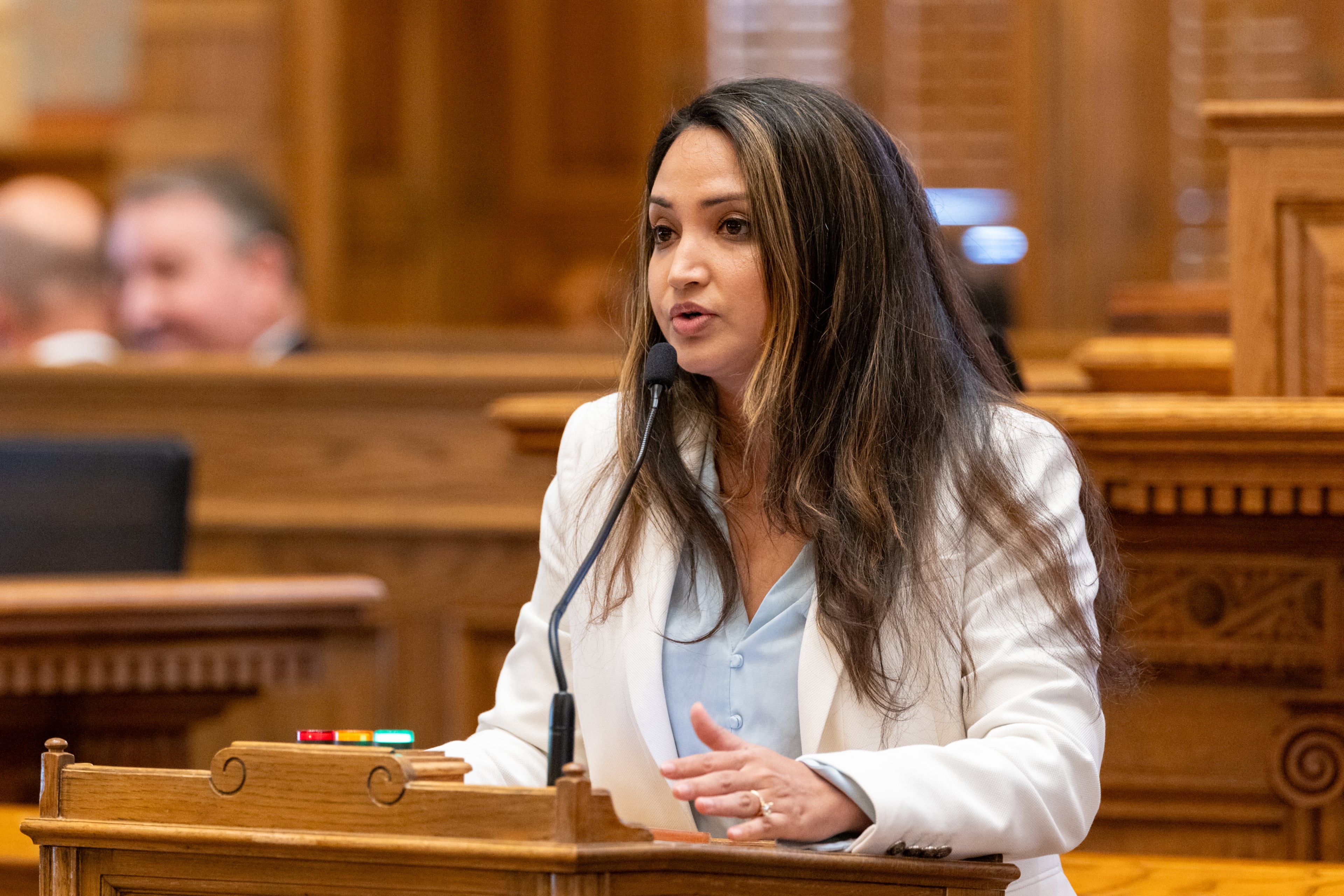
The seat has been held since 2022 by Nabilah Parkes, who embraced the label as “Georgia’s Alexandria Ocasio-Cortez” before stepping down to launch a surprise bid for lieutenant governor. Voters are also choosing a successor in a separate special election to fill the remainder of her term.
“This area has been gerrymandered so many times that enough is enough,” said Adrienne White, a longtime political activist who is competing in the special election.
She described her election against a GOP contender as a “binary choice — either you push back on what’s happening or you get a rubber stamp Republican.”
The sentiment echoes across both contests. For Garabadu, it is both personal and professional. He entered the race after the federal raid on Fulton County election offices, casting it as part of the same voting rights fight he waged in court.
“These are attacks on democracy. Republicans like to hide behind the complexity of redistricting. But people are seeing this for the power grab that it is,” he said between campaign stops. “There’s nothing in the Supreme Court decision that requires this to happen — to gratuitously redraw the lines for the third time in six years is a waste of resources.”
Romman, who waged a short-lived campaign for governor before pivoting to the Senate race, is making a similar argument from a different angle. She says the next redistricting battle won’t be won solely in courtrooms, but through grassroots organizing.
Shortly after Kemp announced the special session, she quickly organized a weekend town hall that drew more than 50 people, including many who had never attended a political event before. Romman reminds voters she earned her master’s degree studying the Voting Rights Act.
“There are some voters who are so exhausted they’re getting burnt out,” said Romman, whose endorsements include national liberal icons like U.S. Sen. Bernie Sanders and Ocasio-Cortez. “But many others are ecstatic about the opportunity to fight Republicans with this election.”
‘Betrayal’
Since Stacey Abrams’ first gubernatorial campaign in 2018, Democrats have made voting rights a focal point of policy initiatives and turnout efforts.
Abrams launched the Fair Fight political organization after her defeat to help cement ballot access as a political issue, while one of U.S. Sen. Raphael Warnock’s top priorities is federal voting rights protections.
In an interview with “Politically Georgia,” he called the GOP redistricting efforts a “betrayal of the highest American ideals” and criticized the Republicans who will line up to praise the Rev. Martin Luther King Jr. while “dismembering his legacy in real time.”
Curt Thompson, chair of the Gwinnett County Democratic Party, said the intensity feels different from a typical legislative runoff.
He joked that low-profile races often come down to “who has more cousins in the district.” This one, he said, feels different. The first round produced unexpectedly strong turnout, spiking roughly 20% compared to the 2022 primary midterm, even in precincts where voter participation is often an afterthought.
“I’m a lawyer, not a psychic. But I think we’re seeing something,” he said. “Our side is energized. People are not just showing up at meetings. They’re willing to canvass and volunteer. The enthusiasm is off the charts.”