Easter weekend shootings put pressure on Atlanta’s youth violence strategy

When Atlanta Mayor Andre Dickens first took office in 2022, the city was grappling with its highest homicide rate in a half century.
City leaders have had reason to celebrate since: From 2022 to 2025, homicides dropped by more than 40%, and youth crime saw a 60% decrease over the same timeline, the mayor announced in March.
Dickens credits much of this progress to his administration’s “Year of the Youth” initiative, launched in 2023, which expanded after-school and summer programs for teens.
But recent shootings over the Easter weekend have thrust teen violence back into the spotlight, at a time when there’s more pressure than ever to keep crime rates down ahead of the FIFA World Cup games this summer.
The convergence of summer break for school-aged children and the international soccer tournament expected to bring hundreds of thousands of visitors downtown could test the strength — and limits — of Dickens’ investment in youth programs.
The city has spent more than $185 million on youth-targeted investments from 2022 to date, officials in the mayor’s office said. Nearly $116 million has gone toward city and parks department activities, followed by about $50 million toward youth workforce development and $7.3 million toward At-Promise Centers, according to the city.

And around 5,900 city kids earned a collective $7.7 million through the city’s summer youth employment program last summer, with more than a quarter of the participants employed by the city.
In January, Atlanta opened its fourth At-Promise Center — facilities that give young residents a safe space after school. The city also extended the hours of its recreation centers.
But the high-profile Piedmont Park shooting on Saturday, along with at least five others over the weekend, has increased pressure on the city’s youth violence strategy. The Piedmont Park shooting killed 16-year-old Tianah Robinson, a North Clayton High School student, and wounded another 15-year-old from Gwinnett County.
“Crime has been down in our city, and we have not had a weekend like this in quite a long time,” Dickens said at a news conference Monday. “We had a culmination of Easter, 404 weekend, as well as eight school jurisdictions all having spring break within the same time.”
That meant 600,000 students were out of school, the mayor said.
Earlier on Saturday, Piedmont Park hosted around 1,200 people for the annual 404 Day celebration that highlights the city’s culture and community. Law enforcement officials say the event ended an hour before the shooting.
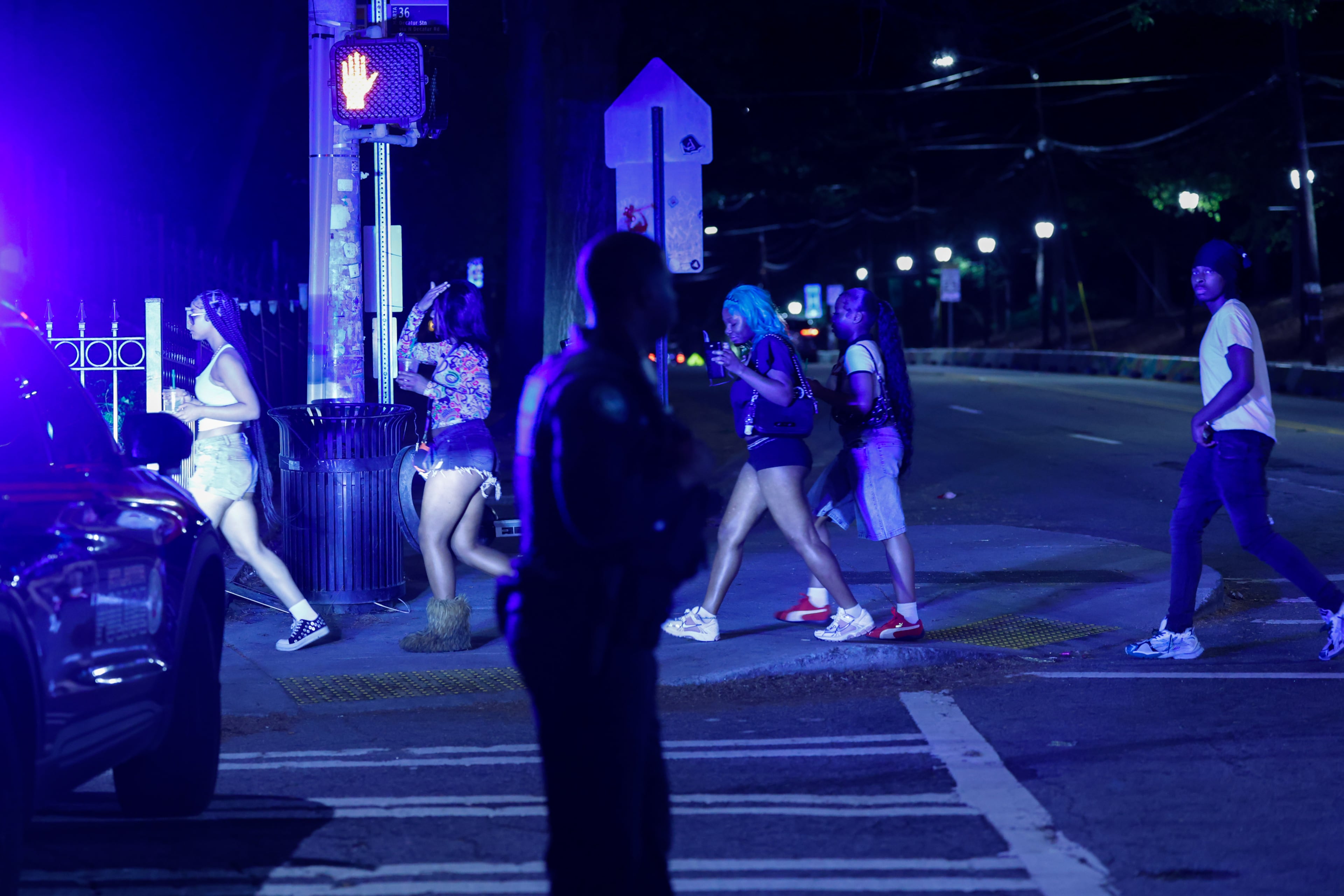
In response, the city is cracking down on its teen curfew and warned parents and caregivers they could face charges if their kids are found outside after hours.
“I’m speaking directly to parents: We don’t want to parent for you. It’s your job to parent,” Dickens said. “If you break curfew, both you and your kid will be in trouble. We have laws for that, and we actually have been taking those laws to the fullest extent possible.”
With the city’s 2027 budget discussions on the horizon, Dickens also wants Atlanta City Council to sign off on increased funding for youth activities and to expand the city’s APD C.A.R.E.S. unit, park ranger program and the mayor’s Office of Violence Reduction.
The mayor also wants to dedicate $50,000 into a new “third space” that can serve as another landing pad for students to spend time outside of school and home.

“This weekend was a tragedy,” Courtney English, the mayor’s chief of staff, told The Atlanta Journal-Constitution. But “youth crime is still down in the city — crime overall is still down in the city — and it’s a byproduct of that type of programming.”
“Now our challenge is to go deeper and to do more and to expand,” he said.
Mayor’s office officials met with school leaders from across metro Atlanta, along with their respective police departments, to discuss widespread strategy to curb teen takeovers and tackle the challenges of spring break.
After the violent weekend, English said, the city is planning on meeting with Midtown and Piedmont Park neighborhood leaders and the police department to review the chain of events from permitting to security needs.
“FIFA is important,” he said. “But we have the Dogwood Festival this weekend, and we will be ready for that festival from a security standpoint.”

‘Too many guns’
The Piedmont Park shooting wasn’t the only incident of gun violence that shook the community over the weekend.
Four teens were shot after a birthday party in southwest Atlanta, according to police, and two men were injured in a shooting in an Edgewood alleyway.
Additionally, an 18-year-old accidentally shot himself fleeing the scene of a mobile banking scam; a 3-year-old was shot by an elderly babysitter; and a father made good on a threat to shoot his son struggling with drug addiction.
“Those incidents are not within our control,” APD Assistant Chief Carven Tyus said Monday, highlighting local law enforcement’s struggle to mitigate gun violence in a Republican-controlled state where access to firearms is widespread.
Atlanta leaders have also struggled with a concerning rise in domestic violence disputes, and more recently, public safety officials raised red flags about a spike in “dwelling shootings,” or gun violence that takes place inside a home or business. The March shooting that killed 7-year-old Zoey Price in northwest Atlanta is an example.
On Monday, Dickens acknowledged a brutal reality: “Let’s be honest, there are too many guns on our streets.”
Recently elected City Council President Marci Collier Overstreet told the AJC that she sees a gap in on-the-ground monitoring of permitted events that could be filled by community members, which she likened to a neighborhood watch.
“We’ve got the FIFA coming up and other big events,” she said. “Instead of us feeling like we’re doomed and we’re going to have one shootout after another, we should band together.”

APD and other agencies like the Federal Bureau of Investigation, Georgia Bureau of Investigation and Georgia State Patrol have been planning their World Cup strategy for the past year with the goal of avoiding crime spikes — related to the event and all across the city’s 240 neighborhoods.
And they’ll be using all the tools in their tool kit: from additional manpower coming from outside the state to mounted patrols and drones. Last year, APD established a special events division specifically to manage major events.
Atlanta Police Chief Darin Schierbaum said earlier this month that the department will move to 12-hour shifts during the World Cup and have 250 contracted police officers from across the country coming to help.
“The sole focus is to do two things,” Schierbaum told council members during a recent public safety committee meeting. “To make sure the games remain safe, and not a single of your constituents see a drop in their public safety.”
About the Author
Riley Bunch is a reporter on the local government team at The Atlanta Journal-Constitution covering Atlanta City Hall. She covers the mayor and Atlanta City Council while also keeping an eye on the city’s diverse neighborhoods.