Ossabaw Island exhibit: ‘Center of all creation’ off the coast of Georgia

SAVANNAH — Erin Dunn and Beryl Gilothwest were in a wilderness of their own making. Surrounded by bright white walls plastered temporarily with schematics and text earlier this month, with valuable pieces of art being unpacked and set on the floor until they could be hung, the duo was witnessing the fruits of more than two years’ labor.
“Off the Coast of Paradise: Artists and Ossabaw Island, 1961-Now” opens Friday at Telfair Museums’ Jepson Center. The retrospective exhibit places the 26,000-acre, undeveloped Georgia barrier island near Savannah among the most important artist colonies of the 20th century.
Dunn, curator of modern and contemporary art at Savannah’s Telfair Museums, sought to show that the grand narrative of American art has significant local ties. “Art is made everywhere, and a lot of artists found inspiration in our landscape, so we should take pride of place about that.”
Between 1961 and 1982, marquee names in American arts, sciences and letters — including Ralph Ellison, Agnes Denes and Ross McElwee — traveled by boat to Ossabaw Island for the Ossabaw Island Project and Genesis, immersive multidisciplinary residency programs founded by Eleanor “Sandy” Torrey West and her second husband, artist and filmmaker Clifford West. Notable artists such as Suzanne Jackson and Sally Mann have visited the island since then.

Sandy West envisioned the 1926 Spanish Colonial mansion built by her parents as a winter home and the pristine landscape of salt marshes, tidal rivers, freshwater ponds, hardwood hammocks, ancient oaks and pine stands as a “catalyst” for visionary philosophical, artistic and scientific creation. The paradox that the lush and peaceful surroundings also harbored the violent history of enslavement offered visiting artists further nuance for contemplation.
West, an heiress-turned-conservationist, sold the 26,000-acre island to Georgia in 1978 so it could be preserved. She lived on the island for three decades until 2016 and died in 2021 on her 108th birthday. The state legislature in 2024 approved $7 million to renovate the “Torrey West House,” the nearby “Little Torrey House” writers’ retreat and a garage once used as an art studio.

Dunn tapped Gilothwest, Sandy and Clifford’s grandson, as an essential research partner and curator. Their accompanying publication, also entitled “Off the Coast of Paradise,” is the first scholarly exploration of the impact of the Ossabaw Island Project and Genesis. It documents “the history that has never been told before,” said Gilothwest, who straddled his personal history and professional life as an art historian.
“It’s really based on both the history that I was uniquely able to dig through in my dad’s basement and all of my grandmother’s stuff on the island, and then use that to help find all of these artists that, even having been on Ossabaw since I was a little kid, I had never heard of and had no idea they’d been on Ossabaw,” added Gilothwest, who is the deputy director of research and exhibitions at the Calder Foundation in New York.

A presentation of ephemera Gilothwest and Dunn uncovered includes the Ossabaw Island Project’s logo stamp designed by Clifford West and the bespoke midcentury-style matchbooks that were practical keepsakes — and ubiquitous around the Torrey West mansion. The matchbox typeface ultimately inspired the publication’s title font. A photograph by Mann that Gilothwest found tucked in a book on his grandmother’s shelves is framed and hanging in the exhibit.
These brief bits find themselves among the fine art works curated from 32 of the hundreds of painters, sculptors, illustrators and photographers who have traveled to Ossabaw Island over the past 65 years. Each piece was inspired in some way by the artists’ immersion in the dense and sometimes dangerous terrain to become an expression of the island’s environmental, cultural, social, spiritual and emotional magic.
The late minimalist sculptor Anne Truitt had the epiphany that she was also a writer during her residency. The journal she kept while on Ossabaw was later published as “Daybook: The Journal of an Artist.”

Metalworker and designer Harry Bertoia visited Ossabaw for the first time in 1961 and was mesmerized “by the constant battle of the elements,” so much so that when he was exploring metal casting at a Connecticut factory soon after his trip, an overflow of molten ingot recalled his Ossabaw experience, and he developed an entirely new form of bronze work called “spill-casting.” A textured, treelike sculpture he created using this technique sat on a table in the West’s living room for years and will be on display at the Jepson.
Sandy and Clifford’s home movies and listening stations that showcase the voices of those who worked and lived on the island add texture to the exhibit. A Telfair-commissioned film that grapples with the island’s darker history, “Venus of Ossabaw” by Allison Janae Hamilton, will screen nightly on the façade of the Jepson Center — another way to bring this remote place closer to the public, Dunn said.
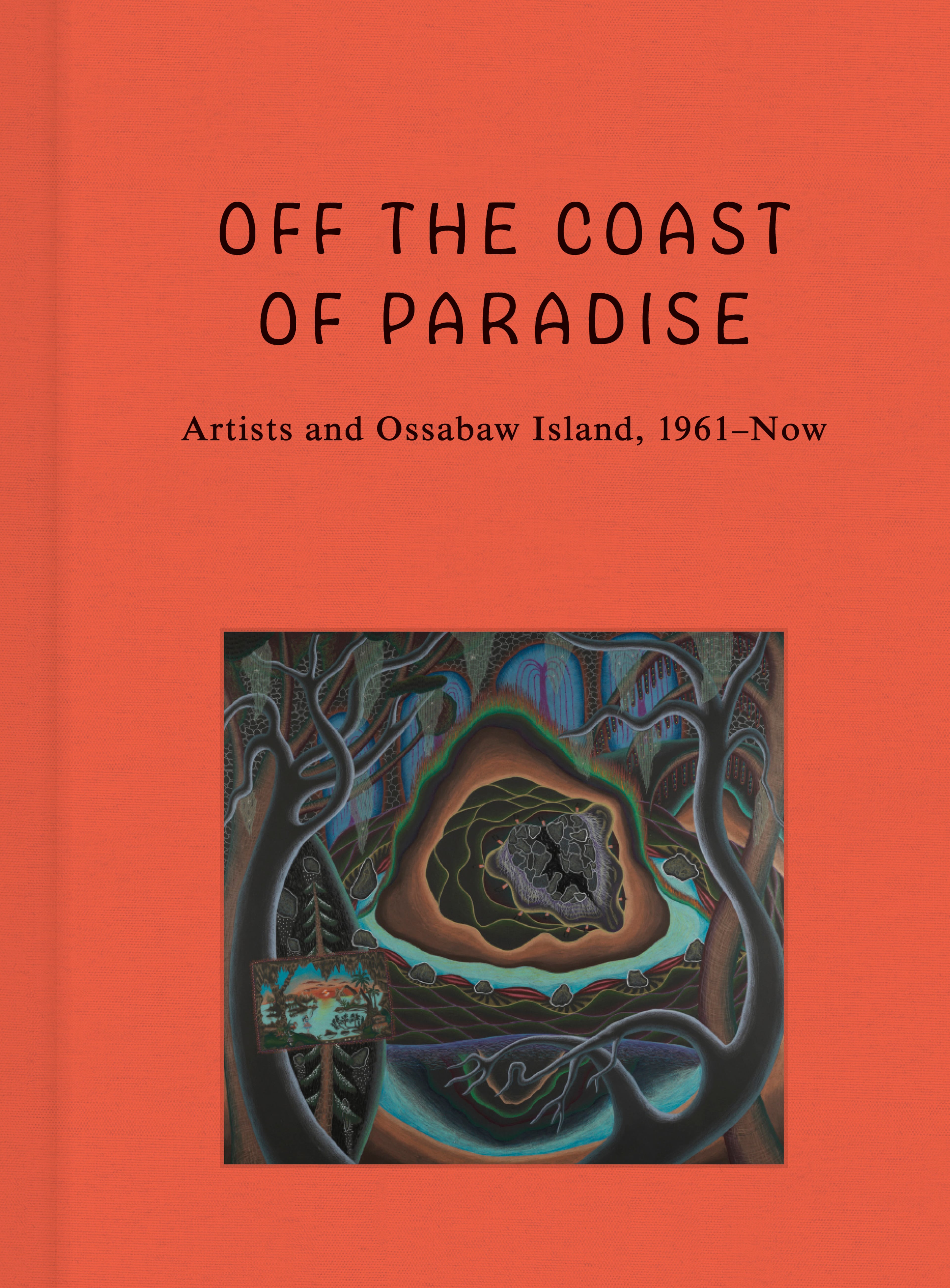
A colored pencil drawing by Vermont-based artist Marcy Hermansader, “Secrets of the Heart,” leads off the exhibition and graces the cover of the book. She made the moody and intricate illustration of tangled tree limbs, rivers and rocks with mosquito netting and thread salvaged from her Ossabaw retreat in 1982. The figure in the center of the drawing evokes the heart-shaped island itself, a place she said was for her “like being at the center of all creation.”
Which is what Sandy West understood all along: Nature itself is the ultimate work of art, and that is why she worked so hard to save the island.
She saw Ossabaw as this “extraordinary place to bring these people and give them this experience of total wilderness and isolation … that’s totally cut off from the world,” so that they could flourish, Gilothwest reflected. “This exhibition is really a testament to the different kinds of ways that we can preserve what remains of the American wilderness … and I really hope people can understand that connection.”
Correction
March 13, 2026This article has been updated to reflect when Suzanne Jackson and Sally Mann visited the island.
IF YOU GO
“Off the Coast of Paradise: Artists and Ossabaw Island, 1961-Now"
10 a.m. to 5 p.m., Tuesdays through Sundays; March 13-Sept. 6; presented by Telfair Museums’ Jepson Center for the Arts, 207 W. York St., Savannah. $10-$30; Children under 6, Free. telfair.org.