Georgia 1776: The ‘miracle’ of America’s newest colony and the Revolution


Delivering a politically charged toast in a public tavern these days can elicit groans, shunning and perhaps even a “You want to step outside?” challenge.
In Savannah circa 1775, recrimination stretched beyond such civilized bounds.
When riverboat pilot John Hopkins raised a glass and pronounced “Damnation to America,” he initiated an incident that would come to symbolize the public divide between English Loyalists and American Patriots in the Georgia colony in the run-up to the Revolutionary War.
Hopkins was tarred and feathered the day after his toast. Seized from his home by members of the Liberty Boys — the local chapter of Samuel Adams’ Sons of Liberty — he was smothered in hot tar, rolled around in feathers and wheeled about the Georgia colony’s capital city in a wagon for three hours.

A year later, three Georgians and 53 others signed the Declaration of Independence. Over the seven years that followed, the colony swung between English rule and Patriot governance in a cycle unique to Georgia, a colony where loyalty to the crown ran deep even, as Hopkins learned, the thirst for liberty swelled.
Thursday is Georgia Day, marking the anniversary of the colony’s founding. It is a time usually reserved to celebrate Gen. James Oglethorpe and the 100-plus settlers who established a buffer colony between Spanish Florida and America’s other colonies in 1733.
But with the nation set to celebrate its 250th birthday this July 4th, historians note a renewed interest in Georgia as it was in the 1770s — and the people, places and events that shaped the colony named for a king.
Georgia, founded in Savannah, was the last of the original 13 British colonies. It was also a latecomer to the American Revolutionary War, and it threw off royal rule later than its coastal neighbors to the north.
“It is something of a miracle that Georgia went with the other colonies at all,” said Stan Deaton, a senior historian with the Georgia Historical Society. “There was no established self-government like in Virginia and Massachusetts and no ruling group of merchants or planters. Savannah and Georgia were an outpost.”
Strong ties to the crown
Georgia’s Revolutionary War history begins at the beginning — with the colony’s founding. King George II funded the early migration of settlers to establish a strategic buffer between Spanish Florida and the other 12 colonies. Georgia’s population grew slowly and by 1770 it remained the least-populated colony, and nearly half the 23,000 residents were enslaved people.

Among white Georgians, most were English émigrés and their first-generation American offspring. Trade with mother England and an annual stipend from Parliament underpinned the colony’s economy, and proximity to Spanish Florida and Native American settlements meant Georgians embraced the redcoat army.
The actions that lit the fuse of rebellion elsewhere, such as the 1765 Stamp Act that levied a tax on papers, documents and playing cards in the colonies and the Boston Massacre of 1770, only sparked in Georgia.
Loyalist feelings were so prevalent that Georgia declined to send delegates to the First Continental Congress. The colony was the lone no-show for the 1774 gathering, although Patriot leaders did send word that they would stand for independence.
The leadership of Georgia’s royal governor, James Wright, suppressed the secessionist movement. Wright came to Georgia from England in 1760 and proved to be a skilled diplomat. He frequently spoke of his dual loyalty to his king and to his adopted home of Georgia, said Wright biographer Greg Brooking, whose book “From Empire to Revolution” was published in 2024.
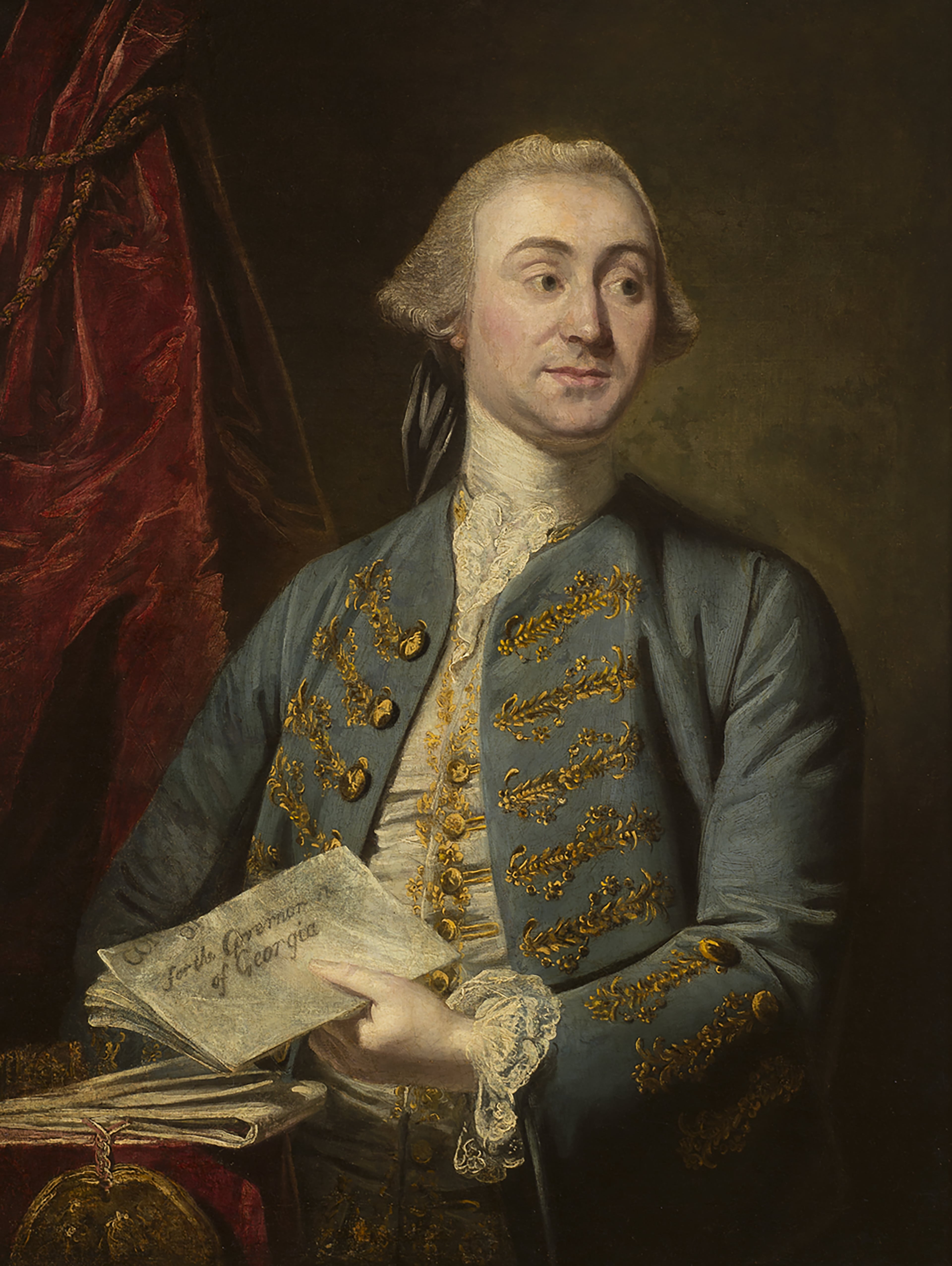
Wright, in letters to administrators before the Revolution, took credit for the absence of a 13th stripe — one for each independence-seeking colony — on the earliest versions of the American flag.
“The people liked him; it wasn’t until things got hairy that they realized his first loyalty was to the king,” Brooking said.
Father vs. son
Even with Wright keeping the peace, the rebellion simmered in Georgia.
The colony’s population largely lived on the coast north of the Altamaha River, which meets the Atlantic Ocean north of Brunswick, and along the Savannah River between Savannah and Augusta. Savannah was the colonial capital while Augusta thrived because of its place along a trade route between Native American settlements and Charleston, South Carolina.
The demographics of the two population centers differed dramatically. While Savannah’s growth was rooted in England, migration to Augusta and other parts of what was known as “the backcountry” came from elsewhere in the American colonies. Most residents were farmers or fur traders.

Once the cause of liberty finally took hold in Savannah in 1775, led by the Liberty Boys and marked by their tar and feathering, the hanging of effigies and other non-lethal intimidation tactics, English rule eroded fast.
The push and pull of loyalists versus patriots pitted father against son. Two of the most prominent Liberty Boys, Joseph Habersham and Noble Wimberly Jones, were the offspring of British loyalists. Jones’ father was among Oglethorpe’s original settlers and a member of the Royal Council, a group of advisers to the governor.
Meanwhile, Habersham personally deposed the governor, Wright, in January 1776. Habersham is said to have arrested Wright at a dinner party where his father, a confidant of the governor, was a guest, although historians note that detail has not been verified in the record.
Wright’s removal came eight months after fighting first began with the Battles of Lexington and Concord outside Boston.
A ruling coalition known as the Council of Safety assumed the governing role and appointed five delegates to the Second Continental Congress, which opened in May in Philadelphia. Three Georgians — Button Gwinnett, Lyman Hall and George Walton — would sign the Declaration of Independence on Aug. 2, 1776.
But the revolutionary fervor remained tepid in Georgia. The colony became the only one retaken by the British during the war, with the redcoats overwhelming a small Continental Army force of fewer than 1,000 soldiers in a surprise attack on Savannah on Dec. 29, 1778. British forces then marched on to Augusta to fully restore the royal government three months later.
A loyalist militia led by Augusta’s Thomas Brown augmented the British army in its return. Brown, like Savannah’s Hopkins, was tarred and feathered for his allegiance to the king before the war’s outbreak, only to get his revenge once the fighting started. He and his troops, known as the King’s Rangers, helped repel a failed counterattack by the Continental Army in September 1779 in a battle known as the Siege of Savannah.
Georgia remained in British hands until the Revolution’s end. Wright, who’d returned to govern the restored colony, evacuated Savannah along with the last of the British troops in July 1782.
Georgia’s plight at the time of the Revolution reflects the frailty of a young colony challenged by economic, geographic and generational divides, said Lee Ann Caldwell, a professor emerita of history at Augusta University.
“Think about those divisions — father versus son in some cases,” she said. “It had to have been a heartbreaking time.”
More about Georgia and the U.S. 250th celebration:
History scholars William Hitchcock and Elizabeth Varon will revisit the last two national commemorations of America’s independence — in 1876 following the Civil War and in 1976 at the height of the Cold War — with a livestreamed lecture presented by the Georgia Historical Society.
What: A United States but a divided America: How we have celebrated the nation’s birthday during turbulent times
When: Feb. 26, 6 p.m.
Where: Christ Church Episcopal, 28 Bull St., Savannah
Registration: eventbrite.com