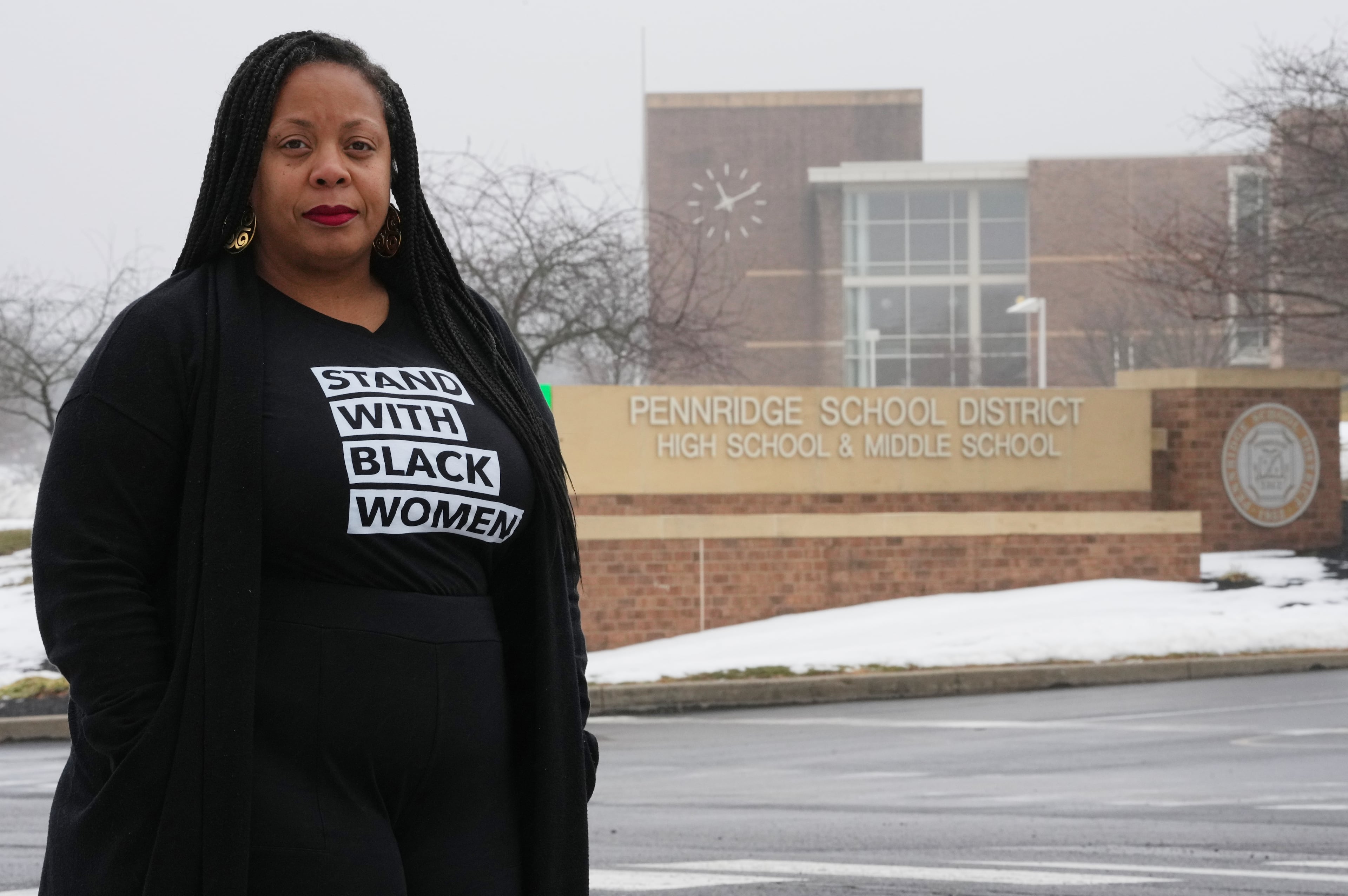
Atlanta’s DAs, mostly women of color, are working to change the game

Georgia’s criminal justice system looks significantly different than it did a decade ago, thanks in part to the record number of women of color now serving as district attorneys across the state.
Metro Atlanta’s top prosecutors say their shared experiences make them uniquely qualified to deal with the challenges faced by their increasingly diverse communities.
But their ongoing fight for more resources and alternatives to mass incarceration can feel like an uphill battle, they said, especially when navigating a mostly white, male-dominated system that’s historically reluctant to change.
Things are slowly starting to shift, however, DeKalb County District Attorney Sherry Boston said.
“We deserve to bring our perspectives to the table,” Boston said. “As our numbers have grown, I’ve watched the room change.”
When Boston first took office in early 2017, she was Georgia’s only Black woman DA. That once-exclusive club has expanded significantly since then.
Among the nine women serving as DAs across the 11-county metro region today, six are Black and one is of Egyptian descent. And in the rapidly changing counties that make up metro Atlanta’s core, all five DA positions are held by Black women.
It’s an impressive stat in a region widely considered to be the “Black mecca,” especially given the fact that Black women comprise just 1% of America’s district attorneys.
“It’s a very small group,” said Boston, who also chairs the Prosecuting Attorneys’ Council of Georgia. “There is no other state that has the number of Black elected women DAs that we do.”

Those prosecutors have formed close bonds in recent years, supporting one another and often turning to each other for guidance. Their experiences as women of color also play a major role in shaping how they view the world, run their offices and even handle certain cases within their communities, they said.
A SEAT AT THE TABLE
Being a powerful woman of color poses its own set of challenges, particularly in a Southern state that still leans conservative, several metro DAs recently told The Atlanta Journal-Constitution.
The local DAs, all of whom ran as Democrats, say they face additional barriers put in place by the Republican-controlled state Legislature. And among other Georgia prosecutors, most of whom are white men, the women say they still struggle to have their voices heard.
“The good ol’ boy network still exists,” said Gwinnett District Attorney Patsy Austin-Gatson, who in 2020 became the first woman and the first African American elected as DA in her diverse county.
Cobb County DA Sonya Allen grew up in then-conservative East Cobb and spent three decades at the sheriff’s office, reaching the rank of chief deputy under the former Republican sheriff.
She is used to being in the minority, she said, but even Allen was shocked by the way she and her colleagues are treated when they meet with other top prosecutors from the District Attorneys’ Association of Georgia.
“We have no voice at all,” Allen said of those quarterly meetings. “It’s disrespectful.”

The others nodded in agreement as they spoke of their own challenges within the association. Even the Black men in their ranks are treated differently than the Black women, Boston said.
Those who do speak up in committee meetings are often labeled “aggressive,” “unpalatable” or “loud.” The women said the words in unison, as if they’ve heard those descriptors their entire careers.
But two things appear certain, they said: There’s power in numbers, and attitudes are rapidly changing. With more voices, they are starting to command more respect from their counterparts.
“We need to be at the table,” said Clayton County DA Tasha Mosley, who spent a decade as Clayton’s solicitor general before being appointed DA in 2019. She recalled a meeting some years back in which a committee comprised entirely of white, male, Republican DAs paid little mind to a suggestion she made.
“It’s just a slap in the face,” she said.
TRAILBLAZERS
Former DeKalb DA Gwendolyn Keyes was the first Black woman elected as district attorney in Georgia. The Emory University graduate took office in 2005 and spent nearly six years as DeKalb’s top prosecutor before taking on roles at the U.S. Environmental Protection Agency during the Obama administration.
She mentored several future DAs over the years and is seen as a trailblazer among those who followed in her footsteps.
“We all stand on her shoulders,” said Boston, who met Keyes while pursuing her law degree at Emory. “She’s been an amazing mentor to many of us.”
Keyes also met Fani Willis when the future high-profile DA was still a law student at Emory. And she was introduced to Darius Pattillo, Henry County’s first Black DA, while he was still on the mock trial team at Atlanta’s Therrell High School. Keyes could tell then he was a rising star, she said.
Keyes said she’s encouraged by the record number of women of color serving as DAs in Georgia today. She’s also amazed by how much has changed since her election more than two decades ago.
“I knew I was the first. My goal was to make sure I was not the last,” she told the AJC. “I’m really proud of all these women to be able to be making their own mark for their respective counties and constituents. It’s impressive.”

Of the 51 district attorneys in Georgia, 12 are Black and eight are Black women. Shifting demographics in recent years, especially in the state’s most populous areas, have helped usher in the historic changes.
Shalena Cook Jones is the DA in Chatham County, which includes Savannah, and Anita Howard is DA of the three-county Macon Judicial Circuit. Both were elected in 2020 and are the first Black women to hold those positions.
Douglas County DA Dalia Racine, the longtime prosecutor who flipped her county blue in 2020, is the daughter of an Egyptian woman and a white man. She noted how much Douglas County’s demographics have changed in recent years — not just racially, but socioeconomically and politically.
“When we moved to Douglas County, it was not the Douglas County we live in now,” Racine said. “We are now a majority-minority community, and it is amazing.”
And Rockdale County DA Alisha Johnson has headed her judicial circuit since she was appointed by former Gov. Nathan Deal in late 2017. The Bronx native attended Spelman College and Georgia State University, beginning her law career as an intern in the Rockdale DA’s office.
Johnson said her ability to send defendants to drug court or order counseling instead of prison helps keep families together.
“There are those who deserve a second chance, and being able to be the person in power who makes that decision matters,” Johnson said.
All six DAs lamented the lack of access to mental health care in the state, saying their county jails and courts have become the de facto providers of mental health services.
AHMAUD ARBERY, GEORGE FLOYD AND THE RACIAL RECKONING
The 2020 murders of George Floyd in Minneapolis and Ahmaud Arbery in Brunswick spurred a racial reckoning across the U.S. that’s still felt today, both in politics and in policy.
Boston said the footage of Floyd’s death at the hands of law enforcement led many of her young assistants to question their decisions to become prosecutors in the first place. She found herself struggling, too, she said.
“I felt really broken. There were moments where I just couldn’t stop crying,” she said. “But for the grace of God, that same thing could have happened in any one of our jurisdictions.”
Mosley recalled seeing the footage of Arbery’s killing and wondering why it took law enforcement so long to make any arrests in the case. The 25-year-old Brunswick man was out for a Sunday jog when he was chased down by three white men in pickup trucks and shot to death in the road.

Cellphone footage of his killing sparked international outrage when it was leaked online more than two months later. Still, 74 days elapsed before any arrests were made.
“He was running away from these men,” Mosley remembered thinking. “How in the world are we saying this was a justified killing?”
Allen, who at the time held the second-highest position at the Cobb County Sheriff’s Office, said Arbery’s murder had her second-guessing her career choice.
“I did not want to do that job anymore,” she said. “I didn’t want to be associated with law enforcement.”

Racine, a longtime homicide prosecutor, had seen plenty of bodies over the years and consoled numerous grieving relatives in the course of her work.
But she said there was something about Arbery’s murder that hit close to home.
“Ahmaud looked like my son,” she said, tearing up during a recent interview. “Ahmaud ran like my son. And when I saw him lying in the street, it was something that broke me.”
Racine’s husband is of Haitian descent, and her three children have a broad ethnic background, she said.
She said the murders of Arbery and Floyd highlight just how vital it is to have diversity within law enforcement agencies and prosecutors’ offices.
“I work in a system that I am terrified of,” Racine said. “We get these reports. This is not a mystery to us. We know what’s happening on the streets.”
The prosecutors said such instances of injustice motivate them to double down and work even harder to stand up for what they believe is right.

FANI WILLIS AND THE TRUMP CASE
Since taking office in 2021, Fulton’s first Black woman DA, has received both praise and intense backlash over her handling of the now-dismissed election interference case against President Donald Trump and his allies.
She has accused her fiercest critics, including some of Georgia’s Republican lawmakers, of unfairly targeting her because of her race.
Willis, the state’s highest-profile district attorney, did not attend last month’s interview. The AJC reached out for comment via email, phone and text over several weeks, but she wasn’t available.
In a recent interview on Pastor Jamal Bryant’s “Let’s Be Clear” podcast, Willis defended her decision to charge the president. She also spoke of the racism and threats she has faced as a result.

Since bringing the case against the president, Willis said she has received thousands of threatening emails, phone calls and letters. She also had a racial epithet spray-painted on her house, Willis told the senior pastor of New Birth Missionary Baptist Church.
“This has been a very huge cross to bear, but I refuse to be intimidated from doing my job,” she said on the podcast. “ ... I know what an honor it is to be the first woman to sit in this seat.”
This year’s AJC Black History Month series marks the 100th anniversary of the national observance of Black history and the 11th year the AJC has examined the role African Americans played in building Atlanta and shaping American culture. New installments will appear daily throughout February on ajc.com and uatl.com, as well as at ajc.com/news/atlanta-black-history.
About the Author