University System of Georgia makes business decision with chancellor pick

Barring a dramatic turn of events, the University System of Georgia will soon officially select a new chancellor to run the show.
Its Board of Regents named Thomas A. Fanning as the sole finalist for the role last week, replacing Sonny Perdue, the former two-term Georgia governor. A final vote is scheduled for Oct. 1. So far, despite having limited experience in higher education, the former Southern Company CEO appears to have some faculty support in part because of his business background.
Derrick Lemons, a University of Georgia professor who represents UGA on the USG’s faculty council, noted the University System has similarities to a large company. In addition to its 25 schools, it’s responsible for a multi-billion-dollar budget, 50,000 full-time employees, 47,000 part-time employees and about 382,000 students.
“When I define USG like that, someone like Tom makes a lot of sense,” said Lemons. “He knows how to work with big organizations, and this is a big organization.”
“I’m not surprised that someone from the private sector was asked to come in.”
Fanning’s business acumen apparently was a factor for the Board of Regents naming him as its finalist.
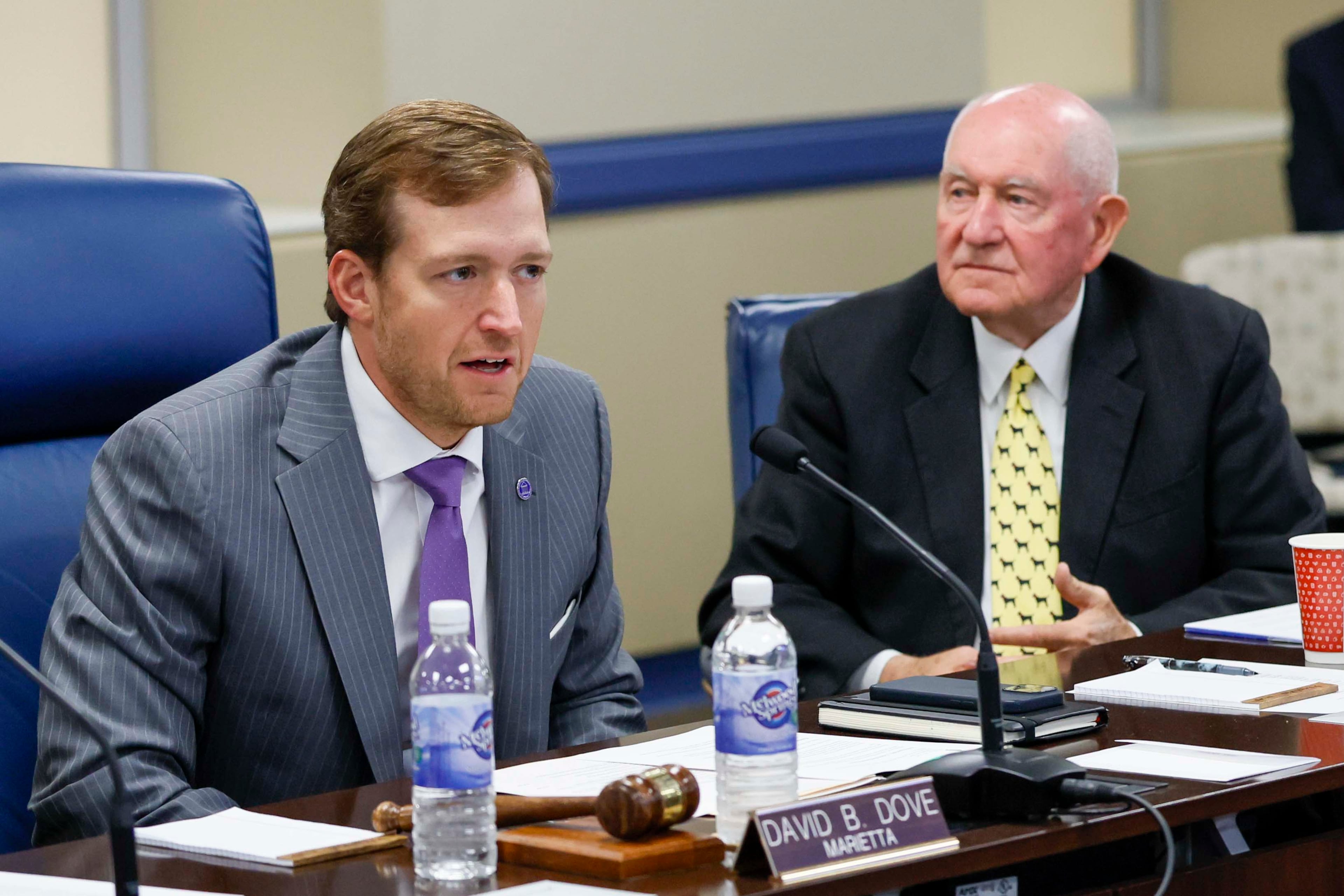
“With four decades of experience running one of the largest energy companies in the nation, Tom knows how to manage complex operations, solve big problems and lead people,” board chair David B. Dove said in a written statement when Fanning was announced as the sole finalist. “He cares deeply about Georgia, understands the power of higher education and has the proven leadership to guide USG forward.”
The board and Perdue have been in harmony during his tenure as chancellor, speaking of the importance of preparing students for the business world. All 19 members of the board run their company, are retired business executives, top officials at their organization or are partners at their law firm. Perdue has emphasized that the USG should provide students and parents a return on their investment, referring to them as “customers” and to the USG as “a business.”
In contrast to many of his predecessors, Fanning’s resume primarily consists of private sector work. Although the Georgia Tech alum served on advisory boards at his alma mater, as well as a leadership role on the Georgia Tech Foundation’s board of trustees, he is best known for his 43 years working at Southern, the Atlanta-based utility giant.
The late Erroll Davis had significant private industry experience, most notably as chairman and CEO of Alliant Energy. But he also served on the Wisconsin Board of Regents and on the board of trustees at Carnegie Mellon University prior to his appointment as chancellor.
Hank Huckaby spent decades as a professor and university administrator. Steve Wrigley had been a longtime USG executive before succeeding Huckaby. It was Perdue’s career in government that bucked the trend of higher education chops.
Yet even though Perdue’s appointment, “came out of seemingly nowhere,” Lemon said his nontraditional background ended up winning over many colleagues.
“There was a lot of potential concern: Well, what does a former governor know about education?” Lemon said. “But he has been an absolute hit with the faculty council because of his openness.”
Professor Patrick Freer, chair of the Senate Executive Committee at Georgia State University, said Perdue’s background in government has served the system well.
“I have to trust that the Board of Regents and those involved in the selection of Fanning see a similar opportunity,” Freer said. “From my understanding of his work at Georgia Tech, he was quite influential in at least understanding the problems faced by students and faced by faculty, and worked toward ameliorating the problems.”
He agreed that Fanning’s background could be an asset for the USG. Even if the Board of Regents had selected someone straight from academia, “there would be elements of the chancellor’s job that that person would not have experience in,” he said.
Fanning understands the role the USG plays in Georgia’s economic development, according to professor Annie Anton, who represents Georgia Tech on the USG Faculty Council.
“When the USG Faculty Council met with Regent David Dove, we talked about wanting a chancellor who listens, builds trust, respects academic expertise, asks good questions and, importantly, gets things done. I see all of those qualities in Mr. Fanning,” she said, calling it an “inspired choice.”
According to Freer, faculty wanted a chancellor who could deal with changing federal policies and collaborate with the state government. Additionally, they want the new chancellor to be open and collaborative with all USG constituents.

“That was a hallmark of Sonny Perdue’s work with our system, and I would love for that to continue,” Freer said.
Georgia’s higher education institutions are among the most centrally organized in the country, said UGA history professor Scott Reynolds Nelson. When he becomes chancellor, “Fanning will effectively control 25 universities, making him one of the most powerful university administrators in the world outside of China,” Nelson said in an email.
While it makes some sense to appoint a former CEO who has run a state-affiliated corporation like Southern Company, “it would be great if he had some university experience,” Nelson added. “In my experience the Board of Regents tends to focus on job training, forgetting that we are entrusted with teaching all undergraduates about citizenship, including U.S. history, Georgia history, and the history of constitutional government.”