See if you can follow this trajectory:
- In 2000, no country allowed same-sex marriages.
- In 2004, George W. Bush's re-election bid was helped by a boost in GOP turnout as voters in 11 states approved gay-marriage bans.
- In 2008, Barack Obama, despite running to Hillary Clinton's left on other issues, said he opposed gay marriage. According to a recent book by his strategist, David Axelrod, this stance was not genuine but purely political.
- In 2012, Obama flip-flopped on the issue. Many Democrats followed his lead.
- Ahead of the 2016 elections, several Republicans have been asked if they would attend a gay wedding. Two leading candidates, Jeb Bush and Marco Rubio, said they would; a third, Scott Walker, said he already had.
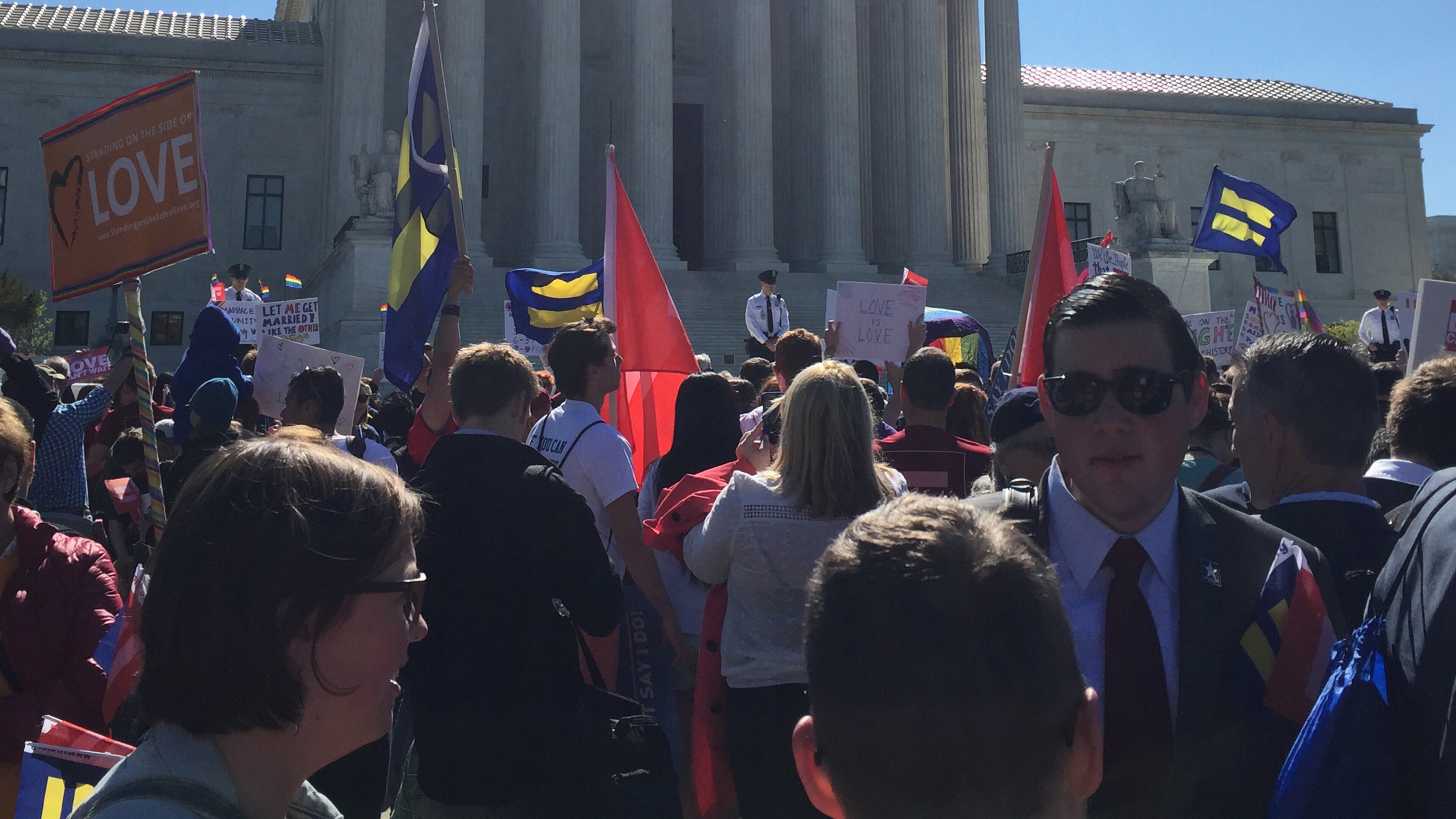
Even as gay-marriage advocates had their day at the Supreme Court on Tuesday, the political momentum was already clearly, swiftly moving in their favor. So why shouldn’t the high court give them a constitutional stamp of approval? Consider this parallel trajectory:
- In April 2014, Mozilla forced out its new CEO , Brendan Eich, because in 2008 he gave $1,000 to backers of a gay-marriage ban in California.
- That same month, the Supreme Court declined to hear an appeal by Elane Photography, a small business fined in New Mexico because its owners refused to work at a gay couple's nuptials.
- Last month, an Indiana pizza parlor closed under a barrage of online threats after one of its owners merely said, when asked by a reporter, the restaurant would serve gay customers but would not cater a gay-wedding reception.
- This month, New York Times columnist Frank Bruni approvingly cited a call to force church leaders "to take homosexuality off the sin list."
- Last week, two gay hoteliers in New York City faced boycott threats after they simply met privately with Sen. Ted Cruz , a gay marriage opponent, to discuss foreign policy.
This second trajectory makes it crucial that this issue continue to be hashed out in state legislatures, rather than decided bluntly and permanently by as few as five judges in Washington.
In Tuesday’s court arguments, there were no good answers from gay-marriage advocates to several questions about what could come next. Could ministers still be authorized to conduct marriages recognized by the state if they won’t marry gay couples? Could private colleges that oppose gay marriage lose their tax-exempt status if it’s declared a constitutional right?
This is to say nothing of the insidious phrase, increasingly popular on the left, “freedom of worship” (as opposed to “free exercise of religion”). Could that come to mean the government can’t dictate what is preached on Sundays, but it can force a church to make its chapel available to couples who supply their own officiant?
The legislative process is messy. It can be ugly. It is often slow. But it is a time-tested method of balancing these kinds of competing interests as finely as humans can.
But if this matter is resolved with a single, final court order, there will be no such balance. As recent events show a rising desire to punish dissenters, the absence of balance could do more harm to liberty than good.