Atlanta artist paints a window into a downtown Waffle House
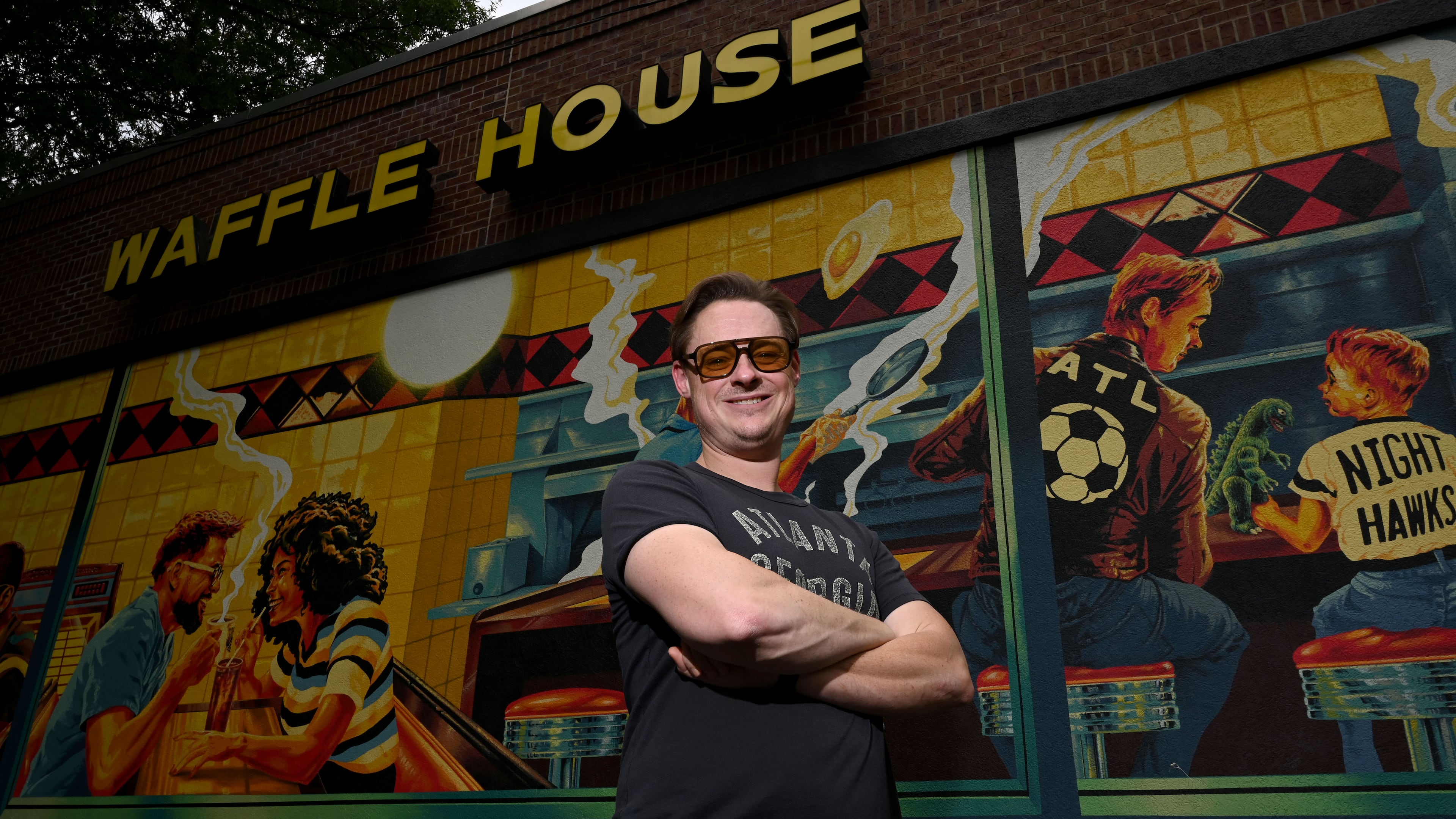

On a path in downtown Atlanta down Andrew Young International Boulevard — one fans are likely to take as they make their way to the Mercedes-Benz Stadium this summer for the 2026 FIFA World Cup — several new murals have appeared.
These murals bring color to a path that otherwise might have remained gray and unremarkable, said Nina Dolgin, the art and activation program manager at Downtown Atlanta Inc., an organization that works to revitalize and improve the downtown district.
One of those murals, right at the edge of Centennial Olympic Park, features a colorful window into a fantastical moment at Waffle House, where Outkast members Andre 3000 and Big Boi laugh on one side, a woman with teal hair reads a book on the other, Waffle House employees flip an egg and offer up a waffle and a couple in the center laugh with their heads close together.
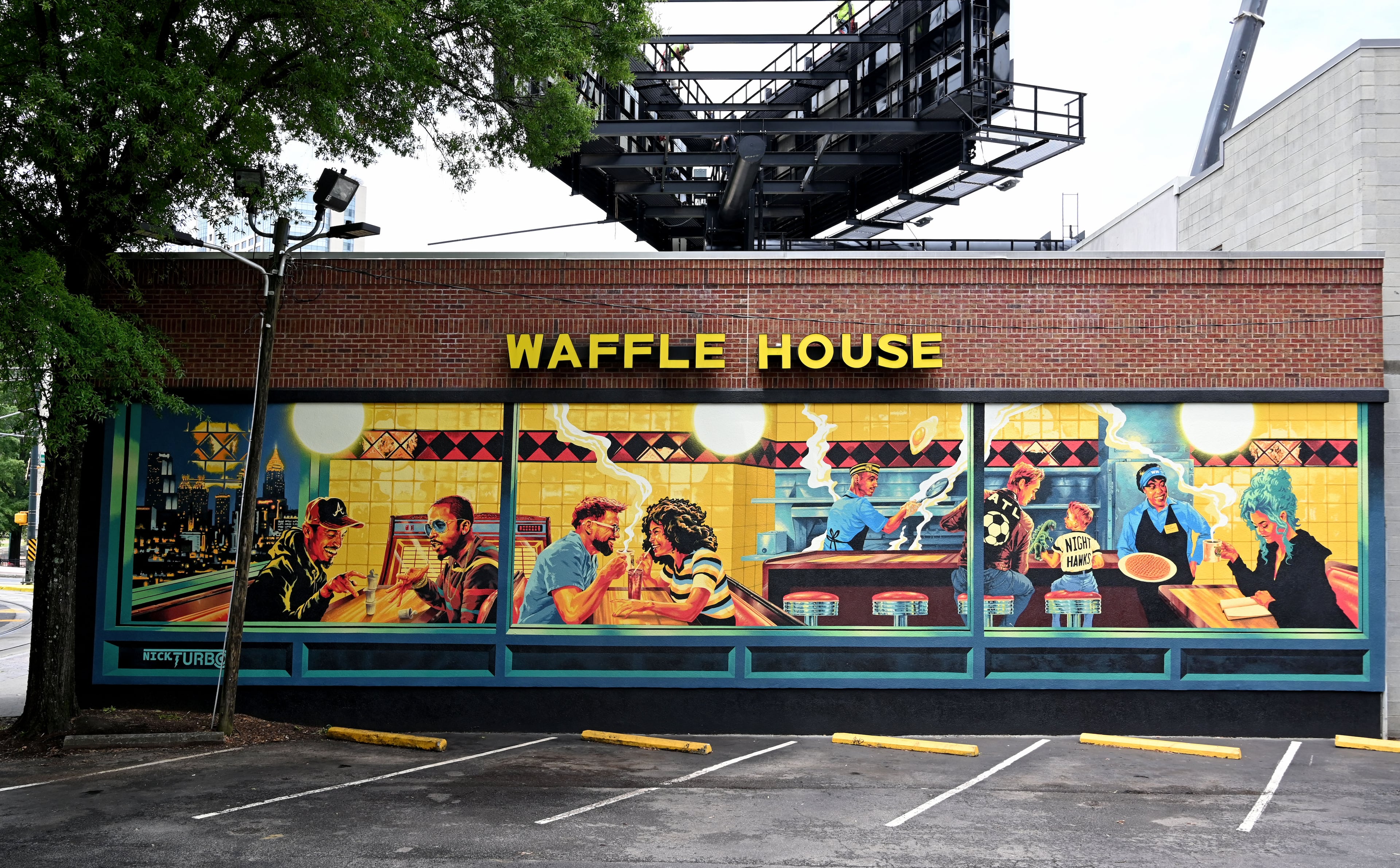
“I’m thinking these guys could be on a first date, or maybe like a 100th date, and they’re just really into each other,” Nick “Turbo” Benson said one cloudy afternoon while observing the larger-than-life mural that took him and two artist assistants, Thomas Turner and Alex Koenig, three weeks to paint.
Benson was commissioned to create the mural by Downtown Atlanta Inc. in partnership with the Metro Atlanta Chamber’s Downtown Reimagined initiative as part of a project to add more public art to downtown.
Dolgin and her team gave Benson the prompt of a more lively take on “Nighthawks” by Edward Hopper, which shows three customers sitting in a lit-up diner surrounded by an empty street at night. Benson took that idea and transformed it into an energetic mural that speaks to the culture of Atlanta.
Dolgin said she thought of Benson because she likes how his style toes the line between “real and surreal.” He knows when to exaggerate while still making the art feel tangible, she said. He also grew up in Atlanta and has spent most of his life here.
After Dolgin reached out to him, Benson spent the next two months planning out the mural. That included visits to multiple Waffle House locations, where he photographed his friends sitting in the booths and some employees.
He also paid a visit to the Waffle House Museum in Avondale Estates, where he drew inspiration from some of the old stools and jukebox machines that are no longer used in stores.
Besides the Outkast members, the other people in the painting aren’t modeled after anyone specific — rather, they’re composites of various customers and employees he’s come across, Benson said.
“I wanted (the characters) to just all feel like regular people, Atlantans all sort of with their own little moments unfolding,” he said.
He also added a self-portrait, fashioned after Norman Rockwell’s painting “The Runaway.” In Benson’s mural, an older version of himself leans over to speak to his younger self, who has a Godzilla action figure next to him on the counter, a replica of the one Benson said he used to carry around as a kid. It’s also a little homage to the many Waffle House visits Benson made with his dad, he said.
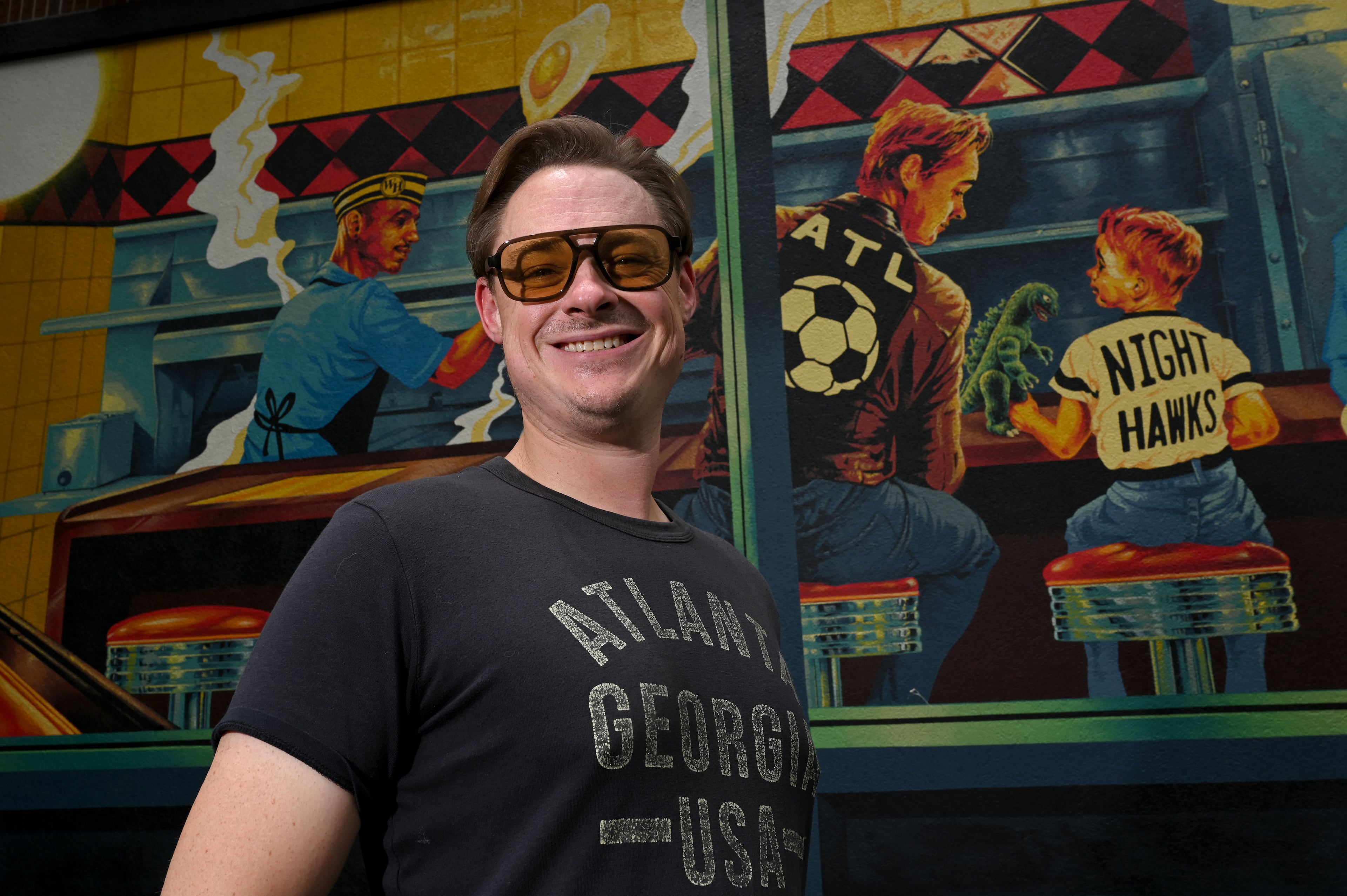
“I really wanted it to feel sort of lost in time, like nostalgic, so you don’t quite know what time period it’s from,” he said. “Everything is the way you might think of it in your head, and maybe a little bit heightened from what the reality is.”
Evoking that nostalgia is part of why he chose to depict Andre 3000 and Big Boi closer to their images from the late ’90s and early 2000s, and why the jukebox in the back is the older one you actually had to flip through, instead of the current touchscreen one.
Benson slipped other Easter eggs into the painting, like the creamers Andre 3000 and Big Boi are playing with — there’s a stack of three of them, a reference to Andre 3000’s nickname Three Stacks.
Edward Hopper has said that “Nighthawks” subconsciously may have been him expressing that feeling of loneliness in the midst of a big city.
But Benson said he wanted to take the setting and the subject matter and turn it into something about connection and energy that tells an evolving story of Atlanta to tourists and residents.
“To me, murals signal that people care about this area and are paying attention to what happens here,” Dolgin said.
You can’t go far in downtown right now without finding public art or an artist working on a new piece, she said. Downtown Atlanta Inc., in partnership with the Metro Atlanta Chamber, is working to make downtown Atlanta a place people want to be, and the World Cup has spurred that push, she said.
“We saw it as an opportunity, especially thinking through visitors and international visitors, like how can we best explain and represent what Waffle House is, because I think it’s not just a diner; it really is such a cultural staple,” she said.
Dolgin said they’re committed to maintaining the murals commissioned for this project for five years. But a key part of public art is that it doesn’t last forever.
“Atlanta as a city has sort of taught me that so many things change so quickly, and I get used to something as it is, and I’ve had to learn a bit of detachment and be like, well, everything’s changing all the time, and you have to just kind of make peace with that,” Benson said.