RECIPES: ‘Egg Rolls & Sweet Tea’ unites Asian and Southern influences

In the introduction to her vibrant new coffee-table cookbook, “Egg Rolls & Sweet Tea: Asian Inspired, Southern Style” (Gibbs Smith, $32), Natalie Keng asks, “Can food be the catalyst for accepting diversity? Can it break down barriers and stereotypes?”
The answer is yes. But Keng’s explorations of the intersections of race, class and gender are filtered through her experiences growing up Asian and Southern in Atlanta.
“I was born and raised in Georgia, attended public schools and worked at the mall,” she noted in a recent interview. “My parents grew up in Taiwan, then lived their adult lives here in Atlanta as first-generation Americans. I’ve had the chance to travel to many U.S. cities, and around the world, and Atlanta is a lush metropolis that offers the best of the South.”

A graduate of Vassar College, with a Master of Public Policy degree from the John F. Kennedy School of Government at Harvard University, Keng worked in the nonprofit sector, and was a strategic marketing executive, before returning to her Georgia roots.
Currently, she lives in her hometown of Smyrna, Georgia, where she’s the founder and CEO (“Chief Eating Officer”) of Global Hearth: Cooking Up A Better World, a food and culture business featuring interactive presentations, tours and events.
“Global Hearth reflects our city’s amazing, diverse culinary offerings, broadens the vision of opening minds, one mouth at a time, and gives back to the community by supporting local businesses and women entrepreneurs,” Keng said. “When we learn to love the food, we are more open to the people, whether it’s a sandwich called banh mi or snails called escargot. I’ve seen that over and over again through my events with organizations and corporate teams.”

Much more than just a cookbook, “Egg Rolls & Sweet Tea” is filled with family stories and food memories. But Keng’s recipes aren’t exactly traditional. They’re more about a question: Does it taste good?
“The dishes in this collection are my version of authentic, even if they don’t fit perfectly into any textbook genre,” she said. “I present these cherished recipes in the hope that they will become part of everyone’s family’s supper-table favorites and evolve into the reader’s own version of authentic.”
Keng’s entrepreneurial journey includes creating condiments, first under the Chinese Southern Belle label and now as part of her Sauce Maven brand.
“My refrigerator door was lined with sauces,” she said. “Yet none captured the flavors of my childhood growing up in the Bible Belt — juicy peaches, honeysuckle nectar, Vidalia sweet onions, and my po-po’s (grandmother’s) tomato wedges marinated in sugar-vinegar brine. Using my own taste buds as a litmus test, I set out to fill the gap.”
Right now, Keng has several award-winning sauces for sale at globalhearth.com. The Sauce Maven’s Recipe-In-A-Bottle products include My Sweet Hottie Sweet Chili Peach Dip, Glaze & Dressing; You Saucy Thing Soy Ginger Vidalia Stir Fry Sauce & Marinade; and Wild Wild East Asian BBQ Teriyaki Pineapple Grilling Sauce & Marinade.
Homemade versions of those sauces are included in “Egg Rolls & Sweet Tea,” along with Hot Hot Hunan Fresh Chile Sambal, which is a tribute to her maternal grandfather.
“This cookbook is really drawn from my own kitchen and my own palate, and it’s inspired by my mom, and my grandmother, and the women in the family who did most of the cooking,” Keng said. “But it’s also inspired by my travels in Asia. That’s why you’ll see Japchae-Inspired Glass Noodles with Swiss Chard.”
RECIPES
These Asian American and Southern fusion recipes from Natalie Keng’s cookbook, “Egg Rolls & Sweet Tea,” reflect a breadth of influences — from Curried Coconut-Cauliflower Fried “Rice,” to Japchae-Inspired Glass Noodles with Swiss Chard, and Hot Hot Hunan Fresh Chile Sambal.

Curried Coconut-Cauliflower Fried “Rice”
In addition to being low in carbs, cauliflower is nutritious and easy to cook, Keng says. This curry recipe doesn’t use curry powder — instead, it uses scratch ingredients and fresh turmeric, available at most international markets, to get a fresher, richer seasoning. Using cauliflower instead of rice makes it a good post-workout protein-rich meal.
- 1 large head cauliflower (about 2 pounds)
- 2 tablespoons coconut oil, divided
- 2 large eggs, beaten
- 1/2 cup chopped green onions
- 1/4 cup chopped celery stalks, leaves removed
- 3 garlic cloves, minced
- 1 tablespoon grated ginger
- 1/2 teaspoon grated turmeric
- 3 tablespoons soy sauce
- 1 tablespoon mirin
- 1 teaspoon lime juice
- 1/4 teaspoon salt
- 1/2 cup cooked or canned chickpeas, drained and rinsed
- 1/2 cup steamed edamame
- 1/4 cup roasted peanuts or roasted cashews, for garnish
- Hot sauce
- Using a large-holed grater or a food processor with a grating disc, finely chop the cauliflower. The texture should approximate rice grains (don’t worry if the size isn’t uniform). Set aside.
- In a large pan over medium heat, melt 1 tablespoon of coconut oil. Using a spatula or chopsticks, scramble and break the eggs in small pieces until cooked. Transfer to a small bowl and set aside. Wipe out the pan with a paper towel and return it to medium heat.
- Melt the remaining 1 tablespoon of coconut oil in the pan. Add the onions, celery, garlic, ginger and turmeric. Stir-fry about 3 minutes, until softened and fragrant. Add the riced cauliflower, soy sauce, mirin, lime juice and salt. Stir-fry about 2 minutes. Stop stirring for 30 seconds to let the cauliflower brown a bit. Mix in the chickpeas, cooked edamame and cooked eggs. Let stand for 30 seconds, then stir-fry 2 minutes more, until the cauliflower is al dente and the chickpeas are heated through. Garnish with the nuts and serve with hot sauce to taste.
Nutritional information
Per serving: Per serving: 310 calories (percent of calories from fat, 53), 16 grams protein, 2 grams carbohydrates, 7 grams total sugars, 8 grams fiber, 19 grams total fat (8 grams saturated), 93 milligrams cholesterol, 938 milligrams sodium.Recipes adapted from and reprinted with permission from “Egg Rolls & Sweet Tea.” Copyright © 2023 by Natalie Keng. Excerpted by permission of Gibbs Smith.

Japchae-Inspired Glass Noodles with Swiss Chard
Keng uses mung bean thread noodles, also called cellophane or glass noodles, because they were easier to find in small-town international grocery outposts when she grew up. Mung bean noodles are a refreshing, less filling and gluten-free alternative to traditional flour noodles.
- 4 cups boiling water
- 3 small bundles (4 ounces each) bean thread or glass noodles
- 4 tablespoons soy sauce
- 1 tablespoon brown sugar
- 1 tablespoon honey
- 1 teaspoon black vinegar or balsamic vinegar
- 2 tablespoons roasted sesame oil
- 2 tablespoons vegetable oil
- 1/4 cup sliced green onions
- 2 garlic cloves, minced
- 1 tablespoon grated fresh ginger
- 1/2 cup thinly sliced yellow onion
- 1 cup julienned carrot
- 1/2 cup thinly sliced red bell pepper
- 4 shiitake mushrooms, stems removed and thinly sliced
- 2 cups chard or spinach leaves, sliced
- 1 tablespoon roasted sesame seeds, for garnishing
- 1/4 cup chopped cilantro, for garnishing
- 1 teaspoon hot chile paste or hot sesame oil, for garnishing (optional)
- Prepare the bean thread noodles by pouring the hot water over the noodles in a large bowl. Let noodles stand 15 to 20 minutes or until al dente.
- While waiting for the noodles to soften, make a sauce by mixing together the soy sauce, brown sugar, honey, vinegar and sesame oil in a small bowl.
- Drain and rinse the noodles under cold water for 1 minute to cool them off and prevent them from sticking.
- Heat the vegetable oil in a large skillet or wok over medium heat. Add the green onions, garlic and ginger and stir-fry for 30 seconds to season the oil. The ingredients should sizzle and be fragrant but not brown. Add the yellow onion, carrot, bell pepper, mushrooms and chard and stir-fry 1 to 2 minutes, until the vegetables are al dente and the greens are slightly wilted. Add the noodles and sauce. Mix everything together and toss for another minute in the hot pan so that the noodles are evenly coated with the sauce. Garnish with the seeds, cilantro and chile paste (if using). Serve hot or cold — it’s delicious both ways.
Nutritional information
Per serving: Per serving: 1,012 calories (percent of calories from fat, 26), 6 grams protein, 185 grams carbohydrates, 14 grams total sugars, 14 grams fiber, 30 grams total fat (4 grams saturated), no cholesterol, 1,779 milligrams sodium.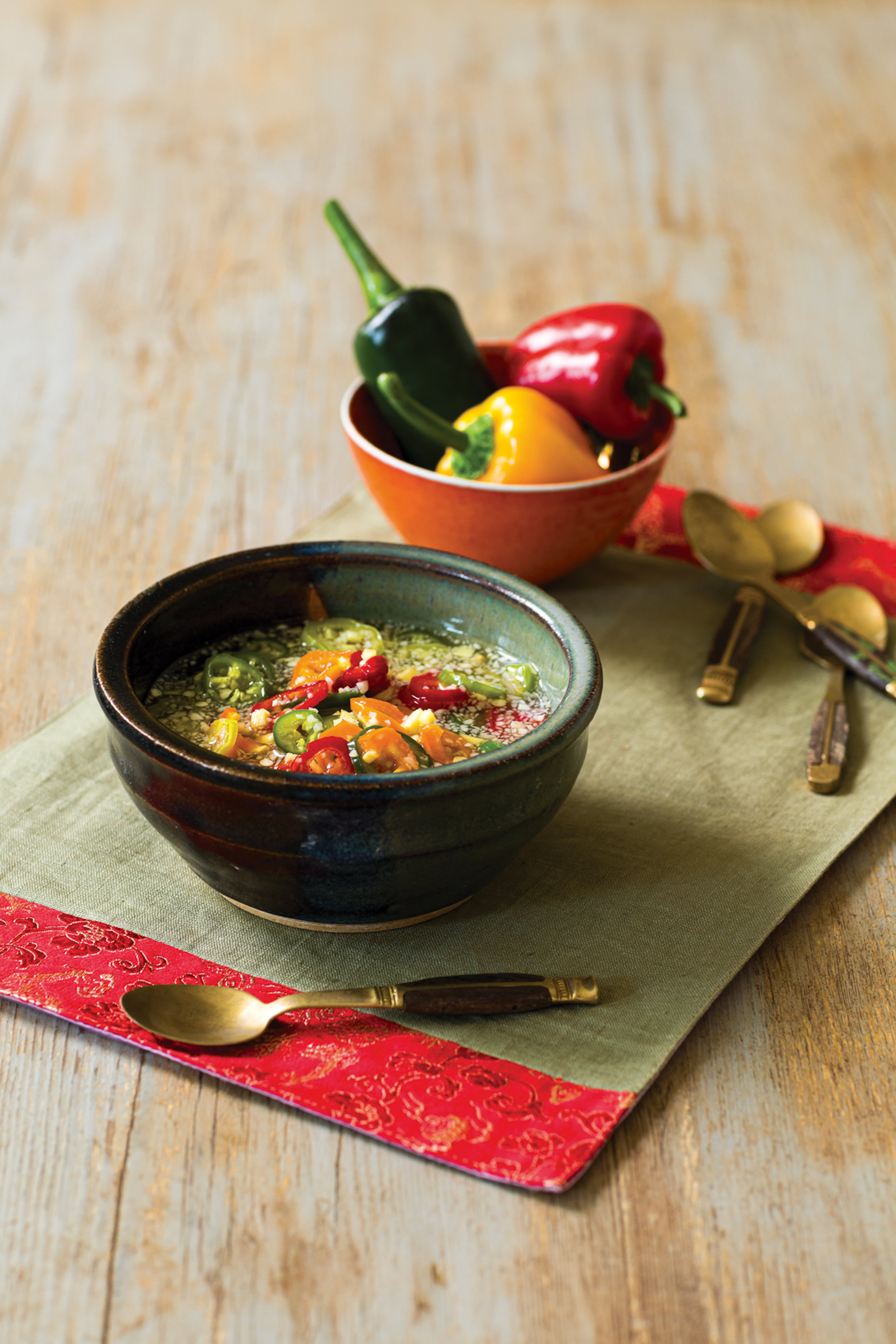
Hot Hot Hunan Fresh Chile Sambal
Keng’s sambal sauce is inspired by Southern hot pepper sauce. “This is a spicy, tangy, umami sauce for a zingy lemony vinaigrette that conjures the taste of chow-chow. It’s to-die-for on dumplings, including gyoza, pot stickers and xiao long bao, not to mention, naked ravioli, matzo balls and pierogies. Also, fish ‘n’ chips, grilled seafood, and omelets, plus, of course, fried chicken.”
If not serving the whole batch right away, spoon out the desired amount of the chile base, add some of the cider-citrus liquid, and refrigerate the remaining sambal mixture in a sealed glass jar for up to three weeks.
- 1/2 cup chopped fresh chiles (about 3 large cayenne or Anaheim chiles)
- 3 tablespoons light rice vinegar
- 6 garlic cloves, minced
- Juice of 1 lemon (about 2 tablespoons)
- Juice of 1 lime (about 2 tablespoons)
- 5 peeled ginger slices (1/8-inch thick and 1 inch in diameter)
- 1/2 teaspoon honey
- 1/2 teaspoon fish sauce
- 3 tablespoons muscadine cider, or any fruit cider, including apple cider
- To make the chile base, put the chopped chiles in a glass bowl and pour the vinegar over the chiles. Add the garlic and stir gently with chopsticks to coat and blend. Be careful not to break apart the chile pieces. Set aside.
- In a 4-cup glass measuring cup, make the citrus mixture by combining the lemon juice, lime juice and ginger. Set aside.
- In a separate small bowl, make the cider mixture by stirring the honey into the fish sauce until dissolved, then add the cider and stir to combine.
- Pour the cider mixture into the citrus mixture, stirring to combine.
- Carefully pour or spoon the chile base into the glass measuring cup. Use chopsticks to gently combine all the sambal ingredients, then transfer to a serving bowl.
Nutritional information
Per serving: Per tablespoon: 9 calories (percent of calories from fat, 3), trace protein, 2 grams carbohydrates, trace total sugars, trace fiber, trace total fat (trace saturated fat), no cholesterol, 15 milligrams sodium.Sign up for the AJC Food and Dining Newsletter
Read more stories like this by liking Atlanta Restaurant Scene on Facebook, following @ATLDiningNews on Twitter and @ajcdining on Instagram.