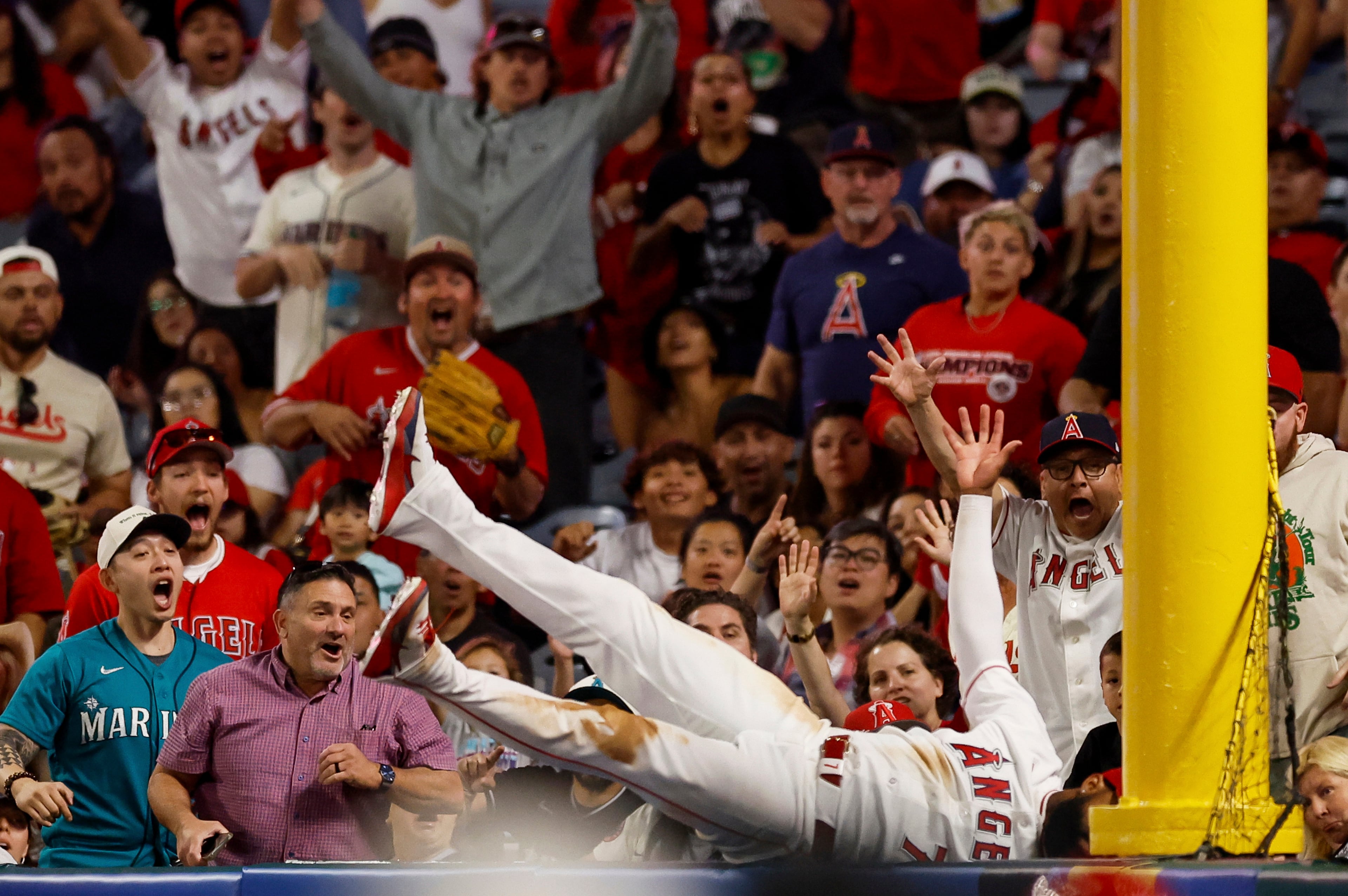
Simmons already rated finest shortstop by some
Talk to teammates about Andrelton Simmons and you’ll find they don’t need statistics, advanced or otherwise, to either inform or help them describe the level of defense they witness nightly from the Braves shortstop.
“When you’re on another team, you hear rumors about, ‘Oh, this guy is really good,’” said Braves third baseman Chris Johnson, who played for Houston and Arizona last year, Simmons’ rookie season. “So I was excited to see him. And he’s that and more. I mean, he’s the best defensive player I’ve ever seen. Ever. By far.”
Said catcher Gerald Laird, in his first season with the Braves after 10 seasons with Texas, Detroit and St. Louis: “He is the best (shortstop) I’ve played with. … The good ones have great body control. It’s almost art, watching it. The things Simmons can do, it’s just special to watch.”
Braves pitcher Kris Medlen: “Alex Gonzalez was the greatest shortstop I ever played with and (Simmons) trumps him. It’s unbelievable. I think taking away runs is just as valuable as driving them in. That’s a statistical thing they’re trying to (quantify) now, right?”
Even if teammates don’t need anything more than visual proof to convince them of Simmons’ supremacy, there is data to suggest the cannon-armed Curacaoan, in his first full season, is the best defensive player in baseball.
Fielding statistics are still evolving and haven’t gained widespread acceptance the way hitting and pitching metrics have. But there are at least a couple of measurements that have been embraced by many baseball insiders: Defensive WAR, and Defensive Runs Saved, formulas that combine a variety of defensive metrics.
Based on DRS, no player has equaled Simmons defensively since the statistic came into use in 2003. He had an estimated 41 defensive runs saved this season, six above the previous record by Yankees outfielder Brett Gardner in 2010. (Milwaukee center fielder Carlos Gomez had 38 defensive runs saved this season, according to FanGraphs.)
The DRS leader at shortstop each of the previous two seasons was Seattle’s Brendan Ryan, with a two-season total of 45.
If one prefers Defensive WAR (Wins Above Replacement), Simmons’ 5.4 score matched infielder Terry Turner’s score with the 1906 Cleveland Naps as the highest ever calculated, according to Baseball-Reference.com.
Simmons, 24, doesn’t get caught up in defensive stats, but conceded, “It’s definitely nice to hear. And every time you hear something good — you have your own standards and then you hear people say, OK, you’re here — it makes you want to stay here and go higher. So that’s pretty cool.”
His swing and hitting approach are still works in progress. He hit .248 with just a .296 on-base percentage. But Simmons’ 17 homers ranked fourth among National League shortstops and he had a few torrid stretches in which he showed what he can do when he gets in sync and utilizes the swing adjustments he has worked on since spring training. He had his best month in July, batting .289 with three triples, five homers, 17 RBIs and two strikeouts in 108 at-bats.
“He’s trying to get better all the time,” Braves assistant hitting coach Scott Fletcher said. “Sometimes it just takes time. But his eye-hand coordination is so good that he hits what he swings at so much and can still do a lot of things (on offense). And as he continues, you’re going to see better and better things from him.”
Simmons intends to add 15 pounds of muscle this winter. He also believes he can get even better on defense.
“You can always get better at making decisions,” he said. “Like when not to throw a ball, when to throw or go for a double play when the ball’s not really in a place for a double play. Sometimes I’m too aggressive. I’m still trying to find that spot where if I’m risking something, the reward is worth it.”
He has the physical tools of an elite infielder — great range and hand-eye coordination, fluid footwork and an arm that might be the strongest of any major league position player. So strong, it allows Simmons to position himself deeper than most shortstops.
“I tell people, if Ozzie Smith had his arm, oh my God,” said Braves first-base coach Terry Pendleton, who began his career playing in St. Louis alongside Smith, a gold standard among shortstops. “Ozzie played years with a torn rotator cuff. He never had that type of arm on him. It makes a difference.”
There also is an intangible that separates most great defenders: instincts. Marvelous instincts. Like the last Braves defender of his ilk, center fielder Andruw Jones, Simmons has an uncanny ability to sense where a ball will be before it’s hit there.
On the outside of Simmons’ gloves are two words stitched by the glove manufacturer: “God given.”
Few would argue otherwise. But Simmons also is a notoriously hard worker, so much so that Pendleton and other coaches sometimes shut him down, tell him to leave the batting cage or stop hitting him ground balls before games. Pendleton said if they don’t, Simmons will keep working past the point of diminishing return, until he’s exhausted.
Simmons has churned out a lengthy catalog of mind-blowing plays, making him a fixture on highlight segments. But big leaguers will tell you the foundation for an elite defensive player is first making the routine plays. Simmons does.
“You know he’s going to make good throws; you know he’s going to make good decisions,” Braves second baseman Dan Uggla said. “And he’s very accurate as well. He’s a fun, fun person to play next to. … The thing about Andrelton, he’s not a flashy shortstop. You don’t see the wristbands, you don’t see any kind of flair or anything like that. He’s just, like, ‘Give me the glove and I’ll make every play.’”
He makes the routine plays, and as Medlen said, “He makes the spectacular plays look routine. It’s like, did you just see that play? He made that look really easy when it shouldn’t have been that easy. I think people are starting to take notice. You can see in other dugouts, when he makes a play it’s like, whew, (expletive). It makes you excited. It makes you go, ‘Hit it to him.’”
Medlen said the ball makes a different sound when Simmons throws it, and Johnson agreed.
“Oh, yeah, you can hear it when he releases it,” Johnson said. “It’s kind of got that (pfft sound). It just, like, flicks out of his hand. It’s pretty cool because usually when people hit a ball in that hole (between third and short) they’re like, ‘I’m going to beat this one out.’ But we know you’re not. You may think you are, but we know you’re not.”
Although the accuracy of fielding statistics frequently is disputed, in the case of Simmons, the DRS ranking matches the opinion of those who watch him play daily and compare him with the best they’ve seen. Pendleton came up with the Cardinals and played from 1984-90 alongside Smith, aka “The Wizard of Oz.” He sees a lot of Smith in Simmons.
“They can change a game with their glove,” Pendleton said. “There are other shortstops that can do that, but their instincts and the way (Smith and Simmons) go about doing things and the way they think the game — they’ll do things instinctively that others won’t. But I keep reiterating to everybody, this kid has a year in the big leagues, and Ozzie did it for 20.”
Pendleton is old-school that way, careful not to go overboard with praise for such a young player. But when it comes to Simmons, Pendleton goes as far as he’ll ever go in lauding such a young player.
“He’s a born shortstop,” Pendleton said. “Just the little things he does. And some of the big things that look so little to him, but to us who’ve played defense out there and know how tough a ball can be, we’ll stop and look at each other because it’s like, ‘No way he just did that and made it look that easy.’ But he does things like that.
“That’s the kind of things Ozzie did. Made ’em look easy.”