There’s a flaw in NAACP’s appeal to Black college athletes, but will it work?
The NAACP is right about what it calls the “contradiction” of college sports. Many of the same people who cheer for revenue-producing Black athletes at universities also support policies that hurt Black citizens.
In response to the latest Republican attack on the Voting Rights Act, the civil rights organization is calling on top recruits in basketball and football to join the resistance.
The NAACP is asking those athletes to withhold their commitment to programs at public colleges in eight states until lawmakers “restore fair congressional maps and meaningful Black representation.” The states are Georgia, Tennessee, Louisiana, Florida, Alabama, Mississippi, South Carolina and Texas.
The targeted programs all generate more than $100 million in annual revenue. Only the University of Georgia clears that bar in this state.
The NAACP also encourages recruits to consider playing at a historically Black college. It’s asking current athletes at targeted schools to contemplate entering the transfer portal and urging fans to avoid supporting sports programs at those places.
The idea is to make those public universities feel financial pain so long as state lawmakers seek to erode Black political representation.
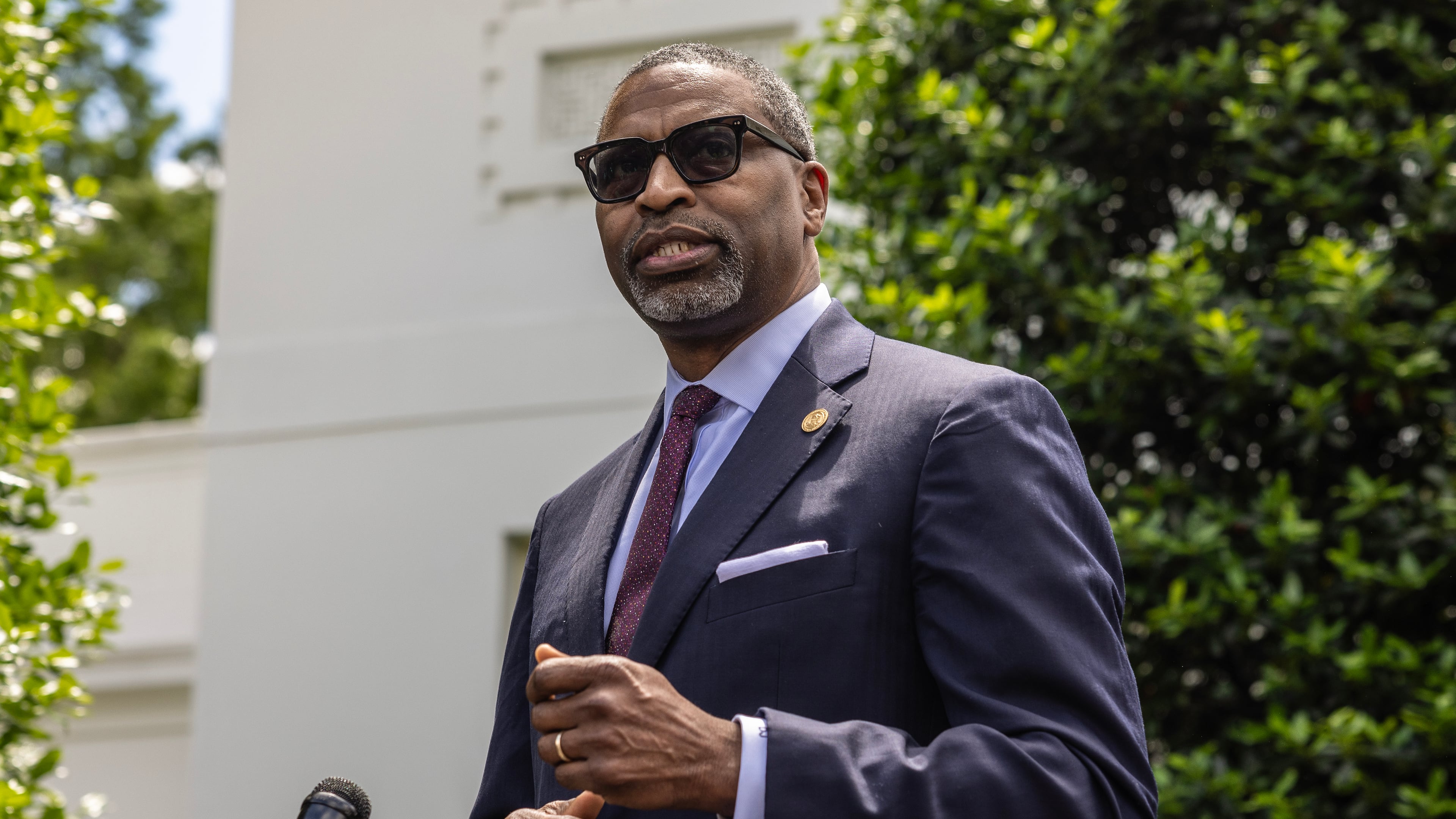
Derrick Johnson, the president and CEO of the NAACP, said he’s received positive feedback about the “Out of Bounds” campaign.
“People are now recognizing the crisis moment we are in,” Johnson said. “All the former Confederate states began to act if they want to move time back to the 1950s. As a community, and as a society, we are too big to fit in that small box. We should be focused on building a global economy … instead of ‘othering.’”
The latest salvo in the GOP’s yearslong assault on the Voting Rights Act is the Supreme Court’s decision in Louisiana v. Callais.
The court’s right-wing majority freed state lawmakers to draw electoral maps that discriminate against Black citizens, so long as those lawmakers don’t make their intent overt. Since the ruling, several GOP governors, including Georgia’s Brian Kemp, have called special legislative sessions to draw maps that dilute Black voting power while following the Court’s direction to hide behind the flimsy cover of partisanship.
It would be difficult for Black recruits to organize a coordinated boycott of the programs on the NAACP’s list. They are a large group of people with no formal ties to bind them. It’s easier for pro athletes to organize because they are a relatively small group of unionized workers with personal relationships and aligned goals.
If college recruits pulled off a large boycott, it may not be enough to convince GOP leaders in those states to abandon their attacks on multiracial democracy. It certainly would get the attention of those lawmakers.
Big-time college programs would be sunk if they couldn’t sign Black recruits in football and basketball. According to demographic data compiled by the NCAA, Black athletes represent roughly half the population of athletes in basketball and football programs at Power 4 programs.
There is precedent for athletes forcing change with the threat of refusing to play. Players on the 2015 Missouri football team declined to participate in football-related activities in protest of the administration’s failure to protect Black students amid several racist incidents on campus.
The Missouri players demanded that UM System President Tim Wolfe resign. He did so two days after the start of the strike.
I’d love to see today’s college athletes stand up for Black people’s right to vote by leveraging their boycott power. But they are the ones who would be making a sacrifice for the cause, not me. I understand why they would choose not to do it.
“I sit on the fence because I don’t want to make a decision for a young person who has prepared their mind, body and soul for this opportunity,” said Maurice J. Hobson, a professor of Africana Studies and historian at Georgia State University.
Hobson played football at Alabama-Birmingham and grew up cheering for the Crimson Tide in his home state. He said he’s a supporter of the NAACP but noted that leaders who are asking athletes to boycott certain programs belong to the upper-middle class, while many of the athletes are from lower economic classes.
From that perspective, athletes could view the NAACP’s campaign as wealthy people asking people from families with less money to sacrifice for a political agenda.
“On another level, it’s hard for me to suit up for Alabama where they are pushing back on the civil rights of the people I come from,” Hobson said. “If there can be a way of having the best of both worlds, I can look at going to the Midwest, or the West Coast now, in the Big Ten. The problem with that is my family can’t come to see me like they can (closer to home).
“I would like to see and believe these players are willing to organize and do this, but there is a lot of money and potential involved with these folks.”
Johnson said the NAACP isn’t asking athletes to sacrifice.
“They have options,” he said. “If LSU is recruiting you, (then) Ohio State wants you, too. If it’s Alabama, Michigan is always looking to recruit you. We’re not saying give up anything. We are just saying, ‘Choose wisely.’”
In some cases, it might not be much of a sacrifice for a top recruit to pick one elite program over another. But recruits have different priorities. The best fit for them could be at one of the programs targeted by the NAACP. Maybe they grew up dreaming of playing for the flagship state school or simply don’t want to play far from home.
Johnson argues that going far away from home for school is a “great opportunity to explore and expand their horizons and exposure. ”
“In this moment … we all have to stand up differently and get out of our comfort zones,” Johnson said. “And there is a history here with (Muhammad) Ali, Kareem (Abdul-Jabbar), (Colin) Kaepernick. There is long history of athletes raising awareness to make the necessary demands.”
Those athletes paid a price for standing up for the rights of Black people. Georgia U.S. Sen. Raphael Warnock has cited “the long and ugly history” of Black athletes facing public backlash for demanding rights because critics believe they “are (only) there to entertain.”
Ali refused to fight in the Vietnam War for a country that treated Black people as second-class citizens. He was stripped of his heavyweight title and sentenced to a five-year prison term for refusing induction into the military (the Supreme Court unanimously overturned Ali’s conviction on appeal).
Kaepernick was blackballed from the NFL for his decision to kneel on the sideline during the playing of the national anthem in protest of police brutality and racial injustice. NFL owners reached a financial agreement with Kaepernick and Eric Reid in exchange for them dropping their collusion grievances.
Abdul-Jabbar told CBS News that, because of his social justice stances, he’s been getting threatening messages since he was 17 years old. Abdul-Jabbar recalled that he was protesting on the UCLA campus after the assassination of Martin Luther King Jr. when a student asked him why he was doing so when he was going to play in the NBA.
“I was just appalled at his ignorance,” Abdul-Jabbar told CBS News.
Abdul-Jabbar was standing up for all Black people, even though he’d earned opportunities with his athletic talent. The NAACP wants Black collegiate recruits to take a similar stance against the latest Republican effort to erode the voting rights of Black people.
Reasonable, fair-minded people can disagree about the organization’s campaign. But there is no doubt that the NAACP is right about the contradiction of people cheering the exploits of Black athletes at college programs while also cheering the diminishing of Black political representation.
You can now get my column sent straight to your inbox. Sign up for my newsletter here.