Revisiting one of the wackiest rules in Georgia high school football history
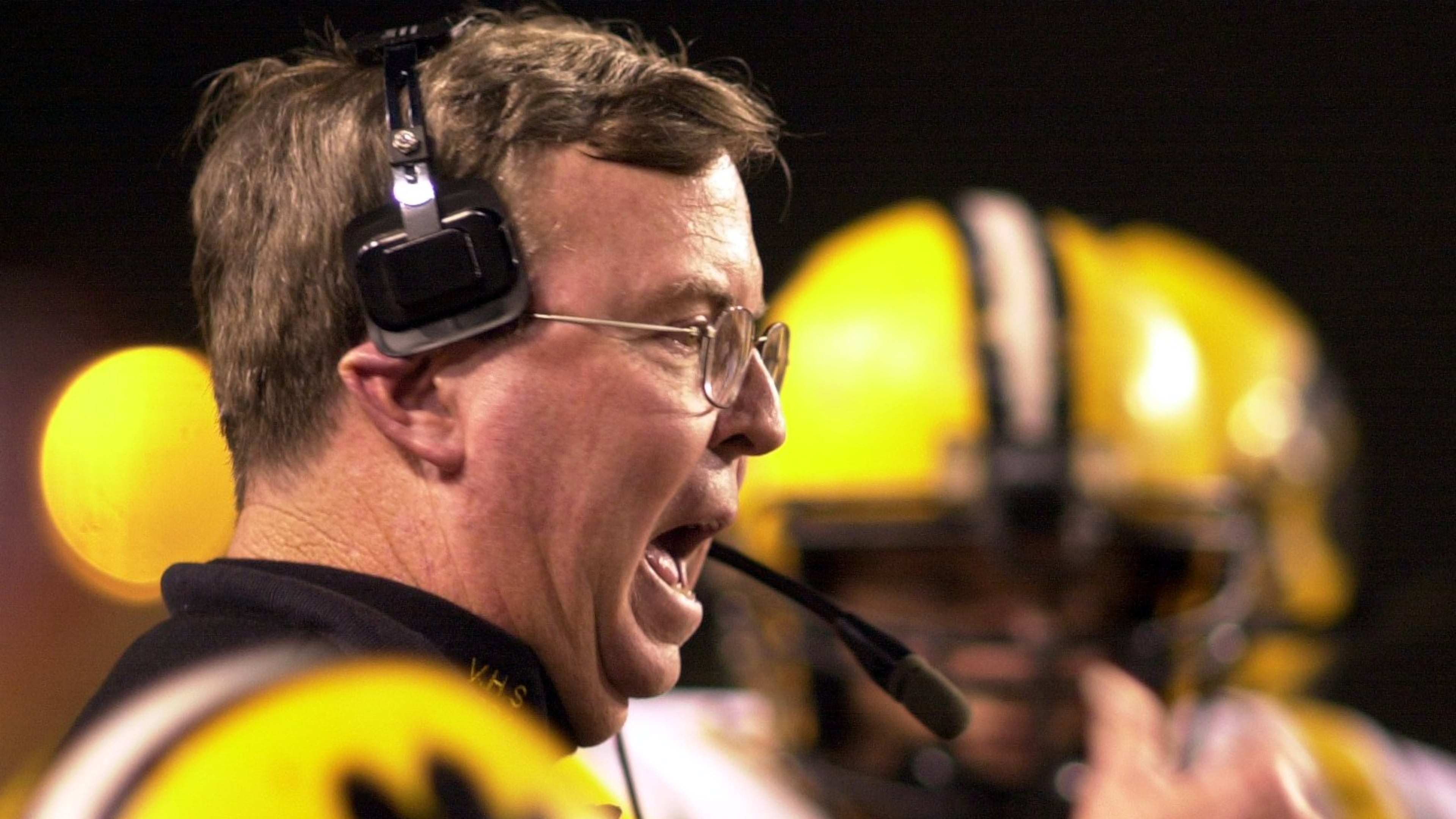
Only one rule in Georgia high school football history made a coach consider taking a knee on fourth-and-goal with his team losing in overtime.
Only one rule had a referee lifting a coach’s hand at the 50-yard line like a UFC fighter to signal a winner.
And only one rule made high school principals play a vital role in what is arguably the GHSA’s strangest tiebreaker.
Meet the “penetration rule,” a tiebreaker that the GHSA used for decades to decide football games that remained tied after overtime.
GHSA football overtime wasn’t always decided by alternating possessions from the opponent’s 15-yard line, similar to the college football overtime format.
Overtime used to be played in two five-minute halves with each team kicking the ball off once, like the halves in regulation. It was essentially a 10-minute mini-game that gave each team at least one drive to outscore the other.
And if the score was still tied after the five-minute halves?
Under the penetration rule, the win was awarded to the team that moved the ball farthest down the field on a nonscoring drive in overtime.
The rule was eradicated in 2003 after decades of shaping Georgia high school football. Penetration has crowned state champions, enshrined local legends and led the GHSA to its current overtime format.
The rule lives in the past, and it doesn’t make sense to most people, but it created some great stories.
The Game-Winner Before Halftime
Fayette County 8, North Clayton 7 (1982)
Fayette County got the ball in its own territory with 30 seconds left in the first five-minute half of overtime.
The Tigers had kept North Clayton off the board — preserving a 7-7 tie — and were set to receive the kickoff to start the second five-minute period.
The Tigers weren’t close to field goal range, and with such little time, there typically wouldn’t be a reason to try to move the ball before the half.
But Charlie Winslette, Fayette County’s coach at the time, thought about the penetration rule.
“Any other time, we would have just knee’d it out and gone to the second overtime,” Winslette said. “But I said, you know, we don’t have a penetration, and they really don’t have a good one either, so why not take a chance?”
Winslette surprised North Clayton with a deep pass instead. The Tigers didn’t score, but they connected for a gain that ended the first half of overtime in North Clayton territory.
Neither team scored in the second overtime period, and Fayette County won 8-7 thanks to the long pass right before halftime.
“I think they were sitting over there in the secondary saying, ‘They ain’t crazy enough to put the ball up and risk an interception, and we run it back down there and get penetration’,” Winslette said. “There was a lot of conjecture that went on.”
The Principal’s Role
Lowndes 8, Valdosta 7 (2000)
The rule also encouraged high school principals to attend every football game just in case they were needed for a crucial role.
On the off chance that a football game went to overtime, principals were entrusted with tracking how far their team moved down the field.
They didn’t do it discreetly from the press box, where every other statistic is monitored. Principals were to stand on their school’s sideline with a large flag, planted at the farthest yard line on a nonscoring drive.
Lowndes football radio broadcaster Marty Rodgers remembered when his mother and former Lowndes principal, Ann Rodgers, carried the flag in an overtime win over Valdosta.
The crosstown rivals were tied 7-7 late in the second half of overtime. Lowndes had the ball and already had a better penetration than Valdosta with little time left.
Lowndes was deep in Valdosta territory facing a fourth-and-one. The Vikings needed a first down to keep burning the clock, but they didn’t want to break the tie with a score because it would give the ball back to Valdosta with time to tie or retake the lead.
“We ran a bootleg, and the coach had told him if you get the first down, go down,” Rodgers recalled. “He did, and from there, all we had to do was run out the clock, and we won, 8-7.”
Marty Rodgers, who has made every Lowndes-Valdosta game since his birth, erupted in celebration. His mother made sure to bring home a souvenir.
“She may or may not still have that flag, I’ll just say that,” Marty Rodgers said. “She may have made off with that penetration flag.”
The Best-Out-of-Three Rule
Lanier-Macon 15, Marist 14 (1948)
In 1948, penetration wasn’t measured by the deepest drive in overtime. The penetration point was awarded to the team that moved the ball past the opponent’s 20-yard line the most times throughout the entire game.
Marist coach Shorty Doyal understood the penetration rule, so he thought his team had beaten Lanier-Macon 15-14 for the Class 2A state championship. After all, Marist had a 6-3 penetration advantage over Lanier.
Then Doyal was informed of a rule change in the previous offseason. Penetration had become one of three tiebreaker factors, and the winning team needed two of them to win.
Marist had penetration, but it also needed an edge over Lanier in total first downs or total yards gained. Doyal and Lanier coach Selby Buck raced to the press box and hovered over statisticians as they totaled first downs and yardage.
Lanier had a slight edge in both categories, giving the Poets the state title.
The Heavyweight Champ
Coffee 28, Tift County 27 (2001)
The penetration rule wasn’t just a headache for coaches. Most fans weren’t familiar with the rule, either, considering how rarely came into effect.
Stanley Lott, the sports radio host for “The Talk Around Sports” show, was broadcasting Coffee’s overtime battle at Tift County in 2001. The Trojans won the game 28-27 because their penetration was three yards deeper than Tift County’s.
Lott said Tift County and Coffee fans initially didn’t know who won the game. The head referee couldn’t explain the penetration rule to everyone, so he called both head coaches to join him at the 50-yard line.
“Here comes coach Tommy Seward walking in from Tift County’s sideline, and (Coffee coach Bonwell Royal) is walking to the center of the football field from our sideline, and they get right there at midfield,” Lott recalled. “The official talks to both of them a little bit, and then he grabs Coach Royal by the wrist and holds his hand up to say that Coffee had won the game, and everybody went crazy.”
Taking a Knee on Fourth Down
Fayette County 11, Newnan 10 (1978)
Winslette’s 1978 Fayette County team was on the verge of a signature upset of then-No. 10-ranked Newnan. The Tigers, who made the jump from Class 2A to Class 4A that season, had already shocked the stadium by forcing overtime at Newnan.
Fayette County trailed Newnan 10-8 late in the first overtime period but was two yards away from the end zone. Winslette faced a tough choice on fourth-and-goal: He could attempt a field goal for a one-point lead or try to score a touchdown for a bigger lead going into the second half of overtime.
Winslette called timeout to talk about the decision when a third option was proposed.
Someone suggested the Tigers take a knee on fourth-and-goal at the two-yard line, almost guaranteeing they would earn the penetration point in the event of a tie.
“We did have another five minutes, and that was part of the reason that we were arguing about what we were going to do,” Winslette said.
Winslette ultimately opted not to take the knee on fourth down, and the Tigers kicked the field goal instead. They won five minutes later, 11-10.
Unlike many football regulation disputes, the penetration rule’s dismissal in 2003 was almost unanimously supported. Many coaches were happy to see the rule give way to a modern overtime format, including those like Winslette who were successful in games decided by the penetration rule.
“It was antiquated when it came in. Let’s just put it that way,” Winslette said. “They had to come up with something … I don’t know.”
About the Author
Jack Leo is a sports writer and reporter for the Atlanta Journal-Constitution. Jack worked for the AJC throughout his four years studying journalism and sports media at Georgia State University and the University of Georgia. He's now focused on telling stories in the grassroots: bringing comprehensive coverage of high school sports for AJC Varsity.


