Capitol Recap: Kemp targets ‘revolving door of criminal justice’


Gov. Brian Kemp promised to get tougher on crime and took aim during his State of the State address this past week at “the revolving door of criminal justice.”
It once again showed that Kemp is taking a harder line than his immediate predecessor in the governor’s office, Republican Nathan Deal, who undertook an overhaul of the state’s criminal justice system, diverting nonviolent offenders away from prison cells and into treatment centers.
Kemp outlined plans seeking tougher penalties for gang offenders who try to recruit children.
The governor’s advisers indicated he is reviewing legislation that could pressure prosecutors to act with urgency in targeting serious offenders. Kemp has also backed efforts to limit no-cash bail, stiffen human trafficking penalties and add more law enforcement officers.
State Rep. Sam Park, a Gwinnett County Democrat, said there’s broad bipartisan support for legislation that targets human trafficking and other problems.
But he warned that care must be taken “not to overcriminalize our communities.”
“The Democratic Party supports and fosters and will do everything to ensure bipartisan support for our law enforcement,” Park said. “But we also must ensure police accountability.”
The governor also:
- Unveiled a Rural Workforce Housing Fund that the state could use to partner with local governments to develop home sites so more workers can live in “quality homes where they can raise a family in the same community where they work.”
- Called attention to his plan to fully fund the state’s K-12 system and pump more money into the HOPE scholarship, reversing cuts to the popular program enacted in 2011.
- Promoted a new $2,000 raise for teachers after obtaining $5,000 in pay increases for K-12 educators during his first term.
- Reminded legislators of his proposal for $4.5 million in loan repayment programs to boost the number of health care workers in Georgia while also providing an additional $1.7 million to finance 102 new residency slots.
- Backed legislation to allow pregnant women who qualify to receive benefits from the Temporary Assistance for Needy Families program, commonly known as welfare.
Following Kemp’s speech, Democrats promoted measures to increase the state’s minimum wage from $7.25 to $15 an hour, create a state child tax credit, hike teacher pay by $10,000 annually, give voters the opportunity through a ballot initiative to vote on abortion rights and add gun restrictions.
Estimate tops earlier prediction for Georgians qualifying for Medicaid ‘waiver’
Gov. Brian Kemp’s Medicaid “waiver” could provide health insurance to 90,000 Georgia adults after two years of operation, his aides say.
That’s a little less than one-quarter of the 370,000 poor Georgians who fit the eligible age range, but it’s up from a prediction of about 50,000 when Kemp first introduced the waiver proposal as a counter to full Medicaid expansion through the 2010 Affordable Care Act. The estimates were calculated for the state by the consulting firm Deloitte.
Kemp’s Medicaid waiver would require participants to work or meet certain other activity requirements to be eligible for health coverage. The governor sees his conservative alternative to full expansion as a way to motivate poorer Georgians to enter the workforce.
The governor’s office still expects that the majority of the target population will not qualify for coverage and remain uninsured. Under the current calculation, about 280,000 poor Georgia adults either wouldn’t or couldn’t meet the requirements to obtain coverage.
In Georgia, Medicaid mostly insures children in poor families, as well as some older and disabled adults.
Democrats have called for full Medicaid expansion.
Georgia has the third-highest rate of uninsured people in the country and is one of 11 states that have not expanded Medicaid.
Suburban school districts face growing poverty rates among their students
Poverty rates are growing among young people in many of metro Atlanta’s school districts, adding to the challenges that educators face.
In DeKalb County, the poverty rate among residents ages 5-17 climbed nearly 7 percentage points from 2019 to 2021, according to the new youth census data. Clayton and Gwinnett counties saw the rate rise by more than 2 points over the same period, while Cherokee County saw an increase of 1.4 points.
All four exceeded the state rate of 1 percentage point.
Atlanta Public Schools was the only system in the metro area to see a significant drop, falling a net 4.7 percentage points by 2021 after plummeting nearly 9 points the year before.
It, however, also has one of the highest poverty rates in the region at 26.6%, falling behind only Clayton at 26.9% and placing just ahead of DeKalb at 23.7%.
Educators say they’ve seen concerns about meals or shelter take a toll on students’ academic performance. Suburban schools could have difficulty dealing with poverty because they tend to be in communities with less support for food and housing assistance.
It’s unclear whether the rate increases are a short-term or long-term problem, but people in the suburbs are taking notice.
“We have an increasing number of people who are experiencing houselessness,” said Marlyn Tillman, co-founder and executive director of Gwinnett SToPP, an advocacy organization. “Our hotels are filling up with people living there.”
Tillman thinks school systems should employ smaller class sizes in high-poverty areas so teachers have more time to detect and address learning gaps that struggling parents cannot.
“They’re dealing with life and may not have that opportunity to provide some extra learning support at home,” she said of such parents, “so we have to be the extra support.”
Proposed boost in tax credits for private school tuition is back before the House
A push is back on to expand tuition subsidies for private K-12 schools after hitting a roadblock last year.
Republicans last year proposed a $100 million increase in the state’s student scholarship program, but they only got $20 million after a group that backed the boost angered the wrong person.
The American Federation for Children made an enemy of then-House Speaker David Ralston when it financed mailers targeting Republican lawmakers in an effort to secure support for the legislation. Ralston called it the “dumbest” and among “the most deceitful” things he’d seen in his career, and he vowed to block the legislation.
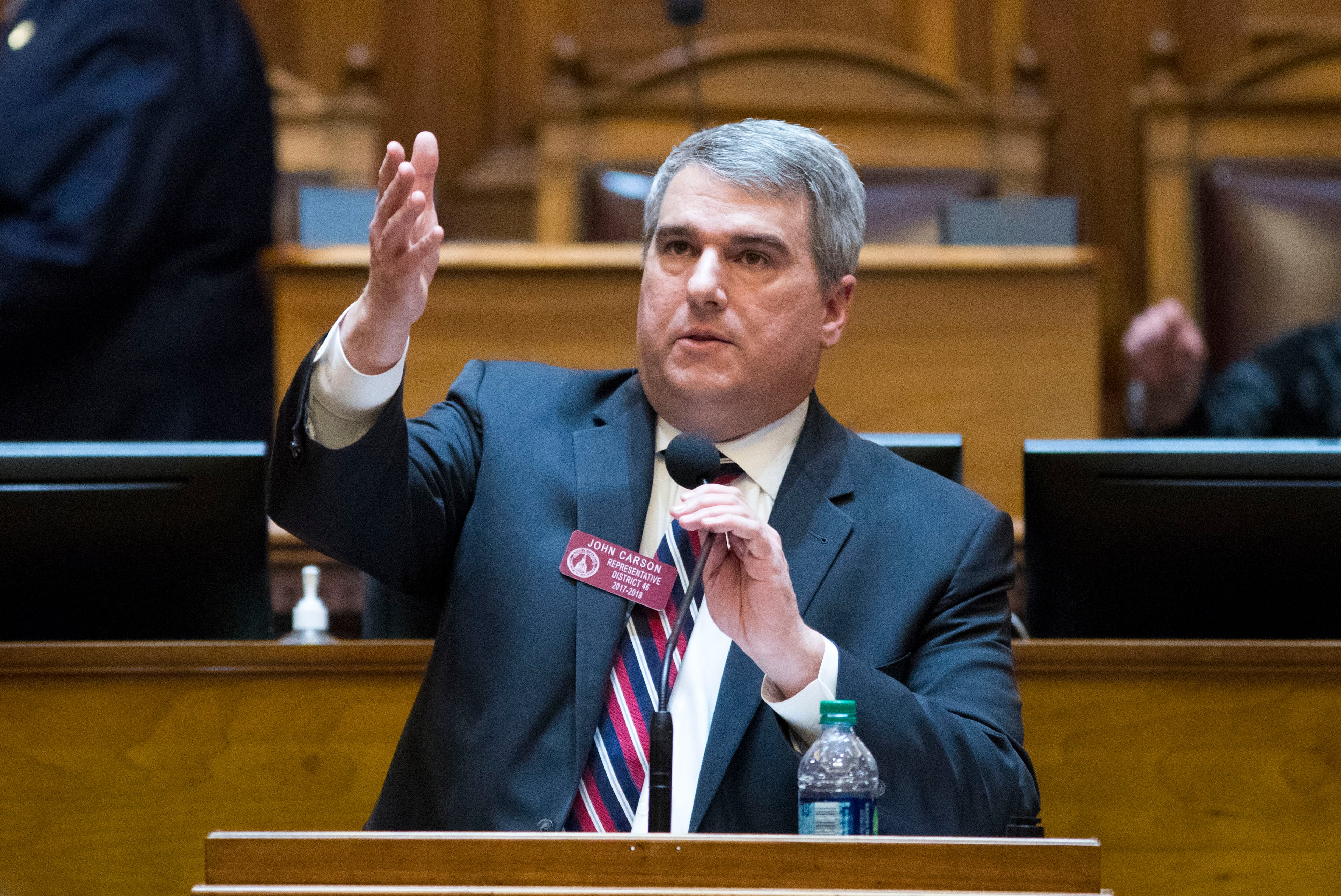
State Rep. John Carson, R-Marietta, who sponsored last year’s bill is now proposing House Bill 54 to expand the cap on the tax credit funded program from the current $120 million to $200 million next year. The measure has more than two dozen co-sponsors, mostly Republicans but at least one Democrat.
Taxpayers who give money toward these scholarships get a like amount credited against their tax bill. The credits run out when the program’s cap is met.
Opponents liken the tax credit scholarships to vouchers. But vouchers are direct government payments to private schools, while the program Carson wants to expand is indirect, with money going to taxpayers who give money to the scholarship fund that they otherwise would have owed the state.
Christy Riggins, director of the Georgia chapter of the American Federation for Children, said in an email that HB 54 trusts parents to choose the best school for their children, whether for rigor, a particular strength, a special need “or simply to escape a failing or unsafe public school.”
Ralston died late last year. The new speaker, Republican Jon Burns, has said that he is looking forward to a “robust” discussion about vouchers this legislative session.

Abortion legislation, for and against, unlikely to advance during session
A total ban on abortion isn’t likely to clear the General Assembly this legislative session. Neither would a repeal of Georgia’s current law that bans most abortions about six weeks into a pregnancy.
Some Republican lawmakers are expected to introduce proposals to give embryos “personhood” rights, but Gov. Brian Kemp has not called for any new limits.
House Speaker Jon Burns has said he doesn’t plan to push for new restrictions on abortion while the Georgia Supreme Court weighs a legal challenge to the law the Legislature passed in 2019 banning the procedure in most cases once a fetal heartbeat has been detected and before many women know they are pregnant.
But it was an abortion opponent who may have dealt a death blow to any legislation this session to tighten restrictions on the procedure.
And he did it in a prayer.
During a Jan. 20 event organized by Georgia Right to Life to coincide with the 50th anniversary of the now-moot U.S. Supreme Court ruling in Roe v. Wade, Nathaniel Darnell thanked God for the recent death of former House Speaker David Ralston.
Darnell, the Georgia director for the National Federation of Republican Assemblies, said:
“Lord, may you please confront those legislators who might seek to be an obstacle to these efforts. We thank you for how you have relieved us from one legislator, a speaker who made himself an obstacle, and we pray that father you would help other legislators to serve you in fear and to take warning.”
Darnell drew immediate condemnation from Republican legislators and conservative leaders, including Cole Muzio of Frontline Policy Action.
“Absolutely disgraceful and not representative of the #prolife movement,” Muzio wrote on Twitter.
One state House Republican called the insult “a spectacular way to kill a bill before it’s introduced.”
For their part, Democrats filed identical bills in the Georgia House and state Senate to repeal the 2019 law and add the right to abortion into the state code.
Before the 2019 law took effect last year following the reversal on Roe, Georgia allowed most abortions up until about 22 weeks of pregnancy. But the Democratic proposals by state Sen. Sally Harrell and state Rep. Shea Roberts, both Atlanta Democrats, would not put any restrictions on when the procedure could be performed.
Senate Bill 15 and House Bill 75 have nochance of passing in a General Assembly dominated by Republicans.

Greene, McCormick to serve on COVID-19 committee
Georgia has two seats on a House select panel that will study the nation’s response to the COVID-19 pandemic.
Republican U.S. Reps. Marjorie Taylor Greene of Rome and Rich McCormick of Suwanee have both been criticized for their responses to the pandemic and accused of spreading misinformation about vaccines and other treatments.
Greene has spread conspiracies about COVID-19 and COVID-19 vaccines as recently as this past week.
McCormick, an emergency room doctor, has questioned mask and quarantine mandates, and he encouraged the use of ivermectin, a medicine usually used for horses, to treat human cases of the coronavirus. A group of 150 medical professionals called on the Georgia Medical Association to rescind its endorsement of McCormick’s candidacy for “spreading dangerous falsehoods about the disease that could put people’s health seriously at risk.”
He said this past week that he hopes the new committee focuses on identifying lessons learned to better prepare for future public health crises.
“I think there’s some admitted mistakes that we can learn from, both from federal agencies, from hospital systems, from doctors,” he said. “A lot of the recommendations we made at the beginning were not what we came up with in the end, because we learned.”
Political expedience
- A tax attack: U.S. Rep. Buddy Carter, R-Pooler, found no fans on The Wall Street Journal’s editorial board for his proposal to replace corporate, income and estate taxes with a 30% sales tax. It dubbed the renewed GOP focus on the proposal “masochistic.” The editorial pointed out that while Carter’s plan would eliminate the Internal Revenue Service, it would replace the agency with two new ones — a “Sales Tax Bureau” and “Excise Tax Bureau.” Georgia’s GOP delegation has long promoted the idea of a flat tax, with John Linder leading the way while he served in the U.S. House from 1993 to 2011. The editorial board wrote that “Republicans would be crazy to squander” one of their few advantages on the tax issue.
- Insulin cap’s impact in Georgia estimated at $21 million: A new $35 cap on monthly insulin costs for Medicare enrollees would save Georgians more than $21 million, the U.S. Department of Health and Human Services estimates. Two Georgia Democrats, U.S. Sen. Raphael Warnock and U.S. Rep. Lucy McBath of Marietta, helped secure the cap as part of the Inflation Reduction Act. HHS based its estimates on 2020 Medicare claims data, suggesting that if the cap had already been in effect, 45,625 Georgians on Medicare would have saved a total of $21.76 million, or $447 per person. Nationally, the savings would have been $761 million. An estimated 11% of the U.S. population has diabetes.
- Enrollment grows under Affordable Care Act: More than 879,000 Georgians signed up for health insurance under the Affordable Care Act in 2023, a jump of 25% over 2022 plans. It’s a second big surge in a row, after a 35% increase in 2022 over the previous year.
- Legislator makes his exit: Democratic state Rep. Mike Glanton of Jonesboro has resigned from the Georgia House. The retired U.S. Army combat veteran served 14 years in office, from 2007 through 2010 and from 2013 to 2022. Glanton’s legislative biography says he helped pass bills to restore MARTA public transportation services to Clayton County and to create a code of ethics for the county school board after it lost accreditation. A special election to fill Glanton’s seat in House District 75 is set for March 21. This year’s legislative session ends March 29.
More top stories
Here’s a sample of other stories about Georgia government and politics that can be found at www.ajc.com/politics/: