What a racetrack can teach us about everyday driving
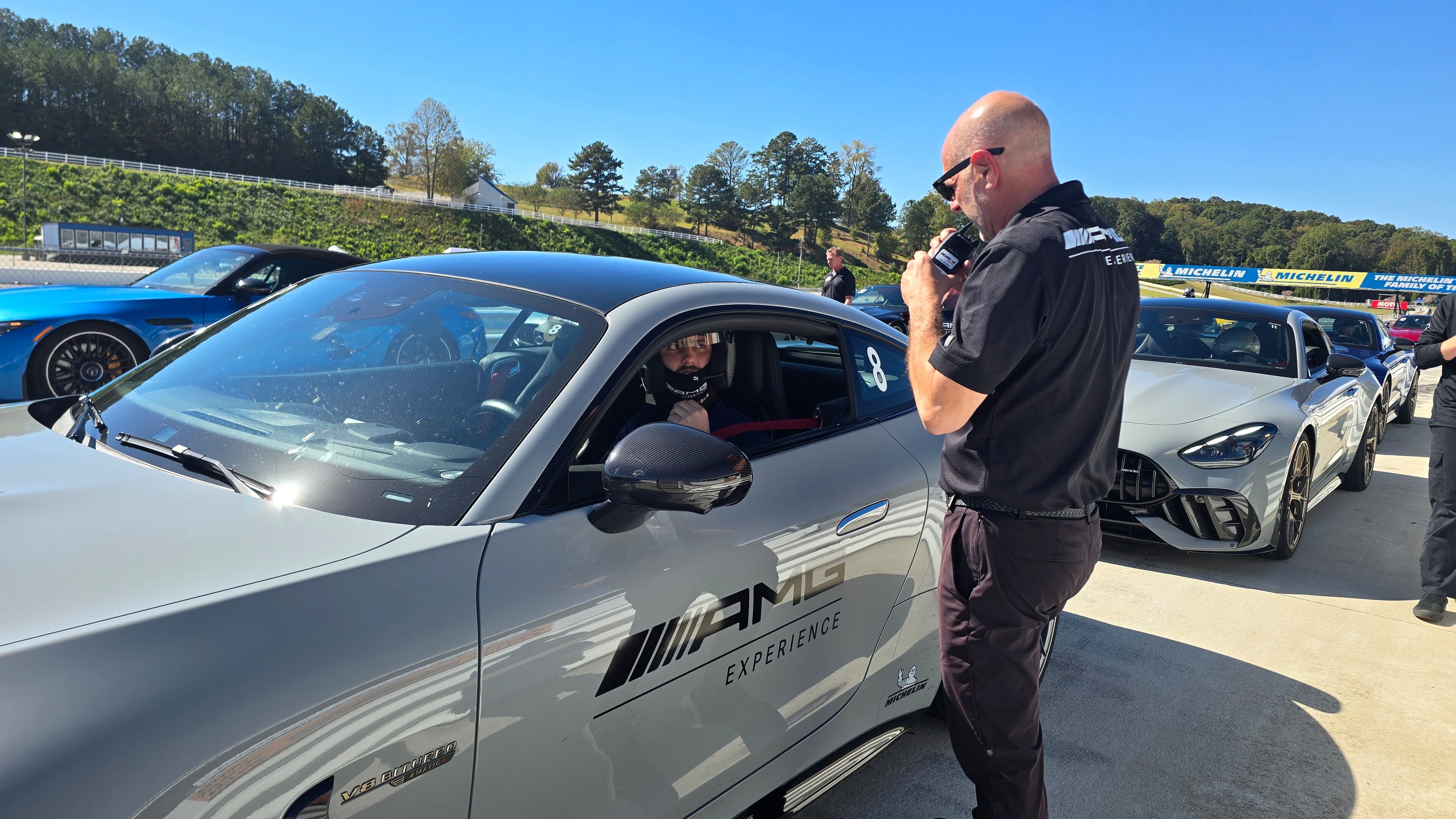
BRASELTON — The radio crackled as I followed an instructor around Road Atlanta.
“If the car I’m driving can do this,” he said, “so can the one you’re driving.”
Technically, he was right. Psychologically, that was another matter.
We were approaching a hard braking zone at roughly 130 mph, slowing to about 50, diving into a sharp left-hand turn, then immediately set up for a sharp right to approach the start/finish line. That is not something I do in my minivan.
But that was also the point.

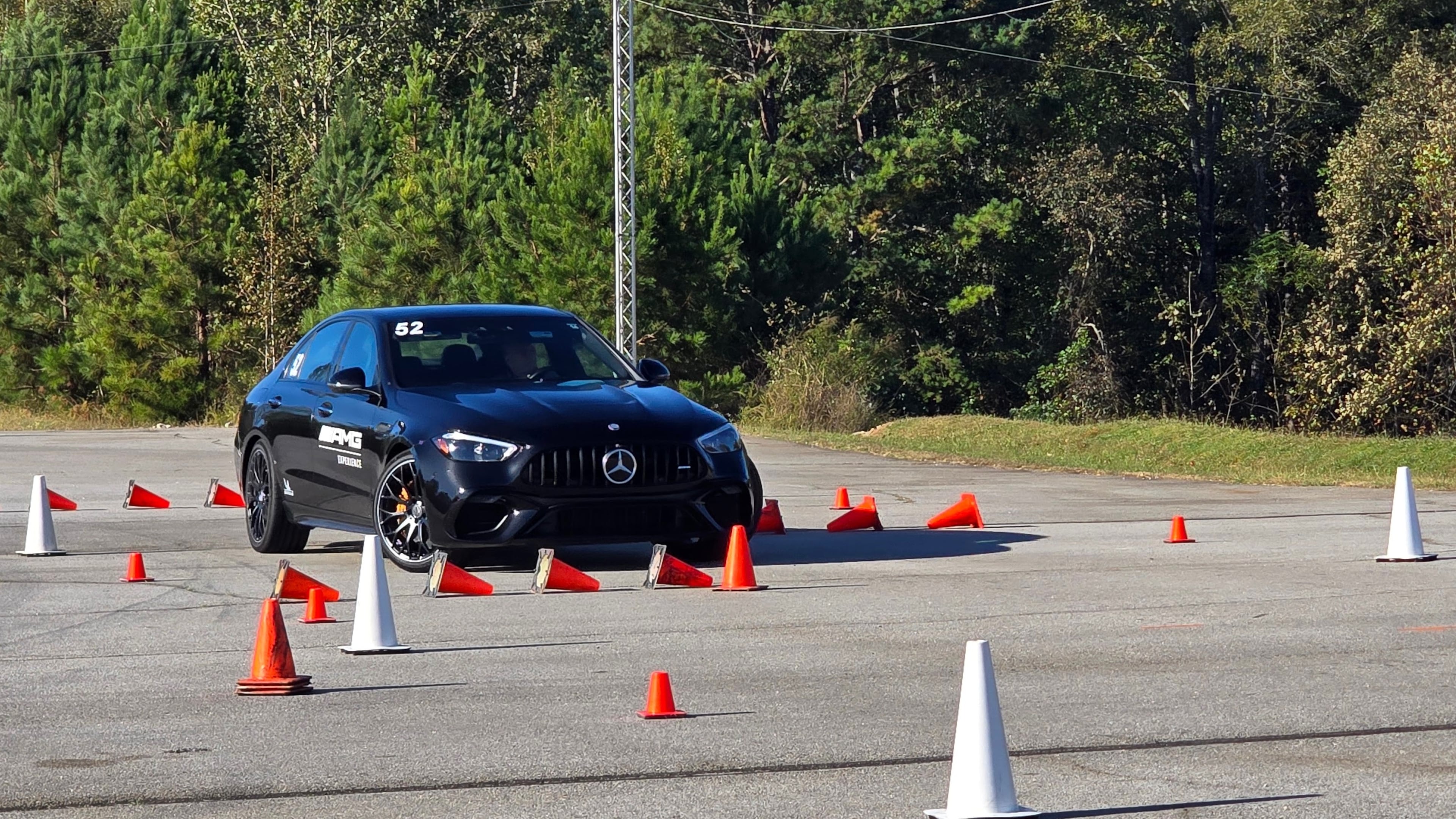
I was a guest of Michelin at the AMG Experience, a one-day performance driving program using Mercedes-AMG vehicles equipped with Michelin tires. Professional instructors put us through a slalom, emergency braking, a wet skid pad and lead-follow laps around Road Atlanta, a 2.54-mile Braselton circuit that hosts Petit Le Mans.
The surprising part was how many of those lessons applied to ordinary driving.
Start with the basics
The first lesson came before we turned a wheel.
Instructors said racing teams can spend hours dialing in a driver’s seating position. The goal is efficiency: enough bend in the knees to work the pedals properly and enough reach to steer without stretching.
It sounds minor until you consider how many of us drive with the seat too far back, one hand draped over the wheel and the other resting somewhere else.
Then came a lesson instructors repeated all day: Look farther ahead.
On a racetrack, that means looking through the corner instead of at the pavement immediately in front of you. On the highway, the principle is the same: Look beyond the car directly ahead and scan for brake lights, merging traffic, debris and escape routes.
It also means not staring at the thing you want to avoid.
The wet skid pad made that lesson obvious. When the rear end starts coming around, instinct tells you to look at the curb, cone or barrier getting frighteningly close.
The instructors told us to look where we wanted the car to go.
That sounds simple until the car is sliding.
Braking hard takes confidence
Most of us know, at least intellectually, that pressing the brake harder makes the car stop faster.
It takes adjustment to actually do it.
In one exercise, we accelerated hard, then stood on the brake pedal while steering into another lane to avoid an obstacle. On the track, we repeatedly braked much harder than anyone normally would on a public road.
Modern anti-lock brakes are designed for that. When you need to stop, stop. Hesitation only gets you closer to whatever you’re trying to avoid.
One instructor, who also coaches racing drivers, talked about how much of his job involves managing confidence.
Too little confidence keeps a driver from using the abilities already there. Too much produces mistakes.

That balance may have been the most useful lesson of the day.
The instructors continually pushed us beyond our comfort zones, but not over our heads. Brake harder. Look farther ahead. Carry more speed. Trust the tires. Trust the car. But not blindly.
A hesitant driver can create problems by braking unpredictably, merging too slowly or freezing when a quick decision is required. An overconfident driver can follow too closely, carry too much speed into a curve or assume technology will correct a bad decision.
Good driving lives somewhere between the two.
It all comes down to grip
Performance driving also makes clear how much ultimately depends on the tires.
A car can have enormous brakes, hundreds of horsepower and sophisticated electronic safety systems, but all of them ultimately work through four relatively small patches of rubber touching the pavement.
That was an appropriate lesson at an event hosted for me by Michelin.
The AMG vehicles were equipped with Michelin tires, but the broader point had little to do with driving a performance car on a racetrack. Every car depends on those same four contact patches, whether accelerating onto a straightaway at Road Atlanta or braking for traffic on I-285.
The harder we drove, the easier it was to understand how much we were asking of them.
Acceleration shifts load rearward. Braking moves it forward. Cornering moves it toward the outside tires.
That is why instructors preach smoothness: Do not jerk the steering wheel. Do not treat the accelerator like a light switch. Do not rush into a corner and then ask the tires to brake and turn aggressively at the same time.
The track version of that lesson is “slow in, fast out.”
For normal driving, “slow in, safe out” works better.
Nobody needs to find the racing line on the way to the grocery store, and most of us will never brake from 130 mph for a corner.
But driving at Road Atlanta reinforced habits that matter every day.
Sit correctly. Hold the wheel at 9 and 3 o’clock. Look farther ahead. Brake decisively when necessary. Make smooth inputs. Know what your tires and brakes can do.
And develop enough confidence to use those abilities without becoming so confident that you forget their limits.
I went to Road Atlanta expecting to learn what high-performance Mercedes-AMG cars could do.
I came away thinking more about two things every car relies on: the four patches of rubber touching the road and the judgment required to use them well.
That matters whether the speedometer reads 130 mph or 30.
Chris Hardesty is a veteran news researcher and editor who provides advice on buying, owning and selling cars for Kelley Blue Book and Autotrader.
The Steering Column is a weekly consumer auto column from Cox Automotive. Cox Automotive and The Atlanta Journal-Constitution are owned by parent company, Atlanta-based Cox Enterprises.