AI deepfake accusation in College Park part of national trend, experts say

An apparent deepfake photograph that portrays the mayor of College Park kissing a man who is not her husband underscores what experts say is a national pattern: the use of images generated by artificial intelligence, or altered by the technology, to target female elected officials, celebrities and other women.
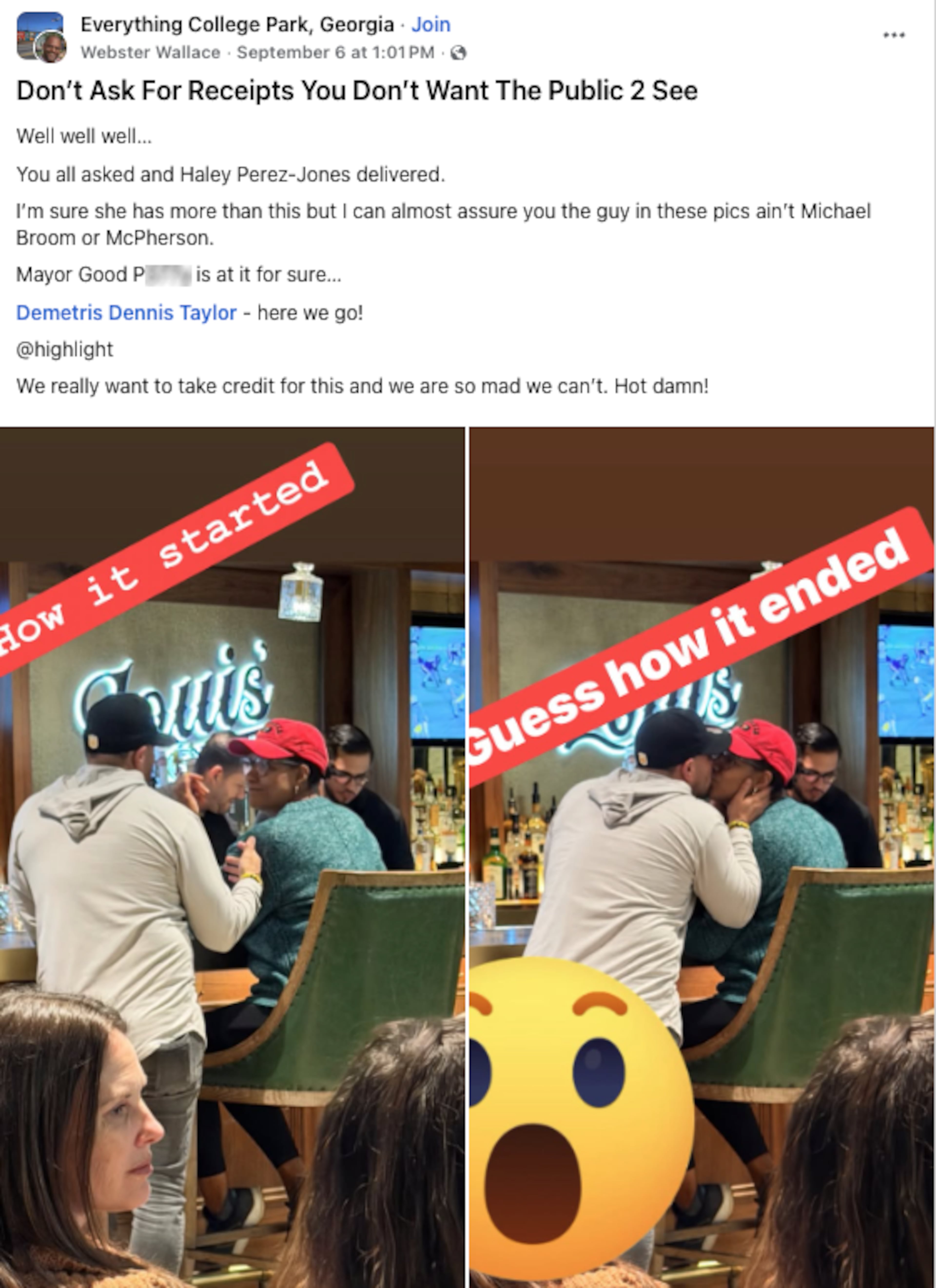
The suspect image of Mayor Bianca Motley Broom was posted on a city-related Facebook page Sept. 6. It was posted beside a photo, which the mayor believes to be authentic, of her making small talk with the man at Louis’ House of Bourbon — a bar at Chateau Elan Resort in Braselton, during a City Council retreat in January.
Motley Broom, who has been married to the same man for more than 13 years, said the image of the kiss is phony and AI-generated. Community outrage about the image, along with online posts calling the mayor a host of vulgarities, spilled into a recent council meeting and is inflaming political divisions within College Park.
“It’s extraordinarily disappointing that individuals are using the same tired playbook against women in leadership,” Motley Broom told The Atlanta Journal-Constitution.
The relationship between the mayor and City Council in College Park has been strained for years. The council has previously restricted her ability to participate in council deliberations, and the mayor has sued the city in federal court. Last year, a judge dismissed her lawsuit.
Brian Magerko, a regents professor of digital media at Georgia Tech, reviewed the images for the AJC and said he’s “99.99999%” certain the kiss picture is fake. That’s because everything and everyone in the first photo are in the exact same position in the second photo, except the mayor and the unidentified man.
Magerko said someone most likely uploaded the first photo into ChatGPT, or another AI program, and told it to make the two people kiss.
Experts say such digital fakes disproportionally target women, often with sexualized images. A 2024 study by the American Sunlight Project said the organization identified tens of thousands of “hits” for AI-generated, non-consensual “intimate imagery” depicting 26 members of the U.S. Congress and Senate. Twenty-five of the 26 politicians were women.
Another study, cited on the U.S. Department of Homeland Security’s website, says about 95% of deepfakes are of nonconsensual pornography of women.
Arun Rai, a Georgia State University regents professor and researcher specializing in AI, said deepfakes targeting women politicians could have a chilling effect by discouraging qualified female candidates from running for office, adding that digital fakes can be especially harmful in small communities like College Park, which has about 14,000 residents.
Rai said it’s difficult to say with certainty the image is fake without conducting a forensic examination, because the technology has become so sophisticated. But he added that positioning “a real photo next to the questionable one is a classic setup.”
Motley Broom said she is considering all legal options.
Elsewhere in Georgia, deepfakes have shaken up several elections, and state lawmakers have debated how to respond to the issue for years.
Some states have enacted laws requiring disclosures or restricting deceptive political deepfakes near elections. But in this year’s General Assembly session, Georgia lawmakers stopped short of creating a broad framework governing AI use in political campaigns over concerns about free speech restrictions.
One thing members of the public can do, though, is refrain from engaging with suspect photos or videos online, experts say.
“We need to be super cautious in sharing, commenting and rushing off to spread the fire,” said Rai, who is on Georgia’s AI Advisory Council. “It’s that type of engagement that leads information to spread.”
‘Temperature needs to be taken down’
In College Park, the image of Motley Broom has been fodder for comments on social media, and it came up at a recent City Council meeting. Much of the discussion has focused on speculation about who was behind the anonymous post.
The image was posted under what appears to be a fictitious name of “Webster Wallace” on the “Everything College Park, Georgia” Facebook page. The Webster Wallace profile is responsible for several other derogatory posts about the mayor, as well.
College Park City Council member Jamelle McKenzie, who told the AJC she is considering a run for mayor next year, said she has been wrongly accused of being behind posts by Webster Wallace.
McKenzie said she doesn’t know who created the Webster Wallace profile, but acknowledged she sent information to the account earlier this year that had to do with real estate and was unrelated to the image of the mayor.
At the Sept. 8 council meeting, McKenzie said she and other city officials were at the bar in January when a photo was taken of Motley Broom talking to the man, but McKenzie said she didn’t snap the picture.

While she denied a role in the photograph, McKenzie told the AJC that “most of what Webster Wallace has put out is a true story.”
And at the Sept. 8 council meeting, McKenzie expressed outrage the mayor was “sitting up there drinking at the bar with men all over her. I was appalled, as a married woman, to see another married woman.”
At the same meeting, McKenzie called for “a stop on all sides.”
“We’re neighbors, we’re elected officials,” McKenzie said. “I think it’s been clear tonight that all of the ruckus in College Park, it’s going to impact our home values, our property values, what kind of businesses we get here in this city, the quality of life for our people.”
In an interview, Motley Broom said: “This is nonsense. None of this has any basis in fact.”
A friend of McKenzie’s, Demetris Taylor, a former College Park mayoral candidate, told the AJC he created the Everything College Park page because another Facebook page, “Speak Up College Park, Georgia,” was censoring him.
But Taylor said he doesn’t know who “the Webster Wallace machine is.”
College Park Councilman Roderick Gay told the AJC the attacks on social media against the mayor, as well as those that supporters of the mayor have launched against council members, are unproductive and do not “reflect the city’s core values.”
Gay said supporters of Motley Broom on Speak Up College Park are just as blameworthy as the Webster Wallace account because they characterize the mayor as a victim and council members as “corrupt politicians.” He said memes of council members on Speak Up College Park have included one of McKenzie as a leprechaun and Gay as the cartoon character Homer Simpson.
“They started the caricatures and the memes,” Gay said. “You started it and now you get mad about it?”
Council members Joe Carn and Tracie Arnold did not respond to requests for comment.
Mose James IV, an outspoken College Park resident who supports Motley Broom, said the deepfake gives residents a false perception of their mayor’s character. He said the political rhetoric in the city has gotten out of hand.
“I believe the temperature in College Park needs to be taken down a whole lot,” he said.