Tennessee Republicans will consider redrawing US House district covering majority-Black Memphis
NASHVILLE, Tenn. (AP) — As civil rights advocates protest, Republican lawmakers in several Southern states are seizing on the opportunity afforded by a U.S. Supreme Court ruling to redraw congressional districts ahead of the November midterm elections.
The latest state to jump on the redistricting bandwagon is Tennessee, where a special legislative session is to begin Tuesday, a day after a similar session kicked off in Alabama. In Louisiana, lawmakers are making plans for new U.S. House districts after the Supreme Court last week struck down the state's current map.
The high court’s ruling said Louisiana relied too heavily on race when creating a second Black-majority House district as it attempted to comply with the Voting Rights Act. The ruling significantly altered a decades-old understanding of the law and provided grounds for Republicans in various states to try to eliminate majority-Black districts that have elected Democrats.
Its impact on congressional representation, specifically for Black Americans, is threatening to undo decades of progress to ensure minority voting rights.
President Donald Trump has been encouraging more states to join in redistricting as Republicans seek to hold on to their narrow House majority in this year’s elections.
Alabama special session draws protests
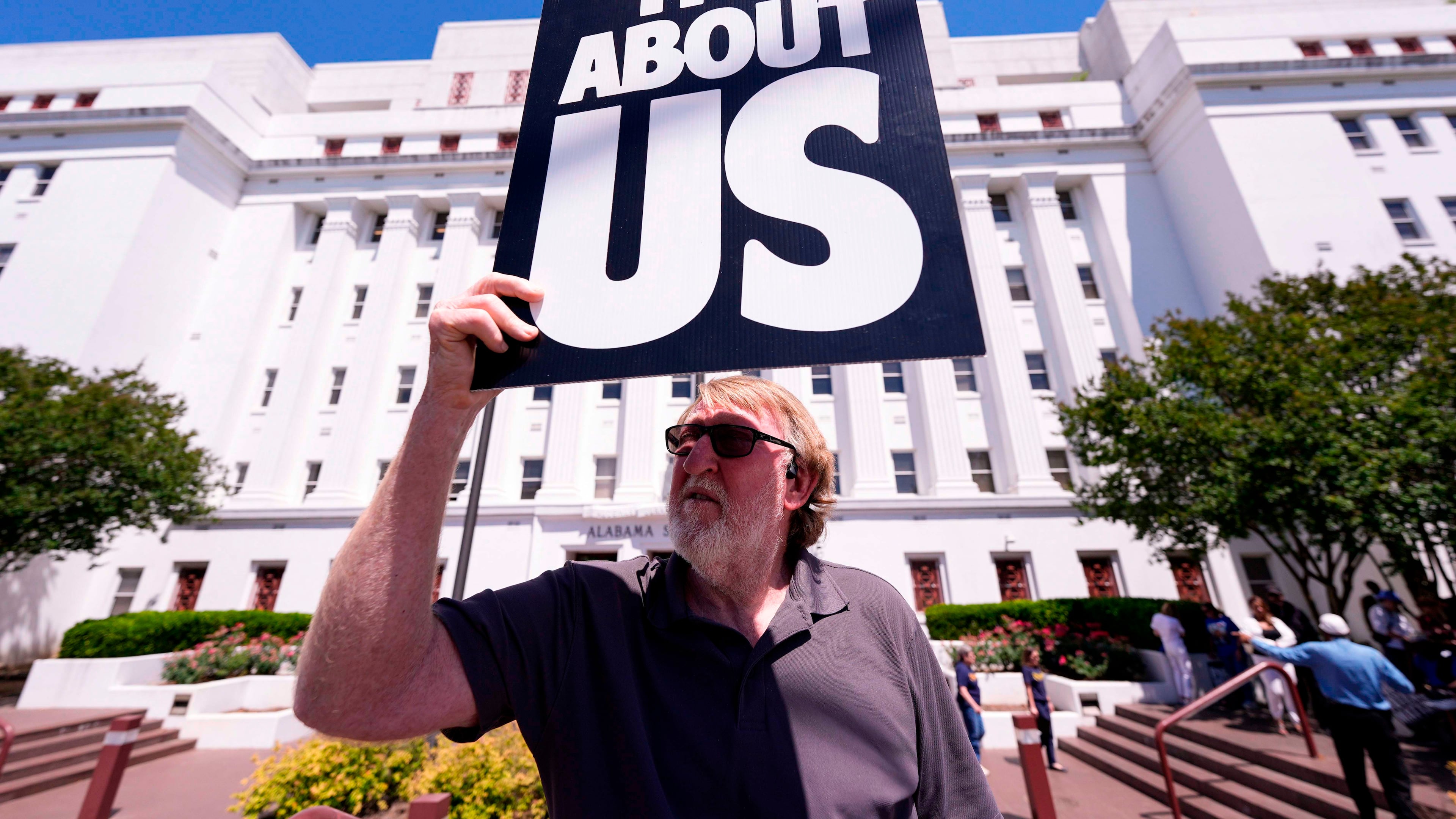
Several hundred people protested on Monday shortly before Alabama's special session began, including some carrying signs declaring “No new map” and “We fight back! Black Voters Matter.”
Opponents of the redistricting session gathered across the street from the historic Alabama Capitol, where the Confederacy was formed in 1861 and where the Rev. Martin Luther King Jr. addressed a crowd of thousands after the 1965 Selma-to-Montgomery voting rights march.
“Much blood, sweat and tears was shed in an effort for us to gain the right to vote,” said Sheyann Webb-Christburg, who as a child participated in the 1965 Bloody Sunday voting rights march in Selma. “In 2026, there are still people who are still not exercising that right to vote, and we are still fighting today, even in an effort to keep our right to vote.”
Republican Gov. Kay Ivey called legislators into a special session to consider contingency plans for special primary elections in hopes the U.S. Supreme Court will let Alabama switch congressional maps ahead of the November midterms.
A three-judge federal panel previously ordered Alabama to use a court-selected map — with a second district that has a substantial number of Black voters — until a new map is drafted after the 2030 Census. Alabama appealed that decision and has asked the court, in light of the Louisiana ruling, to let it revert to a 2023 map drawn by Republican state lawmakers. That map could give Republicans a better chance of winning at least one of the two seats currently held by Black Democratic lawmakers.
“This is the voice of the people,” Alabama House Speaker Nathaniel Ledbetter said while promoting the Republican plan. “We had three judges determine how five million people were supposed to vote, and I don’t think that’s the way.”
At a town hall held by a pro-Democratic group, Doug Jones, a former U.S. senator who is running for governor as a Democrat, said Alabama was “ground zero for voting rights, and we are going to be ground zero to make sure we retain those voting rights.”
Tennessee plan targets Memphis district
Republican Gov. Bill Lee called Tennessee lawmakers into a special session to consider a plan that could break up the state’s lone Democratic-held U.S. House district, centered on the majority-Black city of Memphis. The move comes after pressure from Trump.
The candidate qualifying period in Tennessee ended in March, and the primary election is scheduled for Aug. 6. Lee had said.
Clergy members concerned about plans to split Memphis’ congressional district came together Monday to denounce the move.
“This latest attempt at redistricting is not just about lines on a map. It is about misrepresentation,” said the Rev. Earle Fisher, a pastor at the Abyssinian Missionary Baptist Church and the founder of Up the Vote 901, referring to the Memphis area code. “It’s about whether the voices of Black people in this state will be heard or hidden.”
Advocates urge Louisiana voters to cast ballots
After last week’s Supreme Court decision, Louisiana moved quickly to delay its May 16 congressional primary to allow time for lawmakers to approve new U.S. House districts.
Louisiana state Sen. Caleb Kleinpeter, a Republican who chairs a Senate committee tasked with redistricting, told The Associated Press that his committee plans to hold a public hearing Friday on congressional redistricting. Kleinpeter said lawmakers are still weighing their options, including bills that would eliminate one or both of the state’s two majority-Black Congressional districts
Democrats and civil rights groups have filed several lawsuits challenging the suspension of the state's congressional primary, including another filed Monday in federal court. They are encouraging people in Louisiana — where early voting already is underway — to go ahead and cast votes in the congressional primaries in case courts later allow them to be counted.
A national redistricting battle expands
Legislative voting districts typically are redrawn only once a decade, after a census, to account for population changes. But Trump urged Texas Republicans last year to redraw U.S. House districts to give the party an advantage. Democrats in California responded by doing the same, and then other states joined in.
Florida became the eighth state to enact new House districts ahead of the midterm elections when Republican Gov. Ron DeSantis announced on Monday he had signed a redrawn map passed by the GOP-controlled Legislature. It could help Republicans win as many as four additional House seats. The new map was immediately challenged in court as a partisan gerrymander that violates a Florida constitutional provision against drawing districts that favor one political party over another.
All told, Republicans think they could gain as many as 13 seats from new congressional districts in five states, while Democrats think they could pick up as many as 10 seats from new districts adopted in three states. The newly proposed redistricting in Southern states could add to the Republicans’ tally.
___
Chandler reported from Montgomery, Alabama, and Lieb from Jefferson City, Missouri. Associated Press writers Jack Brook in New Orleans and Nicholas Riccardi in Denver contributed to this report.