The Latest: Trump vows to 'kill' Iranian warships that get near US blockade
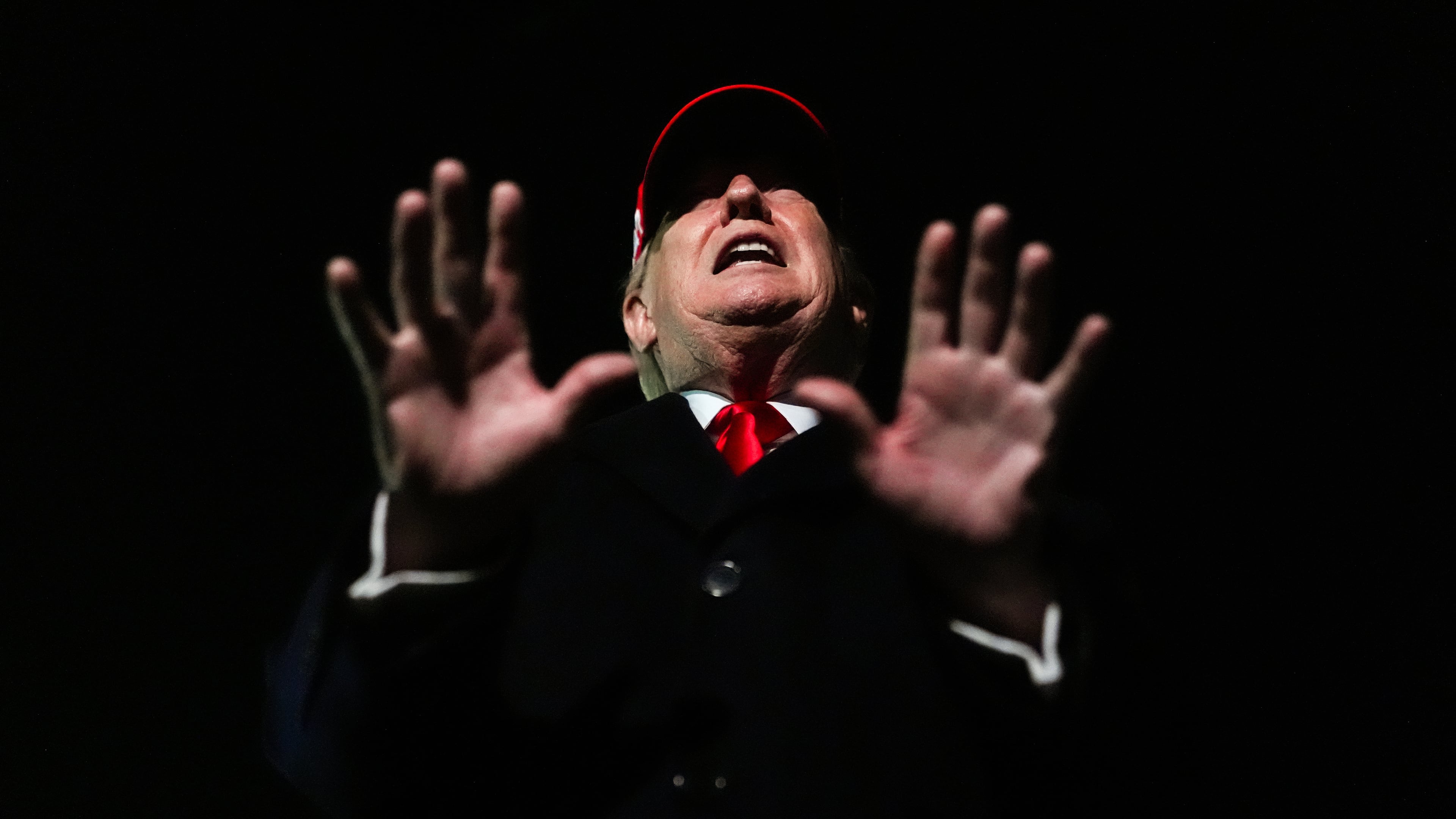
The U.S. military announced it will begin a blockade of all Iranian ports and coastal areas on Monday, tempering U.S. President Donald Trump’s previous vow to entirely block the strategic Strait of Hormuz, as early reports indicated that ships had stopped crossing the waterway.
However, Trump warned on social media that any Iranian warships that come “anywhere close” to the U.S. blockade will be destroyed. It wasn’t clear whether the blockade had started by the designated time of 10 a.m. EDT.
The move sets the stage for a showdown as Iran has responded with threats against ports in the Persian Gulf and the Gulf of Oman. The war, now in its seventh week, has killed thousands of people and shaken global markets. Ceasefire talks between the U.S. and Iran over the weekend ended without an agreement, raising questions about what happens when the current two-week truce expires on April 22.
Meanwhile, the Israeli military is pushing ahead with its air and ground offensive in southern Lebanon, engaging in fierce fighting with Hezbollah militants over a strategic town while the group also fires rockets and drones at northern Israel.
Here is the latest:
Trump confirms that Strait of Hormuz blockade started at 10 am Monday
“We can’t let a country blackmail or extort the world because that’s what they’re doing,” Trump said of Iran.
Trump repeated his argument that safeguarding the strait is of greater concern to other parts of the globe than the United States. The effective closure of the strait since the start of the war, however, impacts global oil prices — which has led to surging gas prices for American motorists and rising inflation on other goods.
“We don’t use this strait,” Trump said. “We have our own oil and gas, much more than we need.”
Trump says he won’t apologize to Pope Leo over Iran war criticisms
Trump is refusing to apologize for sharply criticizing Pope Leo, saying that the pontiff “went public” in his criticisms of the war in Iran, and “I’m just responding.”
In comments to reporters outside the Oval Office, Trump added, “There’s nothing to apologize for” and said of Leo, “He’s wrong.”
Trump was also asked about posting an image of himself as a saint-like healer, which seemed to draw comparisons between himself and Jesus Christ.
The image was posted Sunday night and drew widespread condemnation from Evangelical Christian leaders and has since been taken down.
Trump said, “I did post it.” But he suggested it had something to do with the Red Cross and insisted: “It’s supposed to be me as a doctor making people better.”
Iranian official says US blockade will backfire
Foreign Ministry spokesman Esmaeil Baqaei derided the blockade as a “revenge of choice” against the global economy.
“Is it ever worthwhile to cut off one’s nose to spite one’s face?!” he wrote on the social platform X.
Finland’s president says Iran ‘holds a lot of cards’ with control of Strait of Hormuz
The president of NATO ally Finland says that Iran has the upper hand in the war with Israel and the United States because it controls the strategic Strait of Hormuz, a key shipping lane though which a vast amount of the world’s oil supply transits.
Alexander Stubb said at an event at the Washington-based Brookings Institution think tank that control of the strait has become a “de facto nuclear weapon” for Iran, implicitly suggesting that the Trump administration had created the scenario by starting “a war of choice.”
“Iran holds a lot of the cards right now,” he said. “I’m afraid that that is the reality.”
OPEC oil production tumbled before US threatened blockade
The closure of the strait severely crimped output from OPEC last month. The 12-nation oil cartel, with members in the Middle East, Africa and Venezuela, said Monday that production tumbled by 7.89 million barrels a day in March, to 20.79 million barrels.
“Disruptions to shipping operations in the region raised persistent concerns about regional supply flows, while strong buying of prompt spot market barrels, production cuts, and declarations of force majeure further supported the upward price momentum,” OPEC said.
The organization said demand appears to be steady this year, but cut its forecast for the current quarter, citing the war.
Netanyahu spokeswoman rules out a ceasefire with Hezbollah
Shosh Bedrosian told reporters Monday that Israel’s upcoming talks with Lebanon will focus on disarming Hezbollah and establishing peaceful relations between the two countries.
“We will not discuss a ceasefire with Hezbollah, which continues to carry out indiscriminate attacks against Israel and our civilians,” she said.
Israel and the Lebanese army have both been unable to forcibly disarm Hezbollah.
US-Iran ceasefire is holding despite failed peace talks, Pakistan’s prime minister says
Efforts are underway to resolve the remaining disputes between Washington and Tehran as a two-week ceasefire brokered by Pakistan remains intact, said the country’s prime minister, Shehbaz Sharif.
In televised remarks at a Cabinet meeting, Sharif cautioned that peace efforts take time, citing past agreements such as the Geneva accords.
China says the priority should be to maintain the Iran-US ceasefire
China’s Foreign Minister Wang Yi on Monday said that the current priority should be to maintain the ceasefire between Iran and the United States and prevent conflict from reigniting in the Middle East.
Chinese top diplomat made the comments in a phone conversation with his Pakistani counterpart, Ishaq Dar, according to China’s Xinhua news agency.
Pakistan has been mediating between Iran and the U.S. and was able to bring them to historic, face-to-face talks over the weekend. However, the negotiations ended without an agreement, raising questions about the fate of the two-week truce.
Starmer and Macron to chair a leaders’ meeting on the Strait of Hormuz
British Prime Minister Keir Starmer says world leaders will meet this week to push for a reopening of the Strait of Hormuz.
Starmer said that with French President Emmanuel Macron, “I will convene a summit of leaders this week to drive forward the international effort” to end the conflict and unblock the key oil route.
He told lawmakers in the House of Commons on Monday the strait must reopen with “no conditions” and “no tolls.”
France and the U.K. have in recent weeks been spearheading international efforts to increase pressure on Iran to stop blocking the strait. They have also convened military planning meetings for an operation to provide security for shipping once the conflict ends.
It’s unclear what impact a U.S. blockade of Iran’s ports announced by Trump will have on those plans.
Spanish prime minister Sánchez returns to China seeking deeper ties amid Iran war tensions
It’s Prime Minister Pedro Sánchez’s fourth trip in just over three years to the world’s number two economy.
His visit comes at a complex geopolitical moment as European leaders try to influence an end to the U.S.-Israeli war in Iran, and as Spain’s relationship with the U.S. has been strained by Sánchez’s vocal disapproval of the conflict.
Under Sánchez, Spain has sought to diversify its political relations with the world’s large powers, including Beijing.
On Monday, the prime minister urged China to assume a larger role in a multipolar world, speaking at a university in Beijing a day before he is set to meet with Chinese President Xi Jinping.
Trump says Iranian ships that come ‘anywhere close’ to US blockade will be destroyed
The president made the comment on social media just after the blockade of Iran was expected to begin. Trump said Iran has some “fast attack ships” remaining even after much of its navy was destroyed by U.S. strikes.
“Warning: If any of these ships come anywhere close to our BLOCKADE, they will be immediately ELIMINATED, using the same system of kill that we use against the drug dealers on boats at Sea,” Trump wrote on his Truth Social platform.
He added: “It is quick and brutal.”
Germany’s foreign minister says Strait of Hormuz should remain ‘free and open’
Johann Wadephul told reporters in Berlin on Monday it is “urgently necessary to ... ensure that the Strait of Hormuz, which is, after all, an international maritime route, remains free and open.”
The foreign minister said keeping the strait open “is required by international law, and it must be observed by all; making this a reality must be the goal of us all.”
Wadephul did not further elaborate on Trump’s earlier vow to block the strait. He said Germany is focused on helping to resolve the conflict through diplomacy.
Where things stand on ceasefire talks
The current truce between the U.S. and Iran appears to be holding, with no word on whether negotiations will resume before it expires on April 22.
Pakistan’s foreign minister, Ishaq Dar, said his country will try to facilitate a new round of dialogue between Iran and the U.S. in the coming days. There was no immediate reaction from either side.
A key obstacle seems to be a perception on both sides that they won the war and that each has time on its side.
Hezbollah keeps up fire on northern Israel ahead of Israel-Lebanon talks
As the Israeli military pushed ahead with its air and ground offensive in southern Lebanon, the Lebanese militant group fired more rockets and drones at northern Israel on Monday.
Sirens rang out throughout the day in dozens of Israeli communities along the Lebanese border and in the city of Haifa, some 40 kilometers south, near key energy facilities.
The exchange of fire was taking place a day before Lebanon and Israel, which do not maintain diplomatic relations, were set to begin direct negotiations in the United States for the first time in decades.
The Israeli military said it intercepted more than 10 drones that crossed from Lebanon on Monday. The army says Hezbollah has fired over 250 projectiles since the temporary ceasefire was announced between the U.S., Israel and Iran last week.
Germany’s foreign minister says the world needs US, Israel and Iran to negotiate
Foreign Minister Johann Wadephul welcomed that the current truce is holding and urged the warring parties to keep negotiating for a solution to the conflict.(backslash)
“The whole world is suffering from this. Here, we are engaged in crisis negotiations on the need to lower gasoline and diesel prices. On the African continent, there are now fears of widespread famine this summer because the necessary fertilizers cannot be transported. We have an acute shortage of fossil fuels in large parts of Asia,” he said during a joint press conference Monday with the South African Foreign Minister Ronald Lamola.
Nonetheless, Wadephul said Germany also supports “the American position that we need a credible and robust abandonment of Iran’s pursuit of a nuclear weapon.”
Israeli airstrikes in Lebanon have killed 2,089 people during the latest Hezbollah-Israel war
That’s an increase of 34 deaths since the previous day’s count, according to the Lebanese Health Ministry. It said Monday that among those killed were 252 women, 166 children, and 88 medical workers.
The number of wounded has increased to 6,762 people since the war began on March 2, when Hezbollah fired rockets towards northern Israel in solidarity with Iran, sparking Israel’s ground invasion and aerial bombardment campaign that has displaced over one million people.
Ahead of anticipated direct talks in Washington on Tuesday, the strikes across both sides of the tense frontier and fierce ground fighting in southern Lebanon have intensified.
Iran war’s global energy crisis sharpens China’s advantage in clean tech
While most of Asia is being hit hard, China will likely benefit from war-related fossil fuel disruptions despite being the biggest purchaser of Iranian oil.
China leads the world in battery, solar and electric vehicle exports, and its industries are forecast to face a rise in demand for renewable products.
Chinese industry giants like vehicle-maker BYD and battery-producer CATL are well-positioned to capitalize on growing interest in low-emissions energy products as the world confronts the fragility of fossil fuels. That contrasts with a more fragmented U.S. approach that has promoted fossil fuels.
“China’s approach to energy sector development and geopolitics has been completely validated by the Iran conflict,” said Sam Reynolds with the U.S.-based Institute for Energy Economics and Financial Analysis.
Stage is set for an extraordinary showdown over shipping off Iran’s coast
The U.S. military has vowed to blockade all Iranian ports to pressure Tehran into agreeing to open the crucial Strait of Hormuz and accepting a peace deal. Iran responded with threats on all the ports of U.S. allies in the Persian Gulf and the Gulf of Oman.
The showdown contains serious risks for the global economy and raises the specter that a ceasefire that is currently holding could collapse.
It was not clear if the blockade had started when the designated time of 10 a.m. EDT (2 p.m. GMT) arrived. Minutes earlier, a notice to mariners issued by the United Kingdom Maritime Trade Operations agency, which monitors maritime security, said the restrictions included “the entirety of the Iranian coastline, including ports and energy infrastructure.”
The notice added that transit through the strait “to or from non-Iranian destinations is not reported to be impeded by these measures,” but it added that ships “may encounter military presence” in the strait.
Israeli fire kills 2 Palestinians in Gaza, hospital officials say
They were killed in two separate strikes in southern Gaza Monday, according to health officials at Nasser hospital, where the bodies arrived.
The Israeli military did not immediately respond to a request for comment.
“Where is the truce? Here is the truce,” said Mahmoud al-Faqaawy as he pointed at the motionless body of his cousin, covered in a white burial shroud in a hospital hallway. “They are saying a ceasefire, where is it?“
The Gaza Strip has seen near-daily Israeli fire and strikes since a fragile ceasefire was reached in October, with more than 750 Palestinians killed since then, according to figures from the Hamas-run Gaza Health Ministry.
The Israeli military claims its deadly barrage in Lebanon killed 250 Hezbollah militants
A military official, speaking on condition of anonymity under briefing guidelines, said several senior commanders were among those killed, but provided no further evidence to support the casualty claims.
Lebanon’s Health Ministry said 357 people were killed, including more than 100 women, children and elderly. Based on those figures, Israel’s claims would require nearly all adult male casualties to be Hezbollah fighters.
The strikes were among the most expansive of the war and came as the United States and Iran entered into a ceasefire Israel said didn’t apply in Lebanon. The destruction and large number of civilian casualties drew condemnation from Lebanon and across the globe and prompted Trump to urge Israel to “dial it back.”
The military official said the timing of the April 8 operation was unrelated to the ceasefire. Israel said the next day that it would open peace talks with Lebanon. Negotiations are expected to begin on Tuesday in Washington, while Israel presses ahead with aerial and ground operations against Hezbollah.
— By Sam Metz
Oil prices hit $100 again as US prepares to blockade Iran's ports
Oil prices have jumped to more than $100 a barrel again and Wall Street appears to be following global markets lower as the U.S. military prepared to blockade traffic to and from Iranian ports. In the Strait of Hormuz, most shipping has been stalled since the start of the war.
Futures for the S&P 500 and Dow Jones Industrial Average each fell 0.7% before the opening bell. Nasdaq futures slid 1%.
Trump announced the planned blockade after U.S.-Iran ceasefire talks in Pakistan ended without an agreement, and the U.S. military said the blockade involving all Iranian ports would begin Monday at 10 a.m. EDT.
Iran immediately responded with threats on all ports in the Persian Gulf and the Gulf of Oman.
Iranian envoy says Tehran open to US talks if no ‘unlawful demands’
Iran’s ambassador to India said Tehran is open to talks with the United States if Washington refrains from making “unlawful demands.”
Mohammad Fathali was referring to talks held in Islamabad and said the main sticking points were Iran’s nuclear program, war reparations and sanctions relief.
Asked about the prospects for future negotiations, Fathali told reporters in New Delhi, “If they (the U.S.) accept our conditions, it is possible.”
Russia evacuates almost all of its personnel from Iran’s nuclear power plant
The chief of Russia’s state nuclear corporation said Monday it was pulling nearly all of its personnel from Iran’s Russia-built nuclear power plant.
Rosatom chief Alexei Likhachev said 108 workers were leaving the power plant in Bushehr, and only 20 will stay behind to keep watch of the equipment at the plant where Russia is building two more nuclear reactors. Likhachev said that Russia has coordinated the workers’ evacuation with the Iranian authorities. Since the start of the war, Russia has repeatedly voiced concern about projectiles hitting the territory of the plant, some of them landing near its nuclear reactor.
Russia had planned the near complete evacuation long before the ceasefire, removing about 600 personnel in several waves in March and earlier this month.
Spain’s government calls Trump’s naval blockade threat ‘senseless’
Spain’s Defense Minister Margarita Robles condemned Trump’s threatened shipping blockade, saying it “makes no sense.”
“Since the war began, everything has been senseless,” Robles told Spanish broadcaster TVE on Monday. “Nobody knows the reason why this war started, a war that was supposed to be quick. This is just another episode of the downward spiral we have been dragged into, and that they have tried to drag the entire world into.”
Spain under Prime Minister Pedro Sánchez has been Europe’s loudest critic of the U.S. and Israel’s military actions in the Middle East. The NATO member said earlier this month that its airspace was closed to the U.S. planes being used in Iran, and disallowed the U.S. from utilizing jointly operated military bases in southern Spain in the war effort.
Netanyahu says fighting to continue in Lebanon
Prime Minister Benjamin Netanyahu said fighting is continuing in Lebanon on Monday, focused on the Bint Jbeil area, a strategic point that has been the site of fierce battles between Israel and Hezbollah over the years.
Speaking at a cabinet meeting, Netanyahu said that Israel’s military is expanding beyond the five hilltops it controlled in southern Lebanon since the ceasefire with Hezbollah in 2024 towards a “solid, deeper security zone, which both prevents the danger of invasion and keeps the threat of terrorism away.”
Previously, Netanyahu said Israel wants to control the territory 8-10 kilometers (5-6 miles) from the border in southern Lebanon to remove the threat of short-range rockets or anti-tank missiles targeting Israeli cities and towns on the border.
Iran and Qatari foreign ministers discuss failed Islamabad talks
Iran’s Foreign Minister Abbas Araghchi spoke by phone with his Qatari counterpart Sheikh Mohammed bin Abdulrahman Al Thani.
The ministers discussed the Islamabad talks between Iran and the U.S. which failed to achieve a deal, according to the Iranian foreign ministry.
Iran’s Quds Force chief says US will leave Mideast empty-handed
The U.S. will leave the Middle East without any achievements, Iranian media reported on Monday, citing Brig. Gen. Esmail Qaani, commander of the powerful elite Quds Force.
He noted that the U.S. and Israel should remember how they left Yemen likewise empty-handed in a prior campaign, according to the Tasnim and Mehr semiofficial news agencies.
Qaani suggested that the Iranian-backed Houthi rebels could close the Bab el-Mandeb Strait as they did between 2023 and 2025. The attacks in Bab el-Mandeb prompted the U.S. to launch an air campaign against the Houthis. The rebels stopped attacking ships in the Red Sea after a deal with the Trump administration.
EU chief says bloc’s fuel bill is over $25B higher due to Iran war
The European Union’s fuel bill has risen by more than $25 billion since the United States and Israel launched their war on Iran and is likely to mount, European Commission President Ursula von der Leyen said Monday.
“Our bill for fossil fuel imports has increased by over 22 billion euros – 44 days, 22 billion euros,” she said, noting that “the disruption of energy supplies will continue for some time to come.”
Von der Leyen recommended that EU governments start coordinating how they use their oil and natural gas supplies to avoid adding pressure on the market. She proposed easing restrictions on state aid rules while the crisis lasts to help protect vulnerable consumers and sectors from high energy prices.
Trump is ‘bluffing’ over Hormuz threat, Iranian security official says
A U.S. threat to block the Strait of Hormuz is “more bluffing than reality,” according to Ebrahim Rezaei, a spokesperson for the Iranian parliament’s National Security Commission.
Rezaei warned that Tehran is prepared to respond if the situation escalates militarily.
“It will make the current situation (Trump) is in more complicated and will further agitate the market he is angry about, and we may also reveal other cards that we have not used in the game,” Rezaei said in a post on X.
Netanyahu spoke with Vance after Pakistan talks ended
Israel’s Prime Minister Benjamin Netanyahu said Monday that he has spoken with U.S. Vice President JD Vance about the negotiations in Pakistan.
Netanyahu said the pair spoke Sunday while Vance was on a plane returning from the negotiations in Islamabad.
Israel supports Trump’s “strong stance to impose a naval blockade on Iran,” Netanyahu said, and backs the U.S. position that Iran must remove all of its enriched nuclear material and refrain from any more enrichment within Iran for several decades.
Maritime expert previews potential conflict in Strait of Hormuz
The coming days could be a stress test for the rules that are supposed to govern the Strait of Hormuz, according to Sal Mercogliano, a maritime historian at Campbell University.
It remains unclear, he added, how the U.S. would track, intercept and board vessels moving from Iranian ports through the strait.
Any U.S. or Iranian attempt to choke off the waterway would run counter to the principle of freedom of navigation, said Mercogliano, who has testified before the U.S. Senate on commercial shipping and written for the U.S. Naval Institute.
“We are challenging the concept of freedom of the seas,” Mercogliano said on his “What’s Going on With Shipping?” podcast, which has more than 600,000 followers on YouTube.


