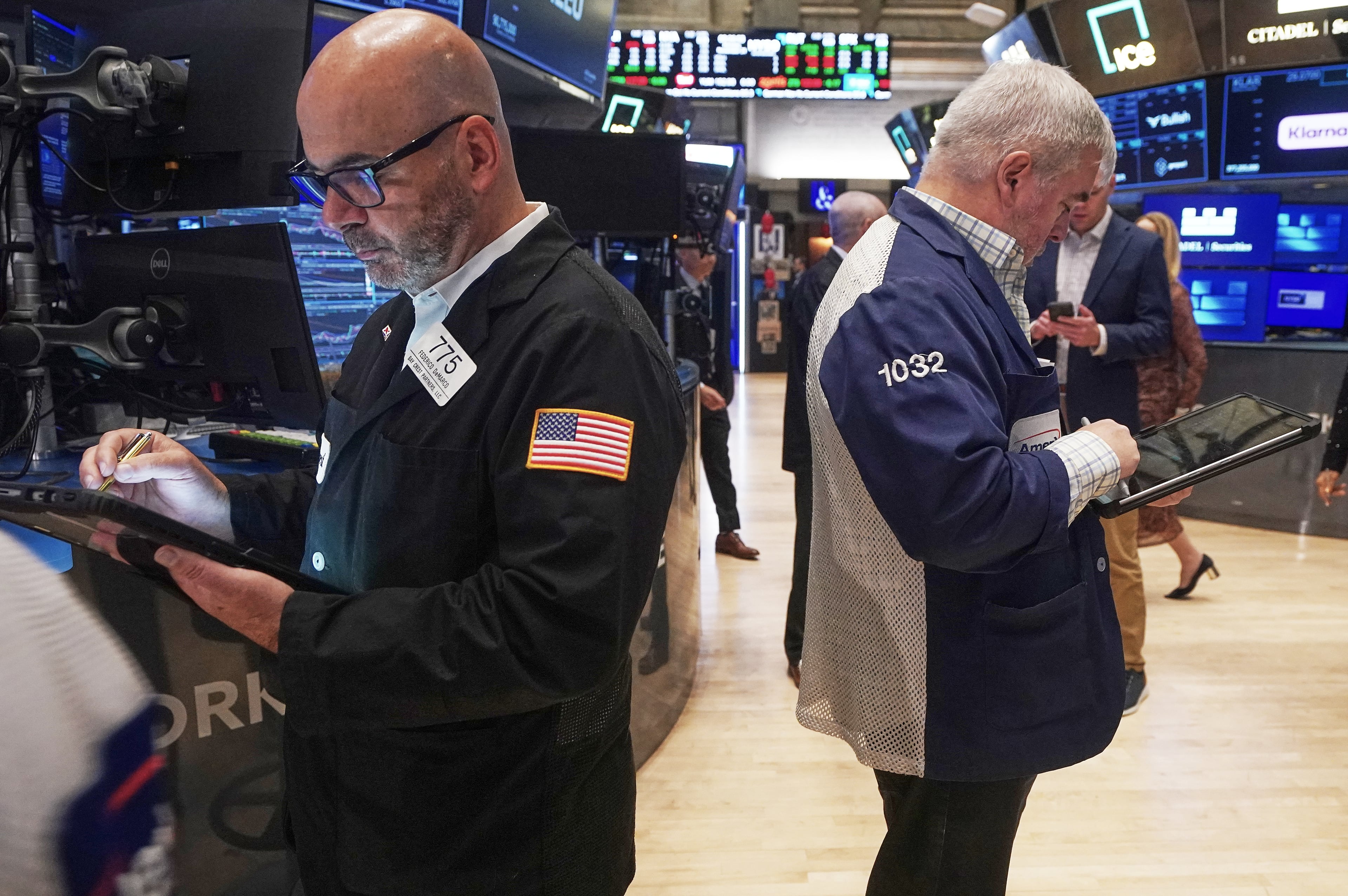
US stock futures dip as crypto takes another beating and oil prices surge

BANGKOK (AP) — Wall Street was poised to give back some of last week's gains when markets open Monday, while oil prices surged and anything related to cryptocurrency sank as investors appeared to distance themselves from risk.
Futures for the S&P 500 fell 0.8% before the opening bell, while futures for the Dow Jones Industrial Average lost 0.5%. Nasdaq futures slipped 1%.
Investors continued to bail on bitcoin, sending it down another 6% to $85,723, adding to its recent slump. The original crypto currency, which bolted to record highs near $125,000 in early October, has lost nearly a third of its value since. It was down more than 17% in November alone.
Anything related to bitcoin was dragged down with it. The mobile trading platform Robin Hood tumbled 3.5% while Coinbase lost 4.2%.
Bitcoin investor Strategy, formerly known as MicroStrategy, slid 5.7%.
At the same time, safety bets like gold and silver rose early Monday.
European aerospace giant Airbus said Monday that most of its fleet of 6,000 A320 passenger jets have received an update after a weekend software glitch that could have affected flight controls. Travelers had faced minor disruptions heading into the weekend as airlines around the world scrambled to push the software updates out after Airbus warned of the problem Friday, one of the busiest travel days of the year.
Every sector was in the red early Monday, with the exception of energy. U.S. benchmark crude oil gained $1.14 to $59.69 per barrel. Brent crude, the international standard, added $1.14 to $63.52 per barrel.
Most energy-related companies were up modestly in premarket.
Consumer spending during the Black Friday and Cyber Monday retailing bonanza was expected to exceed expectations, despite uncertainty over the outlook for the U.S. economy.
Stocks rallied last week on hopes for another Federal Reserve rate cut after swooning in mid-November as investors fretted over the durability of the frenzy around artificial intelligence.
The U.S. central bank, which has already cut rates twice this year in hopes of shoring up the slowing job market, is facing an increasingly difficult decision on interest rates as inflation rises and the job market slows. Cutting interest rates further could help support the economy as employment weakens, but it could also fuel inflation.
The minutes of the Fed’s most recent meeting in October indicated there are likely to be strong divisions among policymakers about the Fed’s next step.
Elsewhere, Tokyo’s benchmark falling nearly 2% after the Bank of Japan's governor hinted at a possible interest rate hike. The Nikkei 225 declined 1.9% to 49,303.28.
Japan's benchmark interest rate, at 0.5%, has remained near zero for years as its leaders struggled to spur faster economic growth and counter deflation. With inflation holding steady above its target of about 2%, the BOJ is caught between raising rates to counter rising prices and a weaker currency, and supporting easy credit to keep businesses borrowing and consumers spending.
Regional reports on manufacturing activity are being closely watched for signs of how U.S. President Donald Trump's higher tariffs are affecting Asian economies.
China’s factory activity contracted for the eighth straight month in November, according to an official survey released Sunday, underscoring challenges for the country’s economy despite an extension of the trade truce between the U.S. and China.
But Hong Kong's Hang Seng climbed 0.7% to 26,033.26, while the Shanghai Composite index gained 0.7% to 3,914.01.
In Seoul, the Kospi slipped 0.2% to 3,920.37. Australia's S&P/ASX 200 declined 0.6% to 8,565.20.
Taiwan's Taiex lost 1% and the Sensex in India shed 0.1%.
Across Asia, PMI readings reflected weak factory activity for November, though exports from the region have been rebounding in recent months, Shivaan Tandon, Asia economist for Capital Economics, said in a commentary.
In Europe at midday, Germany’s DAX lost 1.5%, while the CAC 40 in Paris gave back 0.9%. Britain’s FTSE 100 edged 0.2% lower.