The feds, a flipper and a Russian’s decaying mansion: An Atlanta real estate saga

The abandoned mansion on the corner was a thorn in Colin Rupp’s side long before it landed in the crossfire of economic war with Russia.
Before it drew the attention of U.S. Treasury Department investigators and before it elicited the biggest sanctions penalty against an American in a generation, it was just the derelict house he saw from his bedroom window, the one neighbors constantly complained to him about.
It had been a headache for as long as Rupp had been the president of his North Fulton homeowners association.
No one had lived there in a decade or more. The place reeked of mold. The window frames were so rotten you could practically see inside. Teens would sneak in to hang out by the empty pool. In an Alpharetta neighborhood chock full of million-dollar homes, it was doing the property values no favors.
“It looked like an old haunted house,” Rupp said.
The mansion’s owner, it turned out, had left Georgia behind. A Russian native, she’d had a whirlwind romance with a man said to be one of Russian President Vladimir Putin’s boyhood friends. Now, she lived a jet-setting lifestyle in Moscow, Monaco and the south of France.
Rupp and his neighbors badly wanted someone to come fix up the house, but after Russia invaded Ukraine in 2022, it was against the law to do so. The house’s owner, a woman named Karina Rotenberg, was one of the Russian elites sanctioned by the U.S. government as payback for their country’s aggression.
Her assets had been instantly frozen. The Treasury Department had even filed a public notice at the Fulton County Courthouse marking her mansion off-limits.
Rupp didn’t know about all that. All he knew is that one day in 2023, a work truck pulled up.
He walked over to see what was going on. The man he met, a house flipper, said he’d just bought the place.
Rupp was witnessing a stunning breakdown of the powerful economic sanctions the U.S. uses to bring its adversaries to heel. The story of how the house changed hands reveals how a crucial foreign policy tool can be undermined by bureaucratic omissions at the county courthouse and simple oversights in real estate law offices.
At the center of the story was another immigrant, a man from India named Sahib Arora, who saw the promise of prosperity in property others had cast off.
Opportunity on the courthouse steps
Arora had come to metro Atlanta as a teen, sent to live with his aunt and uncle and get an American education.
He’d admired America’s notion of “in God we trust” — the faith that hustle and effort would be rewarded with opportunity. He believed in the American system and its sense of fairness. And while he’d returned to India for a medical degree, he came to believe that his opportunity was waiting in Georgia on the courthouse steps.
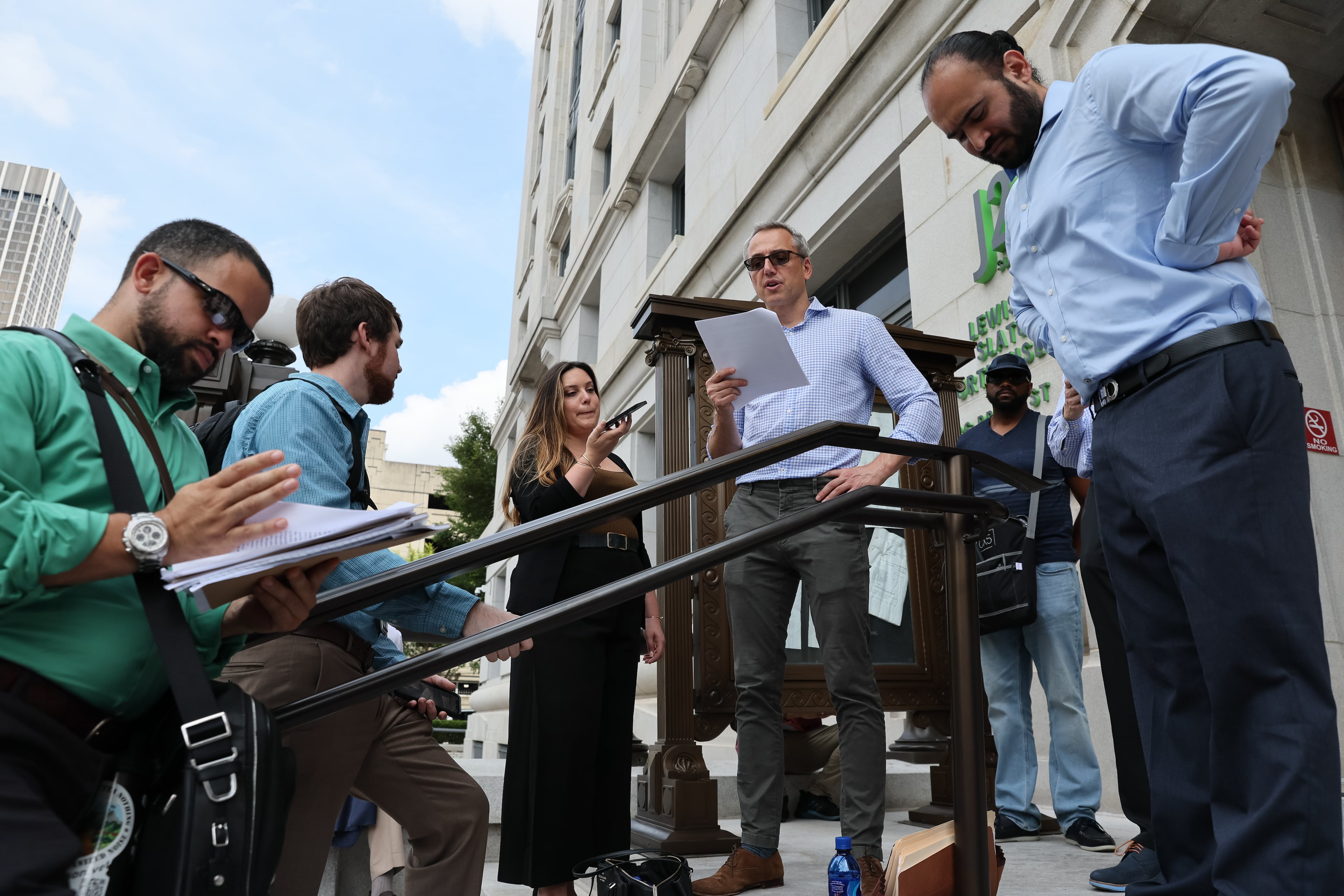
One morning each month, the state’s courthouses transform into hives of speculation. When borrowers in Georgia default on their mortgages, banks have a brief window to auction their properties in a process that is at once chaotic and archaic. They send a representative to read long legal descriptions from the courthouse steps and call out for interested buyers. One recent morning in downtown Atlanta, four foreclosure auctions took place simultaneously in front of the Fulton courthouse.
Arora felt he could see potential in these scrums where others did not. He said he found strong investment returns all over: in a parking lot by the airport, a medical office in Tucker, a vacant lot off Jimmy Carter Boulevard.
Arora had been raised in a family of entrepreneurs. In India, court records show, his father and uncle owned a hotel, an event venue and a farm, among other business ventures.
In the U.S., records show, Arora and his family developed similarly wide-ranging business interests. Among their holdings were a liquor store in Gainesville, a shopping center in Milledgeville and a car wash in Calhoun.
And around 2018, Arora said, he and his brother Vinny Singh expanded into the business of flipping houses. They looked for modest starter homes around metro Atlanta, got loans to renovate them, rented some and sold the rest.
But Arora harbored bigger aspirations: In an interview, he said he dreamed of their real estate business, King Holdings LLC, becoming a Fortune 500 company. When downtown Atlanta’s iconic Peachtree Center office towers hit the auction block in 2022, he decided to place a bid. (The lender decided to keep the property.)
So perhaps it’s no surprise that in 2023, Arora and Singh decided to take a swing at North Fulton’s luxury market, buying a mansion in Alpharetta sight unseen.
Meeting in Monaco
Karina Rotenberg had been living for years in a world marked by tensions between the U.S. and Russia.
Born in the former Soviet Union, she told the Russian-language edition of Tatler magazine she came to the U.S. in 1993 when Russia was in the throes of a violent constitutional crisis. Her father abruptly told her to pack her things, she recalled. She said she didn’t have a chance to say goodbye to her classmates.
Court records show she was granted asylum in the U.S. as a teenager a few years later. Subsequently, in Georgia, she’d acquired a real estate license, married an American and built a life with the trappings of success: a Buckhead condominium and an Alpharetta mansion, two Mercedes in the driveway.
Then, in 2008, she and her husband split a few years after they married. In the wake of the breakup, she told Tatler, she traveled to Monaco to see her favorite soccer team and she found herself swept up with a group of Russians. One of them was Boris Rotenberg, a man 21 years her senior who said he’d seen her in a dream.
Karina didn’t know who he was, she told Tatler. But Boris was on a path to become one of the wealthiest people alive. He and his brother owned a company that constructed gas pipelines in Russia and would later build facilities for the 2014 Winter Olympics in Sochi.
When Congress asked the Treasury Department in 2017 for a list of Russia’s oligarchs, Boris Rotenberg made the cut. He has made the Forbes billionaires list several years running, with an estimated net worth of $1.3 billion.

Soon after she finalized her divorce in Georgia, she and Boris married in 2009. And though she would ultimately keep the Alpharetta house, Boris bought another large house on nearby Lake Windward.
Boris Rotenberg and his brother, Arkady, had close ties to Putin. As boys, they practiced judo together, according to Bloomberg. And when the U.S. imposed sanctions on Putin’s inner circle after Russia’s 2014 invasion of Crimea, Boris was on the list.
In March 2022, just one week after Russia launched its full-scale invasion of Ukraine, Karina Rotenberg was sanctioned too. The couple’s American assets were locked down, including her house in Alpharetta.
Cobwebs
While Rotenberg led a new life abroad, her HOA was pursuing her back in Georgia.
Rupp had called the city of Alpharetta asking for help with the increasingly derelict mansion, but he recalled being told the city couldn’t intervene unless the structure was unsafe.
The HOA had even sued Rotenberg in 2018 for thousands of dollars in unpaid assessments. But when it tried to serve her with papers, she was nowhere to be found.
A neighbor at her Buckhead condo said she hadn’t seen anyone go in or out in at least a year. The process server wrote that the doors to her mansion were covered in cobwebs, “as if no one has use (sic) the doors in months.”
Nevertheless, she appears to have stayed current on the house’s mortgage payments until she was sanctioned.
There is no public record of exactly when or why she stopped paying, but the house didn’t fall into foreclosure until late 2022, after the sanctions were announced. By law, she was locked out of the U.S. banking system.
Reached in December by The Atlanta Journal-Constitution, Karina Rotenberg wrote that “while I have a lot to say on this matter, I will let my lawyers do the talking for me.”
Her lawyers did not respond to the AJC’s questions.
Fox, Gapchuk and Rotenberg
When the Treasury Department announces new sanctions, it lists all kinds of information about the people they are targeting: names and aliases, birthdays and passport numbers.
Karina Rotenberg was no different. The department listed at least seven different versions of her name, plus translations in Cyrillic. It gave her maiden name and her married names, making clear that Karina Rotenberg was the same person as Karina Gapchuk and Karina Fox.
Several months later, Treasury’s sanctions-enforcement arm, the Office of Foreign Assets Control, went a step further: It identified the properties she owned in metro Atlanta and sent a letter in September 2022 pointing them out to Fulton County officials.
It asked the Fulton County Clerk of Superior and Magistrate Courts to publish the notice, which contained a warning: “Blocked property may not be transferred, sold, or otherwise dealt in without authorization by OFAC.” Violators would risk a steep penalty or even prison time.
The clerk’s office logged the letter into Georgia’s massive database of property records, with a catch: While the notice listed three versions of her name, it was only indexed under the name Karina Rotenberg. Meanwhile, the mansion was listed under Rotenberg’s former name, Karina Fox.
A researcher who knew her name had changed could easily find the document. Everyone else would be out of luck.
The sanctions should have stopped anything from happening to the house in Alpharetta. Technically, it was even against the law to do maintenance work. But in late 2022, two foreclosure auctions were scheduled.
It’s unclear if Rotenberg’s lenders knew about the sanctions. U.S. Bank and Wilmington Trust, which controlled her loans, declined to comment on the case. The banks’ mortgage servicer, Select Portfolio Servicing, did not respond to requests for comment. Neither did two Georgia law firms linked to the transactions, Richard B. Maner P.C. and McCalla Raymer Leibert Peirce.
Deborah Bailey, a Roswell real estate lawyer who sits on the board of the American Land Title Association, said banks’ review processes typically only include limited searches in foreclosure cases. It’s possible they didn’t think to search OFAC’s sanctions list, she said.
Once it went up for sale on the courthouse steps, the house kept slipping through the cracks.
‘Nobody knew’
The mansion’s final foreclosure auction was previewed for weeks in newspaper legal ads and real estate listings.
When Arora saw them, he thought it sounded like a fairly safe bet. It was unlike the starter homes he and Singh usually flipped, with seven bedrooms, six full baths and a pool. And they couldn’t so much as lay eyes on the house because it was in a gated community.
Instead, their research was limited to pulling property records for the house, Singh said. They’d wanted to make sure liens wouldn’t follow them if they won the auction, he said, and everything looked fine. They didn’t come across Treasury’s warning.
Other investors were apparently not deterred either. When auction day finally arrived in January 2023, Arora said King Holdings had to fend off several bidders to win the house. Their final bid of $922,000 prevailed.

Treasury’s notice seemed to evade everyone. After King Holdings bought the property, two more lenders, AmeriFirst Financial and United Wholesale Mortgage, lent money against the property. And two more Atlanta-area law firms cleared the loans to close.
Vanessa Goggans, a partner at Goggans, Stutzman, Hudson, Wilson & Mize, which handled the AmeriFirst loan, said her firm’s title examiner was hamstrung by the way the Fulton clerk’s office logged the document.
In property records, the house belonged to Karina Fox. Treasury’s warning didn’t come up under that name.
“There’s no way they could have found it,” Goggans said. “Nobody knew about this blocking notice.”
The law firm Ohlson & Medlock, which handled the other transaction, declined to comment. United Wholesale Mortgage did not respond to requests for comment, and AmeriFirst has since gone out of business.
In a statement, Fulton clerk’s office spokeswoman Natasha Cole Shepherd said the agency had cooperated with the Treasury Department by filing the notice in the county’s property records. Shepherd said that as a practice, staffers record “the names of the relevant parties” for all the documents they receive.
She did not respond to questions about why Karina Rotenberg’s previous names were not included.
‘Who is this guy?’
In Arora’s telling, he was back at the courthouse when he first heard from Treasury’s OFAC investigator in April 2023.
Months had passed since King Holdings won the auction. The company had paid for the property, and it had the keys to the mansion.
He had also learned that the mansion had not been a good bet. It needed hundreds of thousands of dollars of work. Windows were broken, there were holes in the roof, and the floor joists were damaged.
Yet now, in the din of activity, the federal investigator called his cellphone and told him there was a problem: The property had been frozen by the U.S. government. It shouldn’t have been sold. Arora said his tone seemed threatening, like he was being accused of a crime. Arora said he initially wondered if it was a spam call.
“I’m like, who is this guy calling me?” Arora said, adding: “I didn’t even know what OFAC is.”
The agency says the investigator warned Arora that the government still considered the property to be blocked. According to OFAC, the officer said King Holdings needed a special license to work on the house. Federal regulations say that transactions involving frozen property are considered “null and void.”
But in an interview for this story, Arora said he went to a local real estate attorney, who he said told him King Holdings was the property’s rightful owner.
To Arora’s mind, Georgia law was simple. His company held title to the house. If the U.S. government had wanted to block the property, he thought, it shouldn’t have let the sale go through.
OFAC did not agree.
Federal intervention
OFAC published a long news release in November detailing how King Holdings pushed forward with its plans.
The agency singled out a man it called only “U.S. Person-1” for defying its orders. Arora says the document is about him.
The agency says that days after the federal investigator first called, King Holdings took out a renovation loan in April 2023 without applying for the required license.
It says the company finished its renovations and signed a contract that December to sell the house without telling the buyer about the sanctions issue.
It says it sent King Holdings a cease-and-desist order and a subpoena while the sale was pending, and it says Arora went ahead anyway to close in March 2024. The agency says the company’s subpoena response, provided in the weeks before closing, did not mention the pending sale.
To Arora and Singh, King Holdings was simply exercising its property rights. The company was in the business of buying and selling houses. It was out hundreds of thousands of dollars, and it only had a year to pay off its renovation loan. Once they were under contract, Singh said, walking away might risk a lawsuit.
OFAC took a dim view of his argument. In early 2025, well after the sale had closed, it sent a formal notice detailing why investigators believed Arora had violated U.S. sanctions. The notice said OFAC intended to pursue the biggest penalty it could given the value of the real estate transactions associated with the mansion: $4,677,552.
It was at this moment, Arora said, that he realized he had a serious problem. The company hired an attorney with sanctions expertise, he said, and they proposed settling the case with a modest penalty: $5,000 each for himself and King Holdings. They argued that if sophisticated financial institutions and title companies didn’t catch the sanctions issue, it was unfair to drop the hammer on a small house-flipping business.
OFAC was not swayed, even after Arora and King Holdings boosted their offer to $25,000 apiece. Announcing the maximum penalty in November, the agency said the violations were “egregious” and “willful” and that the steps Arora took marked a pattern.
In a series of interviews, Arora expressed frustration with the size of the penalty. He said it was unfair to target a small business instead of the banks. He said Treasury’s announcement had trashed the company’s reputation and jeopardized its ability to get loans. He said he hoped to work something out or have a judge review the case.
“It’s just absurd,” he said two days after the penalty was announced, adding: “How are we going to earn that much to pay that much?”
Because of the condition of the house, King Holdings hadn’t even made money on the deal, he said: All told, he estimated the company lost some $50,000, not counting legal fees.
The Treasury Department and OFAC declined to comment.
It is uncommon for the agency to penalize an individual American. Its website lists only eight penalties against individuals since 2020, according to an AJC review of its enforcement actions. No individual American has received a bigger penalty since at least 2003, records show.
In recent years, they have included the owner of a real estate firm who helped two sanctioned Russians park their luxury condos in other people’s names, a hotel developer who snuck money into Iran, and an attorney who managed a trust controlled by a Russian oligarch.
Arora’s pending penalty was larger than the other seven combined.
For sale
King Holdings had aimed high when it put the house on the market in 2023.
The company asked almost $2.5 million for what it described as an “exquisite” home with ample space to entertain. The home had a library, a gym, a home theater, a wine cellar, a bar and a billiards room.
It sat on the market for months, the asking price slowly dropped, and finally the listing expired. Arora said they ultimately accepted an off-market offer for a little over $1.4 million.
Within a few weeks of closing, records show, the new owners found out about the home’s legal complications.
They hired a white-shoe New York law firm with a partner who once worked at OFAC, records show, and within weeks, the agency granted them a license. (The owners declined to comment, saying their family wanted to “put the matter behind us.”)
The license blessed the purchase and said the family could do all the things homebuyers expect to do: pay utility bills, make renovations and keep the place up.
It was set to expire in April, but just a few weeks before it ran out, OFAC made another announcement. Karina Rotenberg was being dropped from the sanctions list.
As far as the government was concerned, the mansion was back to being just another luxury home in the suburbs, far from the front lines of international conflict.
Freelance journalist John Dell’Osso and AJC investigations editor Brad Schrade contributed reporting to this story.
About the Author