Planting a flag: East Lake mural pays homage to community organizer

For muralist Chastain “Chaz” Clark, brick is not just a blank canvas. He uses brick to tell a story about Atlanta, the city he grew up in.
It’s a story about history, identity and power.
“Bricks are important for a lot of reasons in Atlanta and in the South. They are part of what I would call our collective cultural psyche,” said Clark, who recently created a mural on the side of Legacy at East Lake, an eight-story building with almost 150 apartments for older low-income residents.
“You can’t look at a brick in the South, especially in Atlanta, without thinking about the labor associated with it, and specifically the exploited labor of Black people.”
After the Civil War and emancipation, freed Black people became slaves by another name, forced to work as masons under brutal, deadly conditions.
It was on the back of Black convicts, arrested under Georgia’s discriminatory “Black Codes,” that Chattahoochee Brick Company, owned by former Atlanta Mayor James W. English, made bricks in the 1800s. Those bricks became the building blocks for many of the city’s landmarks, including the Georgia State Capitol.
Residents at the Legacy at East Lake told Clark the brick in the building was important to them too. They asked the artist to preserve it in the mural on the side of the high-rise, which features a multicolored patchwork of an African quilt.

To the quilt’s right is a faceless matriarch with black hair, exposed brick where her face should be. Clark borrowed from classical art, and specifically a 14th-century Giotto di Bondone painting of Madonna holding the baby Jesus.
Eva Davis, well-known in Atlanta in the 1990s for her fierce advocacy for people living at the infamous East Lake Meadows public housing complex, also inspired the design.
“Speaking with residents, and particularly older women, and then thinking about some of the more famous icons in this neighborhood, Eva Davis is the first one that jumps out. She was instrumental in organizing and caring for this community,” said Clark, a NASCAR fan and self-described Atlanta “fanatic,” who comes from a family of attorneys.
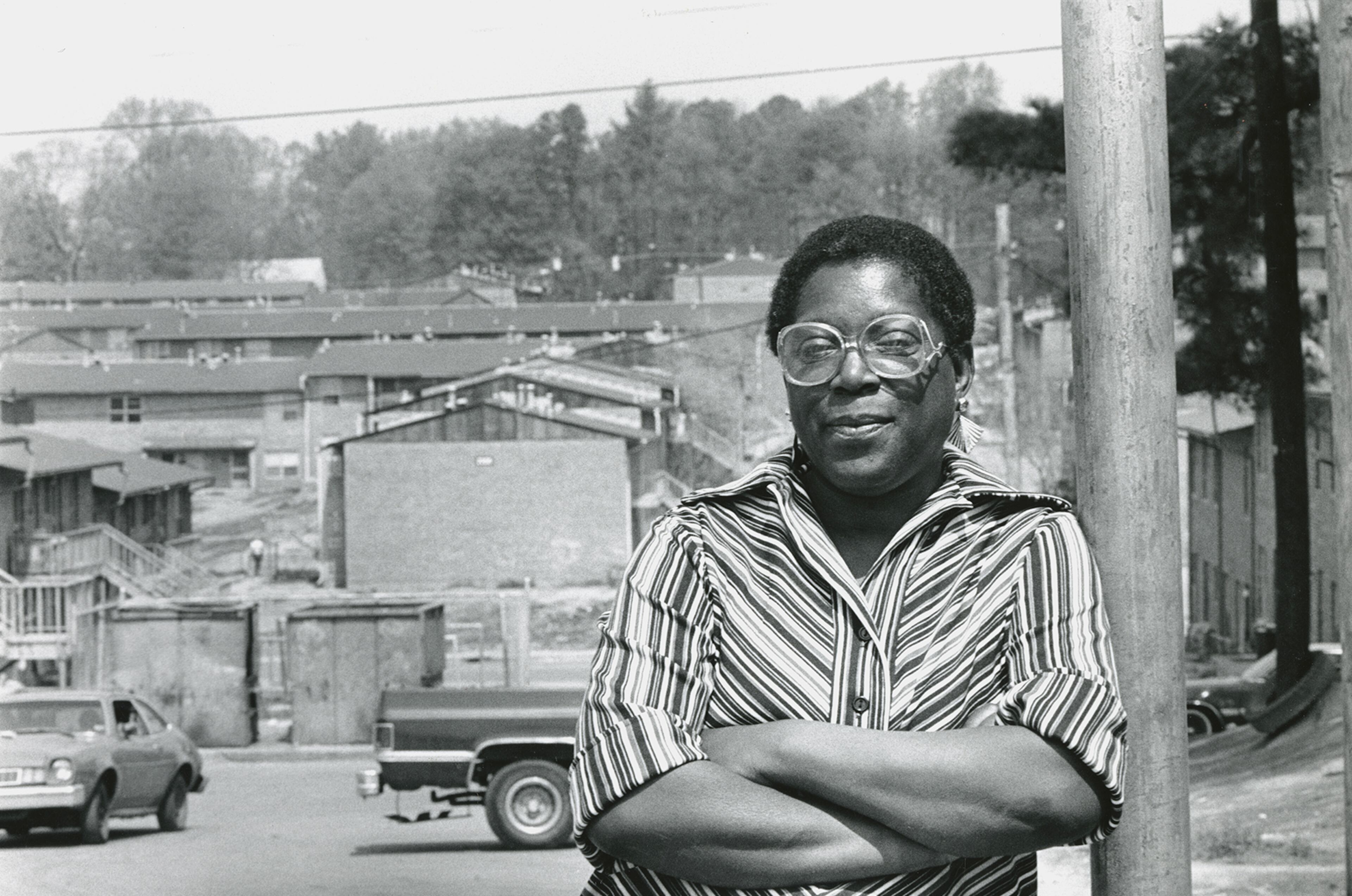
Like other decaying public housing projects in Atlanta, the city eventually reduced East Lake Meadows to rubble in the 1990s.
Over the decades, East Lake Meadows, which opened in 1970, became a cautionary tale about redlining and systemic racism, poverty, and whom Atlanta deemed worthy of safe and secure housing.
At the eastern edge of the city, residents saw the crime-ridden and poorly constructed complex crumble before their eyes, earning it the nickname “Little Vietnam.”
In the backdrop, a crack cocaine epidemic swept across Atlanta, devastating East Lake Meadows and entire communities. Davis lived at the complex and gave voice to residents, as well as fighting for a new mixed-income development, Villages of East Lake, to take its place.
Originally built as the East Lake Highrise, the Legacy on East Lake was also part of East Lake Meadows but survived the city’s wrecking ball. This year, Atlanta-based developer Columbia Residential partnered with the city’s housing authority to reimagine the building on Eva Davis Way and preserve the apartments of affordable housing for older residents.
Columbia commissioned Clark to create the mural in the summer and he only had about four weeks to finish it from mid-September to mid-October. Residents helped him realize his vision. After meeting with dozens of residents, central motifs of bricks, quilts and hands emerged, which he incorporated into the final design.

At times, the work was painstaking, interrupted by searing heat or the threat of a thunderstorm.
It was also a little scary.
Even though Clark had used a boom lift many times in the past, this was the first time he had worked on a project of this scale. He painted alone, suspended in midair in a basket attached to an articulating boom arm, controlling the lift from inside.
“I don’t care how much experience you got, you get up 80 feet and the wind picks up — it’s hairy,” he said.

Clark had a diverse playlist at his fingertips, including Nina Simone’s album “Pastel Blues,” the sounds of Ray Charles’ country-R&B fusion in “Together Again,” and “Getting Killed” by the indie rock band Geese.
On his phone he kept a copy of the mural that he referred to as he painted, with printed copies close by just in case his phone died.
There were frustrations that robbed him of hours or even days. His paint sprayer sometimes clogged, and the boom lift ran out of diesel. But he mostly relished the experience.
“When you’re up there painting, I love it. It’s raining a little bit. I listen to music the whole time. I can see for miles over the trees,” he said.
Normally, for a piece of art this big he would paint the outline. This time, he had to take care not to leave behind paint on the brick. He sketched with chalk first, drawing precise lines with a yardstick. He was left with a grid with letters and numbers — something like a gargantuan page in a paint-by-numbers book.

Clark calls the grid a “map” that guides him as he paints.
After filling in the bold, bright colors on the mural, including red, blue, peach and yellow, he turned to spray paint for the finer details.
“This allows me to achieve complex shading that is otherwise very difficult to render with a brush or with bucket paint,” Clark said. “You can make significant progress and then spend time reflecting on it, and then go back and edit it really quickly. The aerosol allows you to be nimble and move quickly.”
Fifty gallons of primer and paint, and 200 spray cans later, the mural was finished. Clark said he hopes his work, which overlooks the Charlie Yates Golf Course, touches people far beyond the high-rise’s immediate community.
Ultimately, the mural was about “planting a flag” and a permanent reminder of East Lake and Eva Davis’ legacy, he said.
“I think just fundamentally, it has the opportunity just to change people’s day in a certain way, a sort of fleeting way, that maybe people don’t even acknowledge,” Clark said. “I think those little things add up.”

About the Author

Matt Reynolds is a housing reporter for The Atlanta Journal-Constitution's local government team.

