Georgia author charts rise and fall of Columbus-based Tom’s Foods


Growing up in North Carolina, one of my favorite childhood snacks was the oatmeal crème pie produced by Lance, the snack-food manufacturer based in my hometown of Charlotte. Like every elementary school-age kid in town, I toured the factory on a field trip and received a free pack of ToastChee crackers.
In my quest for snacks back then, I occasionally encountered products from Tom’s Foods, a Columbus-based manufacturer of a similar product line. It would do in a pinch, but I was loyal to Lance — with one exception: the fig bar.
When I was an undergrad at the University of Georgia, I took the Greyhound bus every Friday from Athens to Columbia, South Carolina, to visit my future ex-husband. This being the ‘70s and me being a young lass whose frontal lobe had not yet fully developed, I was often hungover on the bus ride back home on Sunday.
The only thing that got me through that wretched ride was when the bus pulled in to Greenwood, South Carolina, where it stopped long enough for me to run inside the bus station and buy a can of Tab and a Tom’s fig bar from the vending machines. Those two things combined were a great source of comfort to me and managed to revive me enough to survive the last leg of the trip.
Both Lance and Tom’s are now owned by the Campbell Soup Company. While Lance products are still made in Charlotte and sold nationwide, Tom’s products are only available regionally with limited distribution, and they’re no longer produced in Georgia.
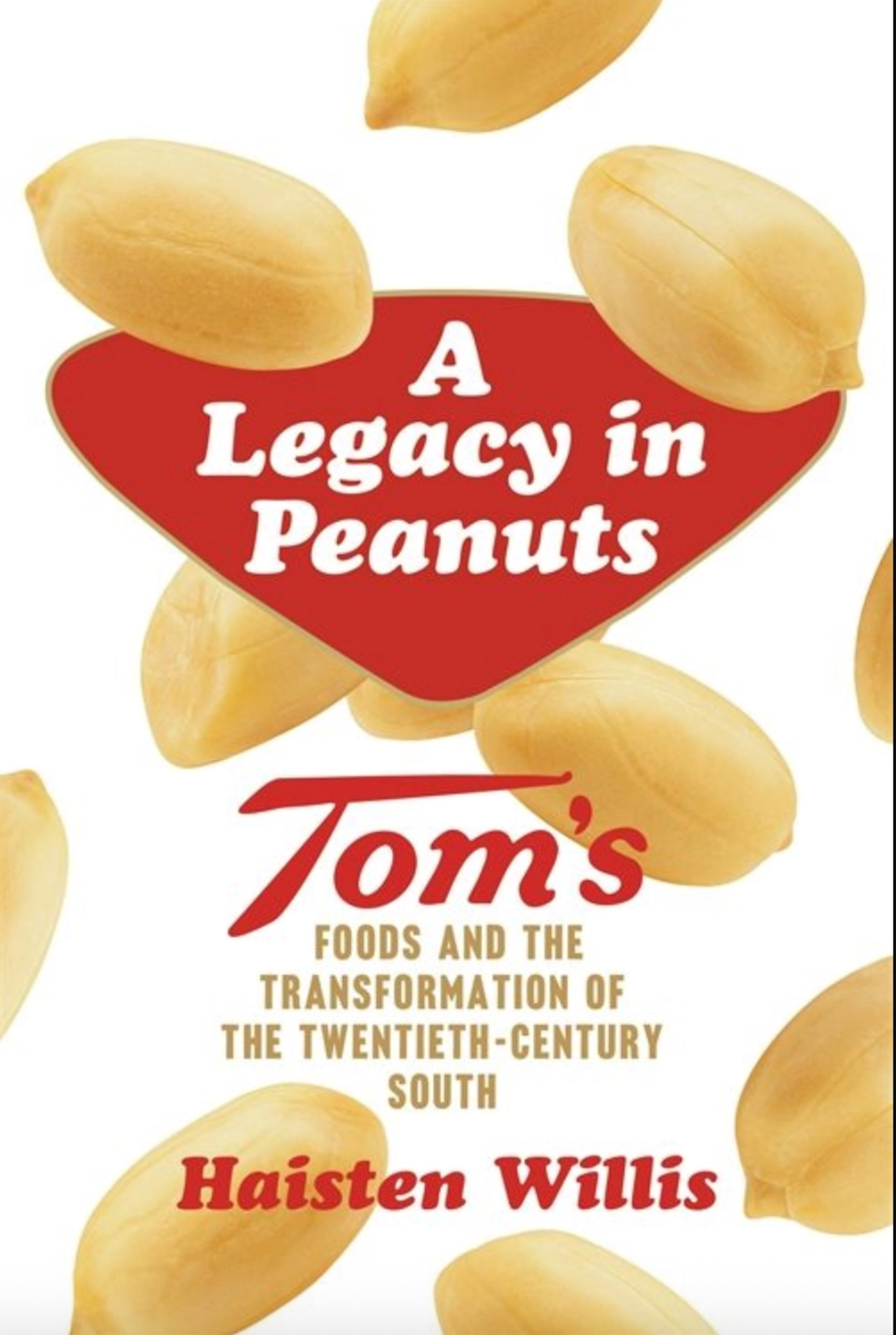
Once the pride of Columbus, Tom’s Foods generated nearly $200 million in annual revenue at its height before filing bankruptcy in 2005. So, what happened?
The answer can be found in “A Legacy in Peanuts: Tom’s Foods and the Transformation of the Twentieth-Century South” (UGA Press, $29.95), a new book by journalist Haisten Willis, who first reported on the company for The Atlanta Journal-Constitution in 2021.
Born in Columbus, Willis grew up aware of the challenges Tom’s faced. Eleven of his family members worked for the company, including both grandfathers and his father, whom Willis often accompanied on his delivery route.
“Riding around with my dad, I could see that some of the other products were moving faster than ours,” said Willis, 41, speaking from his home near Washington, D.C., where he’s editor of Commonplace, a conservative current events publication.
Drawing upon archival research and interviews, Willis’ book charts the company’s rise and fall.

The fall can be attributed to myriad reasons as ownership and leadership changed hands over the years. A leveraged buyout in 1988 that required the company take on tremendous debt and give Citicorp bank 60% ownership was a turning point. Willis points to contributing factors like the company’s shift in focus from its core product — peanuts — to chips, as well as a lack of innovation in product development. Many of Tom’s snacks were knock-offs of their competitors’ products.
But perhaps the most captivating part of “A Legacy in Peanuts” is Willis’ account of the company’s historic origins and ascent.
The company was founded in 1925 by Tom Huston, an innovative entrepreneur who grew up on a farm in Alabama. Like most farms in the South at the time, the Huston family grew cotton. But the boll weevil was spreading, destroying cotton crops across the South, and many farmers like Huston’s father began growing peanuts as a backup crop.
At the time, there wasn’t much demand for peanuts. They were mostly used for hog feed because they were considered a nuisance to shell, and image-wise they were associated with sustenance for the poverty-stricken.
So Huston got the idea to invent a peanut-shelling machine, which he manufactured and sold to farmers transitioning their fields to legumes.
Two things happened that changed Huston’s trajectory. He realized that when you sold a farmer a shelling machine, he had no need to buy another one, so opportunities for scaling the business were limited. And because customers were strapped for cash, they often paid for their shelling machines with peanuts, and Huston found himself with a surplus.

That’s when he got the idea of marketing peanuts to consumers as a snack food. Enlisting input from Tuskegee Institute professor George Washington Carver on how to best preserve and package shelled nuts, Huston launched Tom’s Toasted Peanuts. They were a hit, and other products followed.
As consumers’ appetite for peanuts grew, so did production. Domestic peanut production increased 40% between 1925-1930. But by 1932, Huston had become distracted by other, less successful projects and was ousted from the company.
In celebration of its 25th year, the company produced a promotional brochure touting its success that failed to mention Huston and his contribution to the organization that bore his name.
Nevertheless, Tom’s Foods would go on to have many more successful years before things started to go south in the ‘80s.
“That Tom’s peanut venture succeeded so spectacularly is one of the great stories of the era and, dare I say, of the 20th-century South,” writes Willis. “Huston’s is part of the lesser-told story of the region, when it finally integrated economically with the rest of the nation and made tremendous strides with industries of its own that eventually, though unevenly, uplifted citizens of all stripes.”
IF YOU GO
“A Legacy in Peanuts” discussion with author Haisten Willis
6-8 p.m., Thursday, Nov. 19. Free. Columbus Public Library, 3000 Macon Road, Columbus. cvlga.org.