Haints and boo hags: Superstition exhibit depicts the South’s folklore


In Gullah Geechee legend, the boo hag appears as a beautiful woman who slips out of her skin in the night and rides the chests of sleeping men until they wake up in terror.
The story says that to keep out a boo hag, one can sprinkle salt across the porch, paint their porch ceilings haint blue, or leave a broom by the door to trick her into counting the bristles.
Nalla Roberts has been fascinated with tales like this for years, growing obsessed with Greek myths in her childhood. So the new exhibit “Southern Superstition” at Art Station in Kennesaw matches her area of interest perfectly.
Her “Boo Hag Cuff” quilt, one of her two pieces in the show, hangs on one wall, telling the story through symbols and images of a beautiful-turned-frightening witch.

“Her skin completely comes off and unwraps, which is why I chose the cuff form, just because it wraps around the skin, so to have this feeling of unwrapping,” Roberts said.
It’s one of around 40 pieces of art on display at the Art Station — Big Shanty in Cobb County through Nov. 7, which has installed its latest exhibition focusing on Southern superstitions. The pieces use a variety of mediums including textile art, sculptures, pottery, paintings and collage.
Recreation program coordinators Roxanne Thompson and Ellen Roberts landed on “Southern Superstition” because it fit in well with the spooky time of year, but it also mimics the pieced-together traditions of Halloween, which draw from a variety of cultures and have evolved into a day of trick-or-treating and costumes.
The South’s rich folklore also comes from various cultures and has spread throughout the U.S. While walking through the gallery, visitors will notice elements from Gullah Geechee culture, indigenous Americans, Appalachian beliefs and even personal family lore.

Ellen Roberts said the exhibit is intended to go beyond the macabre and horror. She hopes that it will spark conversations and curiosity in visitors.
“If you further investigate that piece of folklore, you may learn more about history, why that specifically came about, what set of circumstances prompted people to feel that way, or what history, even further back, that they brought with them,” she said. “So I think it actually comes down to learning more about history. I think through learning history, we can have better context for our present biases and feelings.”
The pieces were selected by a blind jury, meaning Ellen Roberts, Thompson and Lacy Hamilton, the collections and exhibitions coordinator at the High Museum of Art, judged each entry solely based on the work without looking at names or backgrounds of any artists. This theme brought in more than 100 submissions, Ellen Roberts said.

Superstition, myth and horror fascinate people, and the South is rich in these stories.
“I think what really draws me to these narratives is that these are people who, not that they have no clue about what science is, but when these stories are being made, they’re really just trying to make sense of their world the way they know how,” Nalla Roberts said.
Roberts has a background in jewelry making, sculpture, metalworking and graphic design. Now that she’s in graduate school, she has combined many of these disciplines in her work with African American folklore and narratives.

She felt that hand sewing quilts and textiles would feel warmer and more intimate.
“How can I convey a story with a material as opposed to it being told by mouth in the oral tradition of storytelling?” she said. “People are more inclined to touch it and engage with it in a way that I think is more intimate than something that’s painted or sculpted with more hard and flat materials.”
Roberts has both “Boo Hag Cuff” and “The Aunt Nancy Chatelaine” on display.
Many of the Southern folklore traditions come from Gullah Geechee culture. Myths can show how a culture and society ordered the world around them, said Kinitra Brooks, the associate chair of literary graduate studies at Michigan State University.
Folklore may offer an “idea of what Southern Black folks valued, what they feared, but also what they used as entertainment, right? I always want to bring in the humanity of Southern Black folks, and sometimes we just like to sit around telling stories,” said Brooks, who is from New Orleans. “It was a way of building community, camaraderie, but also of passing these things down.”
Religious practices like voodoo and conjure, the Black Southern tradition of African religious practices, have persisted over generations as families pass down their family lore and beliefs to each other. It represents hundreds of years of culture, Brooks said.
“I think for me, that’s what’s the most fascinating: Just seeing that people still had time for a story, and people are still finding ways to communicate to one another that we might be treated a certain way, but that does not mean you are not capable of outsmarting someone who believes they’re more powerful than you are,” Nalla Roberts said.

When Sophia Edwards saw the exhibition’s focus, she knew she had to submit a piece of work. Edwards moved back to Atlanta a few years ago after graduating from New York University. The multimedia artist was researching Gullah Geechee folklore for her college thesis. Her dad is Gullah, and most of her family comes from South Carolina, so those traditions have inspired her upcoming body of work, she said.
Her exhibition piece, entitled “Gathering My Tools,” is a mixed media cyanotype featuring Br’er Rabbit at its center. She’s particularly interested in coded messaging through visual language, Black storytelling and quilting traditions.
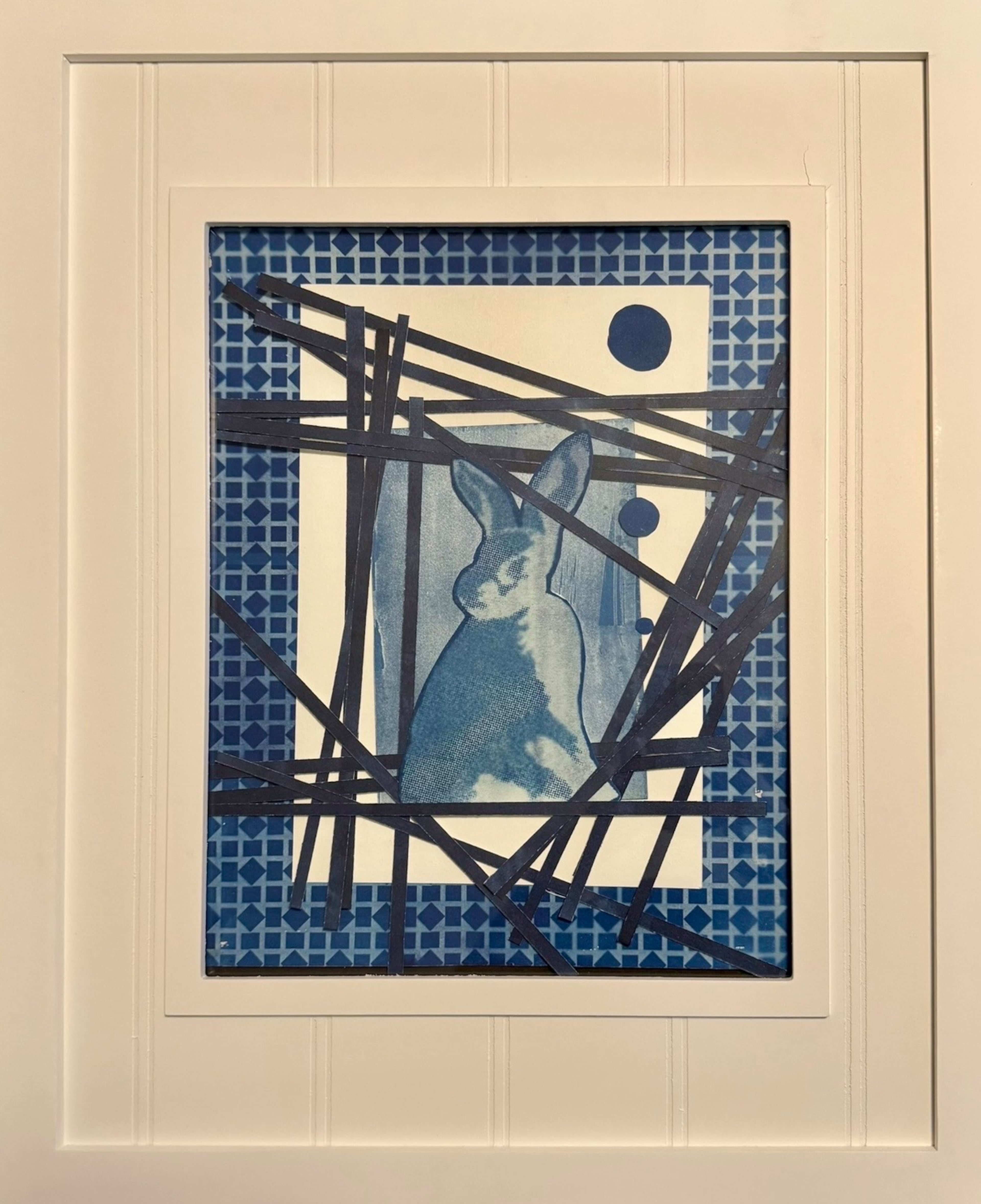
She included the monkey wrench symbol in her piece, which is a coded quilt design that could be used to help enslaved people prepare for escape by conveying the message of “gather your tools for the journey ahead,” she said.
The indigo blue color produced from the cyanotype is also very symbolic in the Gullah culture, Edwards said. Also called “haint blue,” it is frequently painted on windows and porches in South Carolina to confuse haints, the Southern word for ghosts and spirits.
In the center is Br’er Rabbit, a fable shared by enslaved West African storytellers about a tricky rabbit that outsmarted all of its captors.
“This character might not have been the biggest animal or the strongest, but would always use intuition, cunning, intelligence to kind of beat out the stronger, other animals or characters he might be facing,” Edwards said.
For Nalla Roberts, remembering and sharing stories so rooted in this region is an important way to archive these traditions.
“How can we still carry on tradition when we are seeing, you know, books being banned and certain cultural narratives not as prioritized as others,” Roberts said. “There’s a lot of really important stories that I don’t want to see lost.”
If You Go
“Southern Superstition” exhibit. 9 a.m.-5 p.m. Mondays-Fridays. Through Nov. 7.
Big Shanty Bazaar, a Renaissance Festival and the Southern Superstition exhibit reception. 10 a.m.-4 p.m. Nov. 7.
Art Station, 2050 Kennesaw Due West Road, Kennesaw. cobbcounty.gov/events/2026-11-07big-shanty-bazaar