New memoir revisits murder of DeKalb County Sheriff-elect Derwin Brown
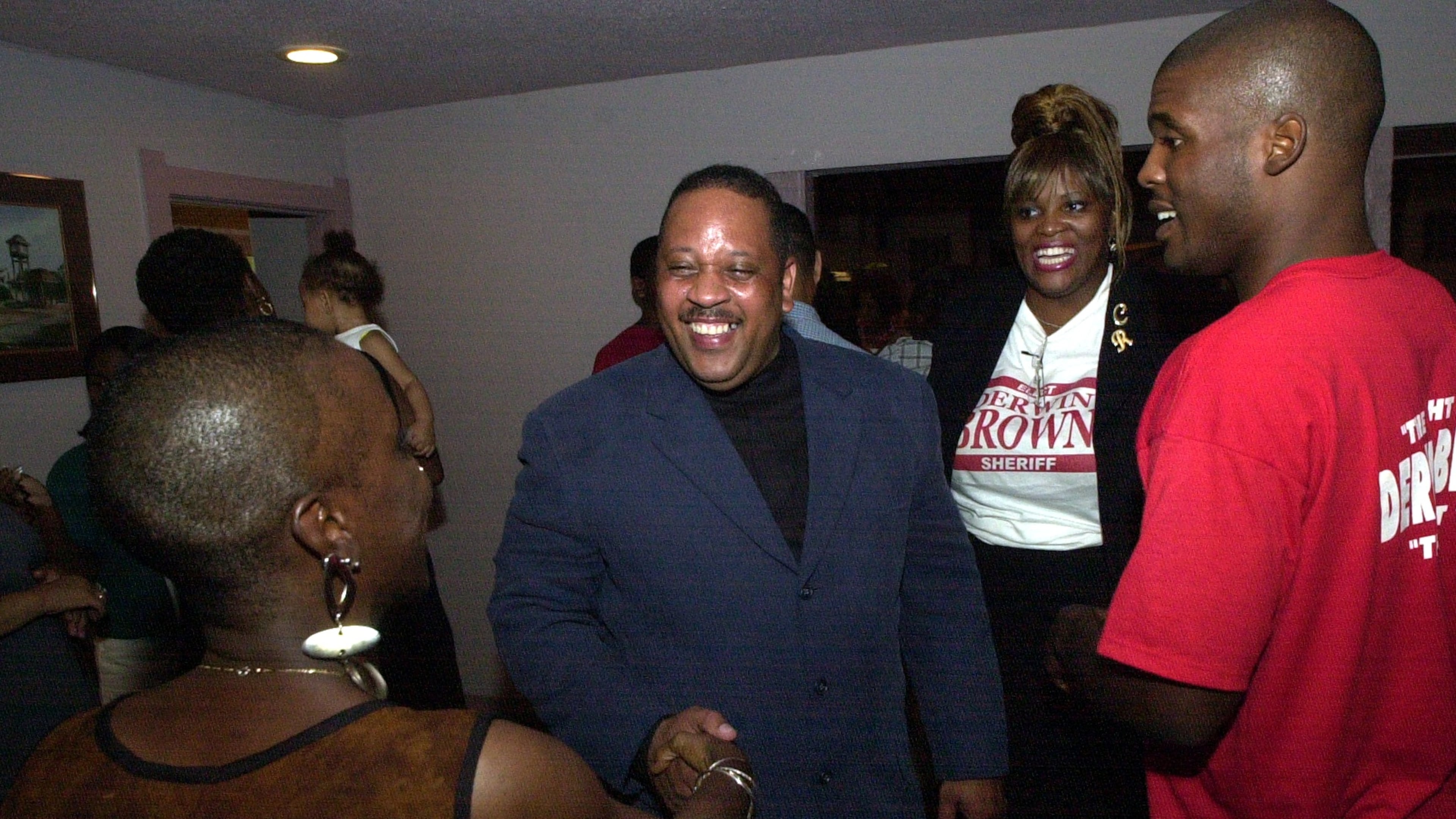
Metro Atlanta has been home to a number of notorious murders over the years, but none are as audacious as the assassination of DeKalb County Sheriff-elect Derwin Brown in December 2000.
Having campaigned on a promise to clean up corruption in the sheriff’s department, Brown defeated incumbent Sidney Dorsey in a run-off election and was just two weeks away from taking office when he was gunned down in his front yard.
Two years later, Dorsey was found guilty of orchestrating the murder and sentenced to life plus 23 years in prison, where he died from natural causes in March. Sheriff’s deputy Melvin Walker and David Ramsey, who worked for Dorsey’s private security firm, are serving life sentences for conspiracy to commit murder-for-hire.

Former District Attorney J. Tom Morgan, who prosecuted Dorsey, provides his firsthand account of the criminal case in his new memoir, “A Rainy Night in Georgia” (Prometheus, $24.95) publishing Tuesday. He spoke about the book with the AJC last week. The following has been edited for length and clarity.
What prompted you to write this book now, 25 years after Derwin Brown’s death?
After we tried it I needed to let the appeals go through. I wanted to make sure there was going to be closure. I took all my notes and I wrote an outline. I had trial transcripts and all the articles from your paper as well as others. And I wrote John Grisham and Pat Conroy. I said, “Guys, I’m not a writer, but I’d be glad to assist you in any way I can. I think it’s a good story.” I never heard from Grisham, but Pat wrote me back. He said, “J. Tom, this is your story. You need to write it.”
I packed everything up in a box and eventually I moved to North Carolina, where I live now and teach at Western Carolina University. Then in 2020 something happened called COVID. I live alone near the top of a mountain and there’s only so many hikes a man can hike, so much bourbon a man can drink. I had to do something, so I tried to channel Conroy. You know he wrote out all his manuscripts by hand on legal pads. I just started writing and writing and writing.
You state that you were more involved than usual in the police investigation of this case because you wanted to ensure you had enough evidence to convict prior to arrest. Can you elaborate?
We’d just come off the Olympic bombing case. It wasn’t Kent Alexander’s fault, but that case got so bungled. I think if Kent, who was U.S. district attorney at the time, had been more involved, they wouldn’t have run into the fiasco they did. … I knew how to try a case. I had worked with the police in collaboration on child abuse cases. Collaborating with them was not foreign. It’s just very unusual, looking back on it, for an elected district attorney of an urban area to be so hands-on.

Can you describe the moment you realized you had enough to convict? What was the tipping point?
Usually prosecutors get confessions either written or audio from the police. I knew that I had to make a judgment on whether or not Patrick Cuffy (a co-conspirator who turned state’s evidence in exchange for immunity) could be believed before I could convince a jury beyond a reasonable doubt. The only way I knew to do that was to interview him myself. Now, I had two very good interviewers along there with me. But it was during the course of that interview that I realized Cuffy was telling the truth. But then we needed an additional co-conspirator. … After we interviewed Paul Skyers (who also received immunity), I decided we had enough to prove beyond a reasonable doubt.
You say that the DeKalb County Sheriff’s Department had a long history of corruption dating back at least to the 1960s. How did that department get so corrupt?
In Georgia the sheriff has unbridled authority with hardly any checks and balances. You’ve got an urban sheriff with a budget of millions of dollars because they feed and house all these inmates, they have medical contracts. The sheriff and only the sheriff in Georgia decides who’s going to operate a bonding company, which is a multimillion-dollar business.

At what point did you realize Dorsey hadn’t planned to stop with Derwin Brown, that you were next on his hit list?
I knew my life was in danger when a former assistant district attorney who’d worked for me called and said he needed to talk to me. He didn’t want to come to my office, he wanted to come to my home. Lawyers are bound to confidentiality. The only exception in Georgia is a lawyer may break confidentiality if a life of someone is in danger. So, this former assistant DA came to my house and he says, “Don’t ask me any questions, but you need to start carrying a gun, you need to wear a bulletproof vest and you need to get round-the-clock protection.”
I kind of had a sense it had something to do with Dorsey. It was only during my interview with Cuffy that I realized that Cuffy was under orders to kill me after he killed Derwin.
Suzanne Van Atten is a columnist for The Atlanta Journal-Constitution. She may be reached at suzanne.vanatten@ajc.com.
IF YOU GO
J. Tom Morgan author talk, book signing. Oct. 3. 4-4:45 p.m. Morgan will discuss “A Rainy Night in Georgia.” 5 p.m. book signing (North Lawn). Free. Decatur Book Fesitval. DeKalb History Center, 101 E. Court Square, Decatur. decaturbookfestival.com.