Amid World Cup pomp, photographs honor quiet grit of college cheerleaders

Jill Frank has loved photography since she was a little girl growing up in Louisville, Kentucky. She was around 9 when she got her first camera, a Polaroid, followed by a Pentax.
When her friends were pondering college and what they wanted to do with their lives, Frank didn’t have to think. Freezing time is what hooked her — photography as an antidote to life’s fleeting nature.
“This is forever. I can keep it; it’s mine,” she said of the photograph’s inherent appeal. “You know, that idea that you can make a split second last forever.”
That passion never left her, guiding her through college at Bard in upstate New York and a graduate degree at the School of the Art Institute of Chicago, to Georgia State University, where she now teaches.
Although her work has appeared in the The New York Times and the New Yorker, perhaps her largest audience yet will get a glimpse of her talents here in Atlanta. Frank’s black-and-white portraits of Brenau University cheerleaders, from her “Discordant Structure” series, will appear (alongside works by artists Mr. Fangs, Charity Hamidullah, Tindel, Hense, Fabian Williams, Dr. Dax and Michi Meko) in a permanent installation at the former CNN Center — revamped by CP Group developers as The Center, and often stylized as the CTR.
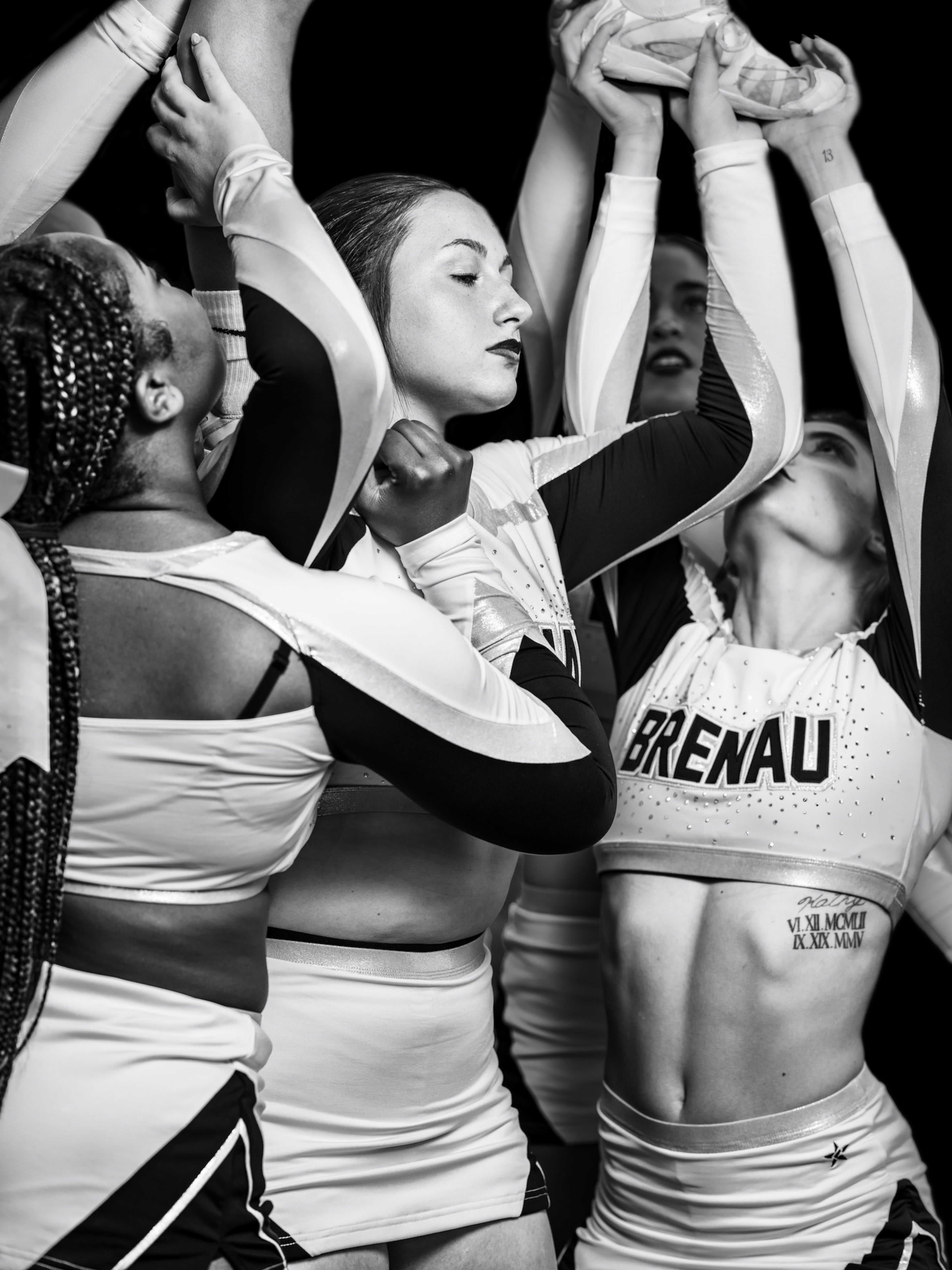
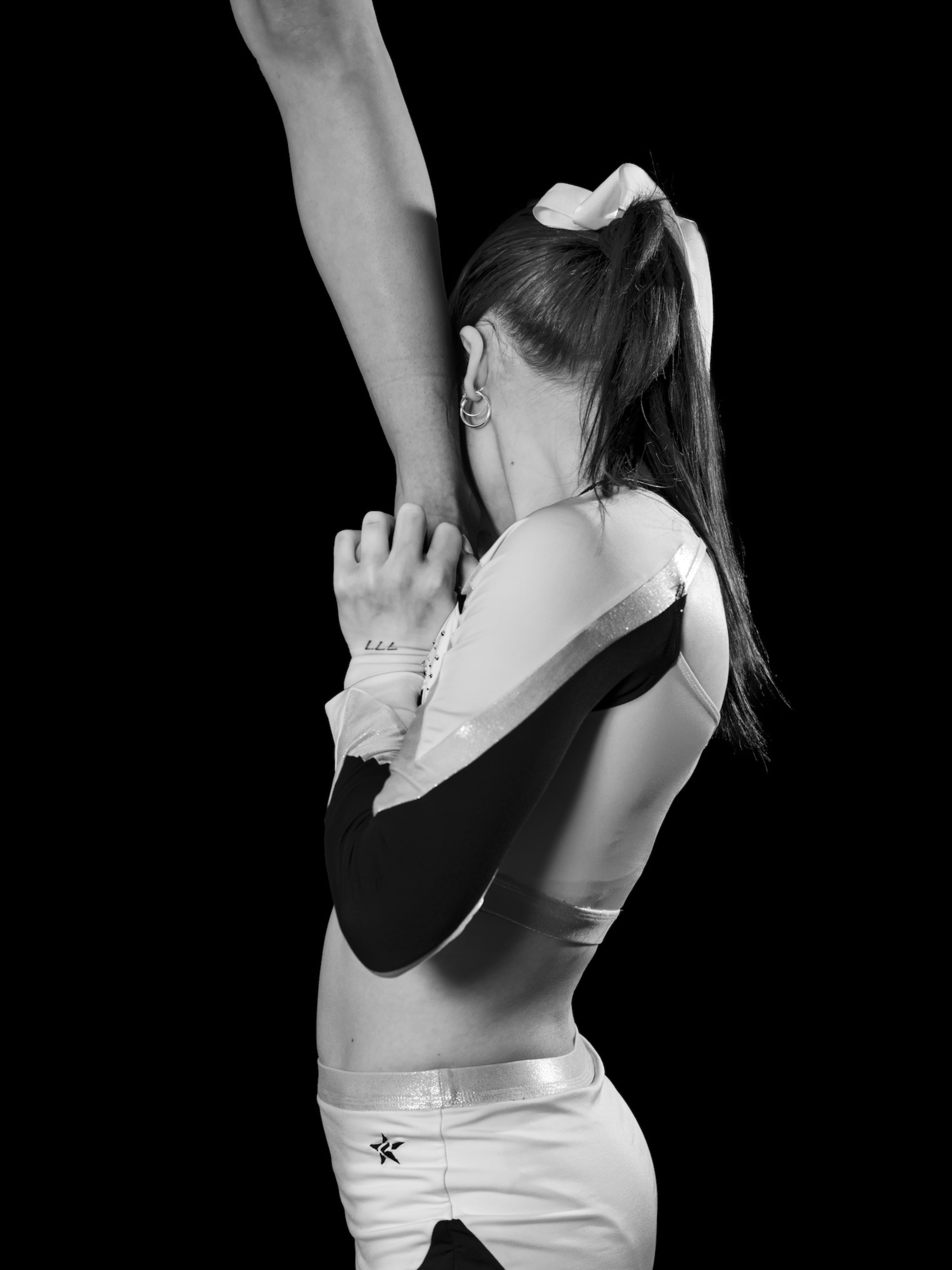
Defying every notion of cheerleaders as glassy-eyed boosters, in “Discordant Structure” the women are more like the Marines at Iwo Jima, hyper-focused and determined as they hold up their teammates with complex human scaffolding, sneakers grinding into palms and the exertion registering on their faces. The pitch black background Frank uses in the images puts their focus and white uniforms into sharp relief.
“Discordant Structure” does not capture the triumphs or the midair, game-winning soccer goals, but rather the quieter moments we all experience and never find commemorated: the struggle, the grit.
Frank emailed coaches at every major college and high school in Georgia to find a willing cheer team.
“She was the only one who replied,” she said of Brenau University head cheerleading coach Bralee Housworth. “I liked her right away.”
Said Housworth, who appreciated Frank’s interest: “I think our sport a lot of times doesn’t quite get the recognition that it deserves. She was wanting to really zoom in and look at the grit and the determination and just the strength and the teamwork.”
Frank worked on “Discordant Structure” for a year and a half.
“I wanted the portraits to be — rather than this single thing that we quickly digest — I wanted it to be the opposite. I wanted it to be hard to swallow simply.
“I wanted all of the emotions that they’re experiencing while they’re doing this important task. I wanted the vulnerability, I wanted the insecurity, I wanted the strength, I wanted the seriousness, I wanted the gladiator-type energy.”
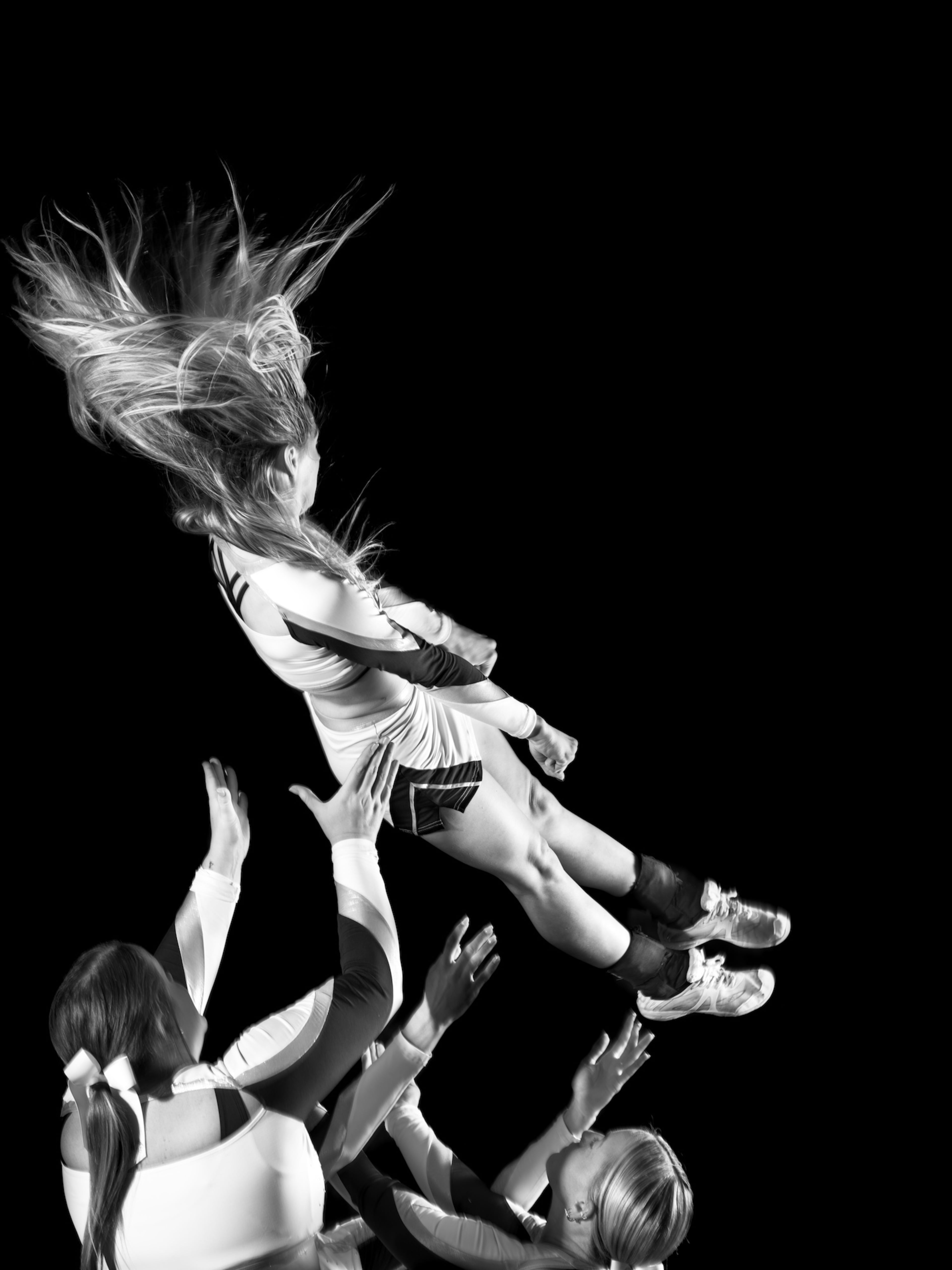
The atrium where Frank’s work will appear is a stone’s throw from Atlanta Stadium (as Mercedes-Benz Stadium is being called during the World Cup), and promises to be a hub for World Cup watchers. In addition to the five large-scale “Discordant Structure” works on view, Frank’s cheerleader portraits will appear across three monumental billboards outside The Center. In September, they will be projected as a 15-minute looped video onto the exterior of the building for two nights.
Frank’s World Cup appearance is thanks to independent art and culture adviser Neda Abghari, who worked with CP Group and a $1 million dollar budget to place art in the repurposed complex in phase one of the ongoing art project.
Abghari first encountered Frank’s “breathtakingly masterful” “Discordant Structure” series at the Beltline pop-up exhibition “Atlanta Biennial” in 2024. “It had me think about the jauxtaposition between how society tends to view youth and adolescence — immaturity, apathy, defiance, selfishness — and what we actually witness in these photographs. The opposite of all of that.”
The positioning of Frank’s work in front of an international audience of visitors to the city is hardly her most significant recognition. She was one of three 2021 Atlanta winners of the prestigious Artadia Award, and she just closed an exhibition, “American Normal,” at Brigitte Mulholland Gallery in Paris. Her portraits of American teenagers drew an unexpected reaction from some of the gallery goers. Behind America’s current facade, they viewed vulnerable, struggling people.
High Museum of Art photography curator Greg Harris, who included Frank in his 2024 show “Truth Told Slant” and has worked with her on several occasions, is a fan.
“I love Jill’s work,” said Harris, who has helped secure 10 of Frank’s photographs for the High’s collection. “She is an exceptional talent, and she’s one of these artists that I want to keep kind of checking in with over the years and making sure that our collection is kind of growing along with the evolution of her career.”
In early June, Frank found recognition of a different order, and attended the premiere of actor Katie Holmes’ new film, “Happy Hours,” at the Tribeca Film Festival. Frank prepped Holmes for her onscreen role as a photographer, adding authenticity by teaching her how to work with the photographer’s signature large format Hasselblad camera and lending her own photographs to scenes in the studio.
What makes Frank’s work so celebrated and compelling is that her photo series are often straightforward in subject matter but rich in emotional complexity that can leave viewers discombobulated.
“There’s a real rawness about them,” Harris said.
In “Cotillion,” she photographs stiff, stressed-looking boys and girls learning social graces, capturing the fraught navigation of adult behavior, social expectations, courtship and social class. In “Talent Show,” she put out a call for kids to perform their best tricks for the camera: high kicks, tears on command, inept juggling, and the resulting portraits are evocations of the common human baseline of struggle. “There was so much vulnerability, there was so much failure,” Frank said. “But there was this really beautiful, strange resilience” in the resulting images.
Though she has become typecast as someone interested in youth — often gravitating toward teenagers at the beach, at parties, skateboarding, playing beer pong — she said it’s mostly the unguarded, in-formation nature of younger people that makes them such great subjects, not the subject of youth in itself.
“I think that we naturally learn to button up as we age,” she said.
“I’m interested in social interactions” Frank said. Her mother, an Emory-educated Louisville psychologist and lawyer, said she thinks her daughter’s work is about trauma, which may just be another way of saying “social interactions.”
Frank said she is interested in the fleeting moments of “social isolation and self-consciousness.”
Harris’ take is she is capturing identity in formation: “How do we become ourselves or understand ourselves or who we are, and what are the ways that we figure that out on our own?”
Frank concluded: “Life is hard, being a person is hard.”
Correction
This story was updated to correct the name Mr. Fangs and where Jill Frank received her graduate degree.
ART EXHIBIT
“Discordant Structure”
On long-term view. 11 a.m.-9 p.m. Sunday–Wednesday, 11 a.m.-11 p.m. Thursday-Saturday, The Center atrium, 190 Marietta St. NW, Atlanta. thectratlanta.com/future/.