Retief Goosen changes putting grip, wins Mitsubishi Electric Classic

One of the best putters on the PGA Tour Champions didn’t like the way he was rolling it this week while preparing for the Mitsubishi Electric Classic. So, nine holes into his pro-am practice round Thursday, hours before the real competition started, Retief Goosen changed his grip.
And won.
It wasn’t anything crazy. No claw. No cross-handed grip. Just a switch from the two-thumb grip to a normal reverse overlap grip, the same one he used to win two U.S. Opens.
That little change was good enough to help him outrace a strong field and win the Mitsubishi Electric Championship at TPC Sugarloaf, the same place where he won the PGA Tour’s BellSouth Classic in 2002.
Goosen scored 14 points on the Modified Stableford system Sunday and finished with 39, two better than three-time Mitsubishi winner Stephen Ames, who scored 19 points in the final round.
Zach Johnson, who led the first two rounds, struggled to score eight points and finished in third place with 36 points. Tournament host Stewart Cink matched Ames for the best round of the day with 19 points and finished fourth with 35.
“I changed that on Thursday and I suddenly felt like, ‘Oh, this feels OK,’” Goosen said. “Maybe I should go back and I stuck with it … and here we go. Just back to the grip that I sort of putted my best with. It felt a bit weird at times, but I managed to release the blade nicely this week.”
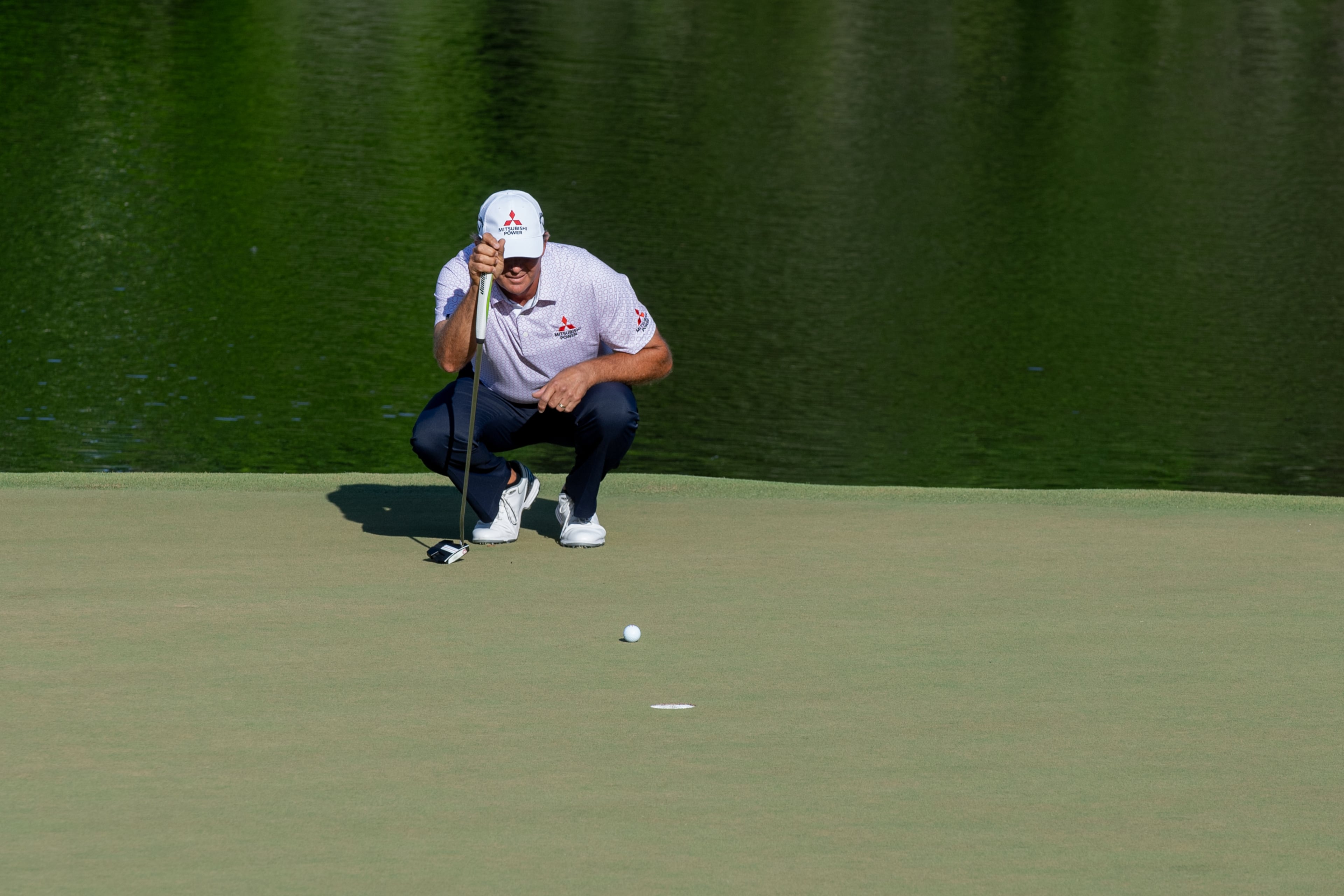
Goosen was a model of consistency all week. His Stableford rounds were worth 12, 14 and 13 points. He had 21 birdies and three bogeys, equating to an 18-under 198. The South African, who built a World Golf Hall of Fame career on great putting, led the field this week with 91 putts.
“You keep telling yourself to stay calm, stay calm,” Goosen said. “It doesn’t come around too often, being on the leaderboard with a chance to win. As you get a little older, you get a little more nervy and start doubting yourself. I think the experience I’ve had around this course helped some with the putts and things you can remember from the past.”
The match may have been decided at the short 13th hole. Goosen drove the green and left his eagle putt on the lip of the cup, settling for a birdie. Johnson drove into the right bunker, hit a poor approach shot and missed the 20-footer to make par. Goosen left the green with 37 points, four shots better than Cink and Ames, and seven ahead of Johnson.

Ames briefly moved into a tie for the lead when he made a birdie on the final hole. That gave Goosen little room for error and forced him to make a birdie or better on 18. On the final hole, Goosen hit his best drive of the day and needed only a 9-iron into the green. He didn’t hit his spot on the approach but only needed to two-putt from 15 feet for the victory.
Ames finished three groups ahead of the leaders and watched the finale on the television in the media center. He didn’t call it a day until Goosen had safely landed his approach on the final hole.

Cink made a late push and shot a 63. He left a pair of birdie putts within inches of the hole at 14 and 15 and failed to make eagle at 18 when his approach found the bunker. But the Atlanta resident could not overcome a poor second round that left him with too much ground to cover on the final day.
“This is how different golf can be,” Cink said. “Yesterday, I hit my drive down the middle of the fairway and had a sand wedge to the green, and I missed the green left and made a sloppy bogey and it set the tone for the rest of the day. Today, I hit it down the middle of the fairway, hit a really good, crisp, decisive, well-planned iron shot and made the 15-footer for birdie and it set the tone for the rest of the day.”
Correction
This story was updated to correct the spelling of Stewart Cink's name in the photo caption.