Brad Raffensperger, known for a tense call with Trump, will soon leave office


Brad Raffensperger, Georgia’s Republican secretary of state, continues to avoid directly criticizing President Donald Trump when talking about elections.
The state’s chief election official spent much of the last year trying to build confidence in the midterms as the Trump administration seized Fulton County’s 2020 election records, sought sensitive voter data, attempted to overhaul mail voting and threatened state officials.
But when asked if he believed Trump’s actions and rhetoric around elections are irresponsible, Raffensperger demurred.
“All I know is what I can control,” he said. “And I try and work every day of controlling the man in the mirror.”
As he prepares to leave office in January, Raffensperger’s legacy will likely be defined by a 67-minute phone call with Trump on Jan. 2, 2021, when the president demanded that he say he had “recalculated” Georgia’s election results to show that Trump had won.
Raffensperger’s refusal made him a hero in the moment for some. But it also alienated him from Trump’s Republican Party, leaving him with few friends in a hyperpartisan political environment.
That showed in his campaign for governor this year, where he finished a distant third. Democrats would go on to sweep every statewide office on the ballot.
Now that he’s leaving office, Raffensperger is speaking more frankly about the party’s future, urging the GOP to “face the brutal truth.”

“We got our ass beat,” the mild-mannered 71-year-old said, using a rare public expletive.
Still, he sees the Republican Party’s defeat as “a great opportunity” to find candidates that he says “have the right character, right temperament to strengthen and rebuild the conservative movement.”
Machines, ‘suitcases,’ and a ‘brother’ named Ron
An engineer and businessman, Raffensperger began his political career at the Johns Creek City Council and the state House of Representatives.
Trump endorsed him for secretary of state in 2018, and he won.
Once he took office, he was confronted with a daunting task — implementing a costly statewide touchscreen voting system after Republican lawmakers passed a law to replace an antiquated system with technology that creates a paper trail.
State officials did it, but it wasn’t without its headaches.
The June 2020 primaries were marred by long lines, technical difficulties and voter confusion. Making matters worse, during the COVID-19 pandemic, officials trained many poll workers on the new machines online and contended with social distancing and sanitizing equipment that added to congestion at the polls.
The system has dogged Raffensperger throughout his tenure. Since the rollout of Georgia’s machines, critics have cast the computer-printed paper ballots as untrustworthy. But after 2020, the new touchscreen voting equipment quickly became a target for Trump and his allies, with claims ranging from vote flipping to meddling by foreign governments.
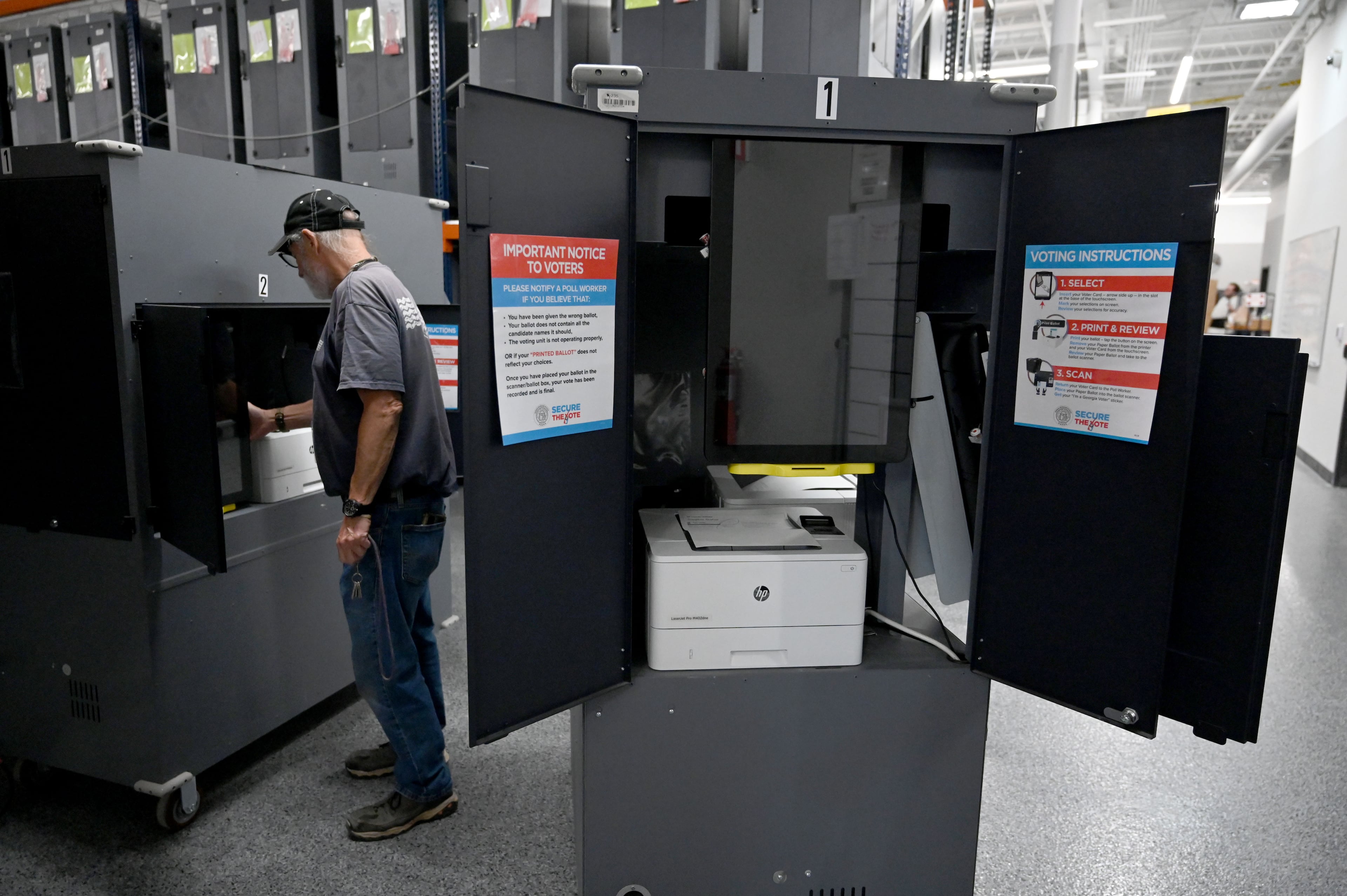
Experts say there’s no evidence the machines were tampered with in 2020. Still, security experts have identified several flaws in the equipment manufactured by Dominion Voting Systems, which was sold to Liberty Vote last year. Security upgrades have never been implemented. Raffensperger has insisted the machines are safe and secure, pointing to postelection audits and other procedures.

Conspiracies were widespread — among them were claims of absentee ballot stuffing, “suitcases” of fraudulent ballots and vote flipping. Amid the fever pitch of allegations circulating online, some turned personal. Trump posted on social media that Raffensperger had a brother named Ron who worked for a Chinese tech company.
There is a Ron Raffensperger whose LinkedIn shows he has since left the tech firm. He’s not Brad Raffensperger’s brother, according to state officials.
State investigations did find errors in Fulton County’s 2020 vote. But the secretary’s investigators and election monitors have repeatedly attributed the issues to human errors and sloppiness.
Despite the numerous investigations and multiple vote counts, some conservatives, including those on the State Election Board, have sought to find wrongdoing in Fulton’s 2020 election and still have questions.
“That office became heavily invested in a narrative that this was mistake-free, that it was perfect, that this process was above reproach,” Georgia Republican Party Chair Josh McKoon said. “And I think that attitude has angered a lot of activists.”
Georgia Republican Party delegates approved a resolution in 2025 barring Raffensperger from qualifying to run as a Republican — he did anyway. The resolution was a symbolic rebuke of Raffensperger more than anything, though it may have offered a warning sign for his political future.

Policy decisions
Rick Hasen, a UCLA law professor and election expert, said that outside the 2020 vote, Raffensperger comfortably fits in as a typical Republican chief election official more interested in issues of election security and purported voter fraud than expanding ballot access.
Many of Raffensperger’s loudest critics come from his own party. But he has no shortage of criticism from the left for his job policy choices.
Since campaigning for office in 2018, Raffensperger has fixated on rooting out and preventing noncitizen voters, which election experts and Democrats say is infinitesimally small. He’s backed an expansive law passed after Trump’s 2020 loss that made absentee voting more difficult. And voting rights groups have raised concerns about eligible voters being swept up in some of the secretary’s mass voter registration cancellations — among the largest removals of inactive voters in U.S. history.

Lauren Groh-Wargo, CEO of the left-leaning voting rights organization Fair Fight, expressed frustration about the praise Raffensperger often receives for what she described as doing “the bare minimum.”
His policy proposals, and his unwillingness to publicly criticize Trump, likely limited any crossover appeal with Democratic voters.
“I think people wanted him to go and blast the president more,” said Gabriel Sterling, Raffensperger’s longtime aide. “And that’s just not him.”
Raffensperger supported and defended the sweeping 2021 law passed after Trump’s 2020 loss that reduced ballot drop box availability, required additional ID for absentee voting, tightened absentee ballot application deadlines and banned handing out food and water to voters waiting in line.

Conservatives championed it as a way to protect election integrity. Democrats decried the law, saying it would create obstacles for voting calling it “Jim Crow 2.0.”
His office’s audits of the state’s voter rolls have found few noncitizens out of the millions registered to vote in Georgia. He has also championed the Trump administration’s overhauled federal database that allows states to verify the eligibility of voters on voter rolls. The tool has drawn criticism for being error-prone and its use of sensitive voter information.
Raffensperger has cast such efforts as measures to ensure the accuracy in voter rolls and prevent fraud. However, Raffensperger has acknowledged the shortcomings of the U.S. Department of Homeland Security’s tool.
“Their data wasn’t always correct, but at least it gave us a baseline,” he said in an interview.
Wake-up call?
Raffensperger and his allies cast the outcome of the midterms as a wake-up call for the GOP.
When Raffensperger ran for governor earlier this year, Sterling, his top aide, ran to replace him. He finished fourth.
Cleta Mitchell, a key lawyer in Trump’s efforts to overturn the 2020 presidential election, sought to stop both Raffensperger and Sterling from advancing. She frequently posted on social media about their campaigns, labeling them “scumbags,” “awful people,” “slimeballs” and “scoundrels.” She publicly celebrated when they lost.
Despite this, Raffensperger maintains that “Georgia has really been good to me, my family.”
“This is where we started our first businesses. This is where we raised our family,” he said.
For Sterling, the shadow of 2020 still looms large over his and Raffensperger’s legacy.
“Depending on where you sit, we were those who fought for the rule of law and to save American democracy or we helped engender the terrible steal that occurred,” said Sterling, now a senior fellow at the Secure Democracy Foundation.
“It’s frustrating because there’s so much more that we did,” he added.
