Inside Rick Jackson’s pivot from Donald Trump and to Brian Kemp


Rick Jackson spent much of the Republican primary promising to be President Donald Trump’s “favorite governor.” Now he seems like he wants Georgia voters to forget he ever said those words.
It’s a tightrope Republicans are walking across the nation as Trump’s approval ratings sink, the Iran war pushes gas prices higher and voters sour on the economy.
But Jackson’s challenge is particularly stark: He can’t win without wooing Trump’s loyal base while also courting the independents and crossover voters who will decide his race for governor against Democrat Keisha Lance Bottoms.
That balancing act was on display during their sole debate Tuesday, when Bottoms repeatedly tried to remind voters of Jackson’s pledge to govern like Trump but with a “Southern tone.”
Pressed over Trump administration cuts that have cost Georgians their jobs, Jackson went further than ever in describing his willingness to oppose the president without actually mentioning Trump’s name.
“I will stand up to anybody, just like Brian Kemp has done,” Jackson said. “He works with both parties, both presidents, and he stands up when he disagrees.”
When asked if the Justice Department should intervene in Georgia’s elections, Jackson again deferred to the popular second-term Republican governor.
“I don’t think it’s necessary,” he said, “unless Gov. Kemp thinks it’s necessary.”
It was the clearest illustration yet of how Jackson has recalibrated his campaign since winning a MAGA-tinged primary brawl against Lt. Gov. Burt Jones for the Republican nomination in June.
He isn’t disavowing Trump. He still backs much of the president’s agenda and counts several Trump deputies in his inner circle. His path to victory depends on Republicans who remain fiercely loyal to the president.
But Jackson is talking about Trump very differently than he did during the primary, when he declared there was “no bigger supporter” of the president and said he couldn’t identify a single White House policy he opposed.

Instead, Jackson is trying to borrow Kemp’s formula: fire up the GOP base with conservative policies while appealing to voters with a more independent streak. It helped Kemp cruise to reelection in 2022, but other Georgia Republicans have struggled to replicate it.
“The hardest needle any Republican has to thread in 2026 is to keep the base fired up, then win over the independents and suburban voters who have cooled on the party,” veteran GOP strategist Chip Lake said. “Kemp has successfully done both twice now, so Rick is smart to lean in to that proven playbook.”
But that carries risks, particularly if Jackson creates too much space between himself and Trump.
“This election is going to be a base turnout election,” said Jones, who has notably declined to endorse Jackson. “And the goal is to energize your base and get them out. The president represents at least 30% of the base, and the last thing you want to do is alienate them.”
Bottoms is determined to make sure Jackson can’t pull off a pivot. After the debate, she called Jackson a “chameleon” and mocked what she cast as a November conversion.
“You all have it on tape. You saw it just like I did. He said he wants to be his favorite governor. He wants to be him with a Southern tone,” Bottoms said. “And now he wants voters to believe that he’s changed his mind.”
A shift months in the making
Jackson’s shift has been building for months. The debate just made it easier to follow the breadcrumbs. The first clues came almost immediately after Jackson defeated Jones in the June runoff.
During the primary, Jackson routinely invoked Trump to win over skeptical MAGA voters.
He called himself a political outsider in the president’s mold, touted his $2 million donations to his campaign and made a personal pitch to Trump at the president’s Virginia golf club.
It didn’t sway Trump from dropping his support for Jones, but it did help him avoid the president’s wrath. Trump notably declined to criticize Jackson through the campaign and quickly endorsed the billionaire for what he called a “great TRUMP Campaign” after Jackson won the nomination.
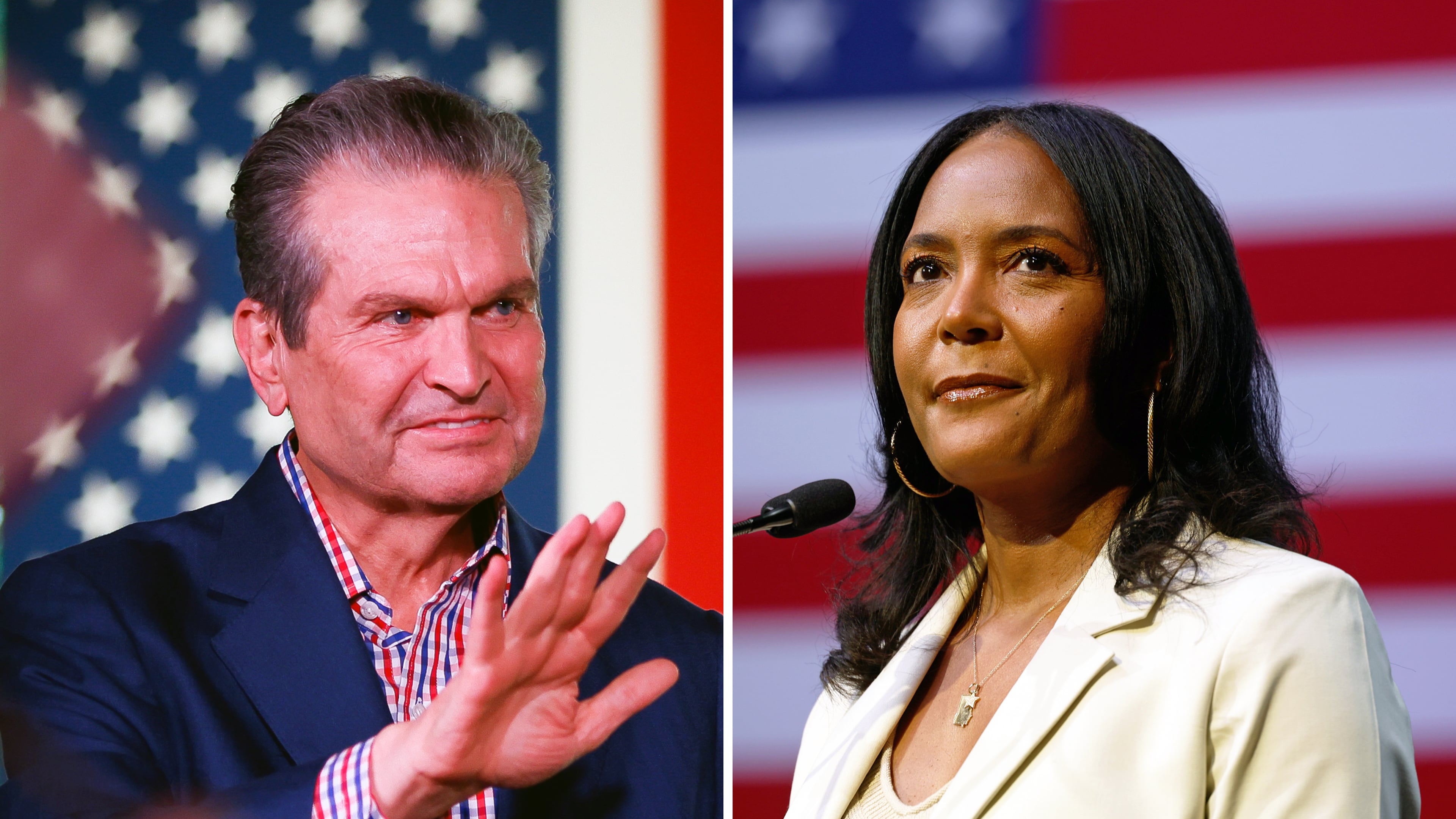
Jackson’s first major rally as the Republican nominee sounded markedly different. During a 19-minute speech in the North Georgia town of Cleveland in July, Jackson never once mentioned Trump.
Instead, he tackled just about everything else, from affordability to his own turbulent childhood in Georgia’s foster care system.
It was a preview of the campaign to come.
Soon, Jackson’s campaign quietly removed Trump’s name from a key section on immigration policy on his campaign website.
And when Jackson unveiled a sweeping governing agenda in September, it centered on an “intelligent” Medicaid expansion and not the culture war fights that long fueled GOP campaigns.
That doesn’t mean Jackson has changed his positions. He supports Georgia’s anti-abortion law and has railed against “woke ideology.” And he still appeared with Trump during his Cobb County rally, outlining a Georgia version of the Trump Account savings plans for children.
What has changed is the emphasis. That was clear at the Georgia Faith & Freedom Coalition’s annual gathering last month, where one speaker after another waded into MAGA-friendly rhetoric.
Then Jackson took the stage. He didn’t mention Trump and skipped the culture wars. Instead, he told his life story and delivered a message aimed beyond the Republican base.
“God did not send Jesus here to save Republicans or Democrats,” Jackson said. “He came here to save everybody.”
A playbook with limits
The contrast is particularly striking alongside Republican U.S. Senate nominee Mike Collins, who is in an uphill battle challenging Democratic U.S. Sen. Jon Ossoff.
While Jackson is looking toward the middle, Collins is running the other way.
Trailing Ossoff in every major public poll, Collins is betting that an energized conservative base can overcome Democratic enthusiasm. He’s hugging Trump tightly, embracing the “MAGA Mike” label and refusing to moderate his message for swing voters.
The dueling approaches amount to competing theories about how Republicans can win Georgia in a difficult political environment. And Democrats are wagering that neither will work.

“Jackson showed how little he thinks of Georgians’ intellect. He is treating Georgians like they can’t remember what he said or did only weeks before,” said state Rep. Stacey Evans, a former Democratic candidate for governor.
She added: “And now he wants us to believe he’s independent and he’s going to stand up to him? Please.”
Still, there’s sound political logic behind Jackson’s pivot. He and Kemp have rallied together several times, including a recent Middle Georgia event where he linked Bottoms to Stacey Abrams, his twice-vanquished rival.
But there’s a catch: Kemp’s formula has proved far easier for other Republicans to admire than to replicate.
Kemp built his independence from Trump over years, including a nationally watched 2022 primary where he crushed a Trump-backed challenger who was backed by several of Jackson’s key aides.
The candidates who tried to emulate Kemp this year fared worse. Attorney General Chris Carr finished fourth in the GOP primary for governor after tying his campaign to Kemp’s style. He is now one of Jackson’s top supporters.
Kemp’s hand-picked candidate for U.S. Senate, former football coach Derek Dooley, lost after Trump endorsed Collins.
And Kemp backed Jones days before the gubernatorial runoff, only to watch both of his preferred candidates for Georgia’s marquee races lose their bids.
But Republicans may not have much other choice than to follow Kemp’s lead. Lake, the GOP strategist, put it this way:
“When your party doesn’t have the national wind at its back, you run on what’s working at home,” he said. “And what’s worked in Georgia is Gov. Kemp.”