President Trump will campaign in Georgia on Friday

President Donald Trump is returning to Georgia on Friday for a campaign rally aimed at energizing the Republican ticket — a visit that will test GOP nominee Rick Jackson’s efforts to chart a more independent course in the race for governor.
The rally will be at 3 p.m. in Dalton, a Republican stronghold in northwest Georgia. It will be Trump’s third visit to the state this year, following a February stop in Rome and a July appearance at Cobb County’s Wheeler High School.
U.S. Rep. Mike Collins, the GOP nominee for U.S. Senate, is expected to attend. It’s not yet clear whether Jackson or other Republicans will join him in Dalton.
Both candidates joined Trump for a Sunday night tele-rally, where the president urged supporters to vote as if he were on the November ballot.
“When I’m on the ticket, we win everything, and we’ve won everything all three times,” he said, falsely claiming he won the 2020 election. “You have to pretend that I’m on the ticket if you would, because in a sense I am on the ticket.”
The visit comes as the president is crisscrossing the country for Republicans facing tough elections next month, with events scheduled in Alaska on Tuesday and Montana and Arizona on Wednesday — all states he won in 2024.
Georgia opens three weeks of early voting Tuesday as the state’s leading Republican candidates pursue sharply different strategies in races that could shape the final two years of Trump’s presidency.
Collins has leaned into his “MAGA Mike” nickname and his support for Trump’s agenda in an uphill battle to unseat Democratic U.S. Sen. Jon Ossoff.
Jackson, locked in a tight contest with Democrat Keisha Lance Bottoms, is increasingly modeling his campaign on Gov. Brian Kemp as he courts independent voters souring on Trump.
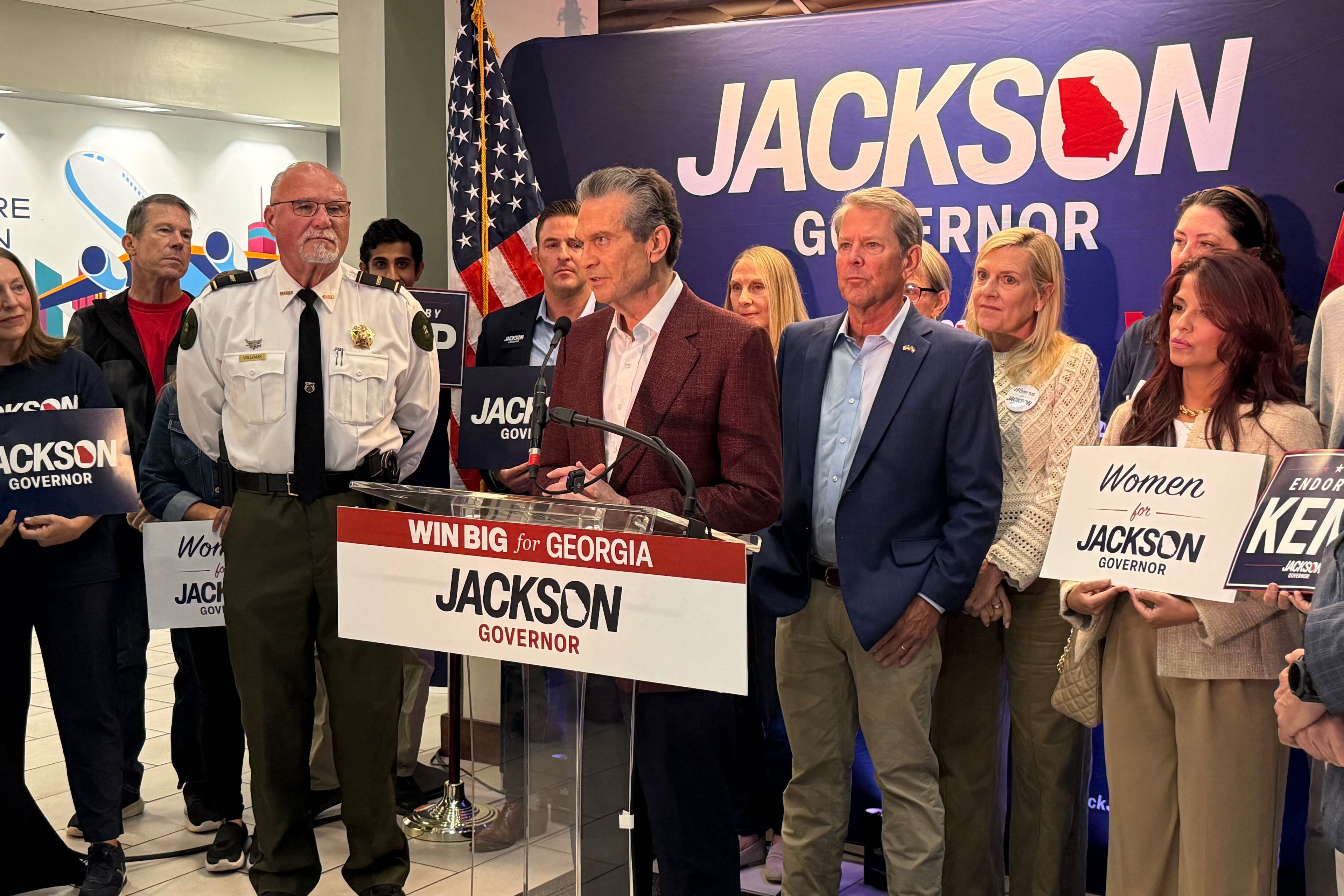
That distinction was on display Monday during a campaign stop with Kemp in Atlanta when Jackson was asked whether he would follow the governor’s example and tell Trump “no.”
While fighting for the GOP nomination, Jackson said he couldn’t name a single Trump administration policy he opposed. On Monday, he cited data centers — an industry he says needs guardrails — as a point of disagreement. And he stressed that he would set his own agenda.
“Nobody ever gave me anything, and nobody’s ever told me what to do. You can’t make it in life by doing that,” Jackson said. “My priority is Georgia.”
‘Favorite governor’
Friday’s visit will bring that balancing act closer to home.
Trump’s last Georgia appearance, a July event in Cobb County promoting new investment accounts for children, quickly became a campaign rally. Jackson shared the stage with the president and declared that he wanted to be Trump’s “favorite governor.”
Since then, the billionaire healthcare executive has courted the crossover voters who helped Kemp win a landslide reelection in 2022. During last week’s debate, he pointed to Kemp as his political model.
“I will stand up to anybody, just like Brian Kemp has done,” Jackson said. “He works with both parties, both presidents, and he stands up when he disagrees.”
Kemp’s record offers Jackson a template for maintaining GOP support while carving out distance from Trump. The governor refused Trump’s demands to overturn Georgia’s 2020 election results and survived his wrath to win a second term.
But Bottoms is fighting for many of the same split-ticket voters, and she has cast Jackson as a “chameleon” now trying to reinvent himself.
“He said he wanted to be his favorite governor, wants to be him with a Southern tone,” she said. “And now he wants voters to believe that he’s changed his mind.”
For Collins, the political calculation is more straightforward. He is betting that an energized Trump base can help him close the gap against Ossoff and wring out more GOP voters who often skip midterms.
Ossoff has welcomed the effort to frame November as a referendum on Trump. At a campaign stop Sunday in Roswell, he again blamed the president and Collins for the war in Iran, rising household costs and cuts to healthcare coverage.
“None of these things had to happen,” Ossoff said. “These were all decisions that Donald Trump and Mike Collins made.”