The Revolutionary War's chief villain is being rehabilitated — just in time for America's 250th
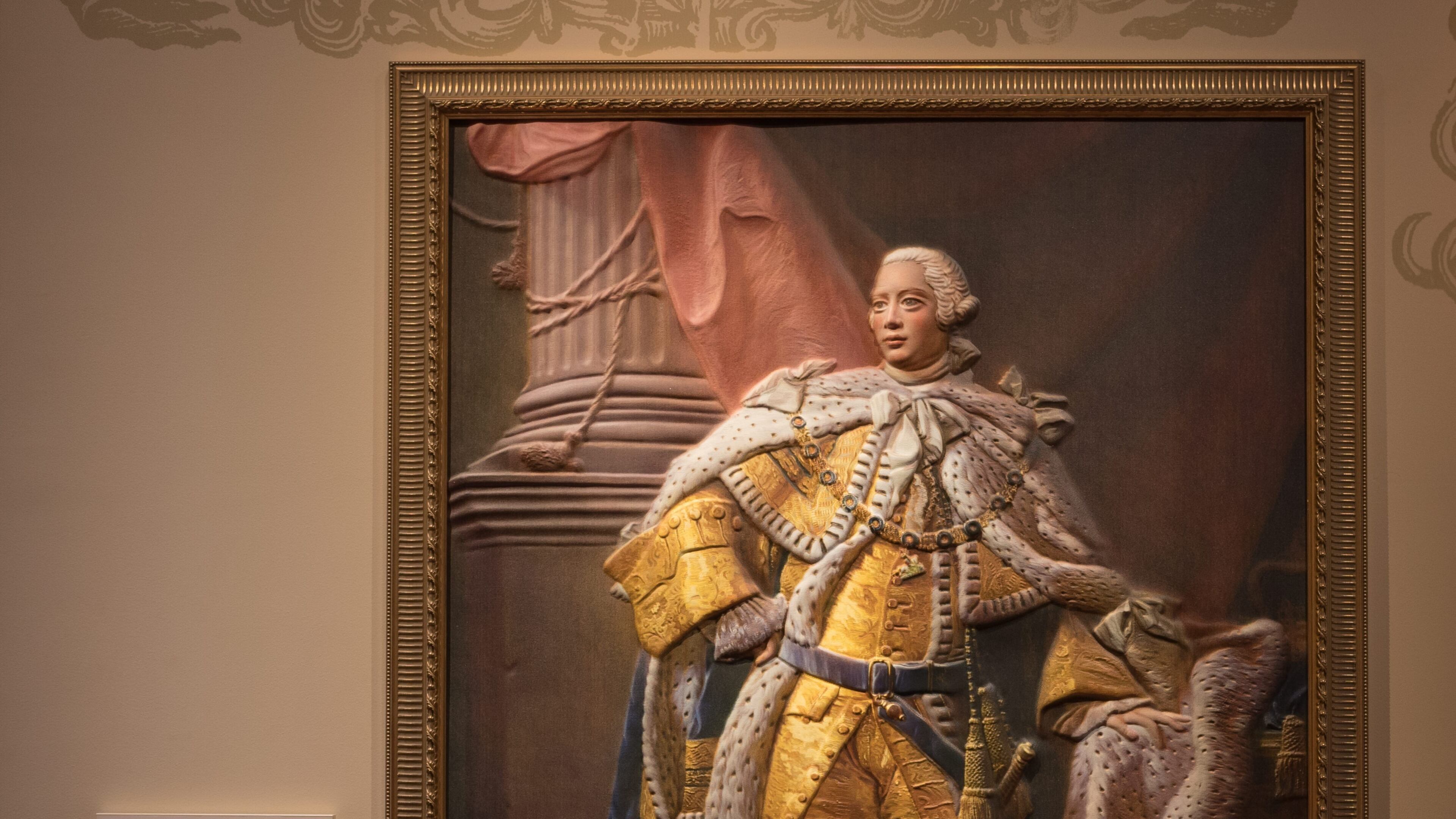
LONDON (AP) — “Mad” King George III — the villain of “Hamilton,” “Schoolhouse Rock” and the Revolutionary War — has undergone a makeover in time for America's 250th birthday.
He's been known in the United States for centuries as the English ruler who lost the American colonies. You might remember him as the maniacal monarch from the Broadway musical or the subject of the 1990s play and film, “ The Madness of King George.” Americans of a certain age would recall him as the tyrant who taxed them without consent in the song, “ No More Kings."
Except the runup to the Revolutionary War didn't happen quite that way — a point worth noting in this age of disinformation, misinformation and “alternative facts.” In George's time, Parliament approved laws and taxes, as it does now. And that list of 27 complaints against the king in the Declaration of Independence? Mostly “wartime propaganda,” according to British historian Andrew Roberts, who says all but two crumble under scrutiny.
Historians now generally agree: George was not mentally ill during the Revolution.
“Truth became the first casualty of the American War of Independence, as it is in most wars," Roberts wrote in his 2021 biography, “The Last King of America.” “The American Revolution is a testament not to George III's tyranny, which was fictitious, but to Americans' yearning for autonomy.”
America's backstory, as told by the Founders, is up for review
The American origin story is rooted in the notion that George III was its vanquished villain, an irrational tyrant who oppressed the American colonists. Scholars began pushing back against that narrative before the United States' bicentennial, with the Prince of Wales writing a spicy rebuttal in 1972.
“If the average schoolchild remembers anything about history after leaving school, he will remember that George III was mad,” that prince, now King Charles III, wrote in the foreword to a biography on his five-times great grandfather. “If he is American as well then madness is often given as a reason for the 'irrational' behavior of the King toward the Colonists, making it necessary for them to declare independence."
Perhaps, he closed, "Americans will soon come to see the true George III without bias and traditionally held opinions."
George inherited the throne from his grandfather in 1760, at age 22, and with it an empire that stretched from England into North America and to Asia. He saw himself not merely as England's ruler but the father of his subjects — duty-bound to be their role model. In family and British life, he emphasized order, integrity and an Enlightenment-era curiosity about art, books and the natural world.
George was, like every British king since, a constitutional monarch — meaning that he had influence and selected the prime minister, but Cabinet members and the House of Commons passed laws and budgets. George's job was to assent to the policies passed by Parliament. So it can be argued that he went along with what the colonists saw as Britain's oppressive and coercive policies, such as the Stamp Act of 1765, the first direct tax on the colonies.
The future founders condemned the move and popularized the war cry, “No taxation without representation.” As Britain saw it, the members of Parliament represented the colonies. The colonists argued that they were represented by their elected colonial assemblies, which already taxed them. After they imposed damaging boycotts on British goods, Parliament repealed the Stamp Act in 1766 — but followed that same day with an act saying the British Parliament could legislate for the colonies.
In the decade that followed, relations soured. Not helping was Parliament's passage of the Tea Act in 1773, to which revolutionaries responded by dumping tea into Boston Harbor. That shocked George, who the next year approved Parliament's acts designed to rein in Massachusetts' ability to govern itself.
The Continental Congress met and petitioned the king, as “your majesty’s faithful subjects,” for relief. George stood with Parliament.
In April 1775, the “shot heard ’round the world” rang out from a clash between militiamen and British troops in Lexington and Concord, launching what Brits widely call the American War of Independence — the Revolutionary War.
George III’s archives went public in 2015 — and fueled a shift on “the king’s malady”
Queen Elizabeth II released the uncatalogued Georgian Papers, 280,000 from the period held at Windsor Castle, and later put them online as part of a five-year project to digitize the records. What emerged was a detailed reappraisal of a monarch who kept charts, lists, letters, speeches and notes — including dates and the time of his writings — tracking a long list of administrivia: crop yields, botany, land management, household stores and expenses and closely tracked the politics in Parliament.
But the 2015 archives released something else: more detail on medical notes, including doctors orders, treatment reports, observations by others of George's behavior during his illnesses. Those raised questions on the cause of what historians had called “the king's malady.”
The long-accepted theory that George suffered from porphyria, a physiological metabolic disorder, was wrong, Roberts wrote in 2021. His analysis of 100,000 Georgian documents and 21st-century medical research pointed to bipolar affective disorder Type 1 — defined in part by at least one severe manic episode. George had been known to suffer extended bouts of mania after 1788.
As America turns 250, George's story is told differently — even in America
Dig into the American Revolution in 2026 and you won't find much, if any, suggestion that George was "mad" during the war years. If anything, the story during the semiquincentennial casts George as more of a whole person than the tyrant depicted in the ad hominem complaints peppered throughout the Declaration of Independence.
The Library of Congress' exhibit is titled, “The Two Georges,” the king and George Washington, “Parallel lives in an age of Revolution.”
And the first gallery in the Museum of the American Revolution in Philadelphia is begins 15 years before the Revolution, when Americans had great affection for George III and showed it by posting royal symbols on items ranging from drinking vessels to fire backs and a royal coat of arms that probably hung in the city's courthouse.
“We make the point that he was literally called ‘the king of liberty’ in popular culture, said R. Scott Stephenson, the museum's president and CEO. "This was not a despot in anyone's minds.”
Charles name-drops George III during his speech to Congress
On April 29, Elizabeth's son, King Charles III, twice name-dropped George III from the rostrum at the heart of American democracy. First, he endorsed the “Tale of Two Georges” theme, noting that George III was his five-times great grandfather.
“King George never set foot in America,” he said lightheartedly, “and, please rest assured, I am not here as part of some cunning rear-guard action.”
None of the modern-day patriots in his audience — elected members of Congress whose forebears rejected the rule of George III — batted an eye or booed.
That night, Charles invoked his ancestry by name again at a White House state dinner in a further celebration of America's 250th birthday. “As the direct descendant of King George III,” Charles said, “I know this is a nation that never gives up.”
That's true of some Americans and the narratives they prefer, according to Roberts. Asked whether his findings took hold in the American psyche, he responded by email: “Nothing will dislodge the Americans from their desire to see GIII as an evil dictator.”
More Stories
The Latest