At one of Georgia’s solemn salutes to the fallen, every day is Memorial Day
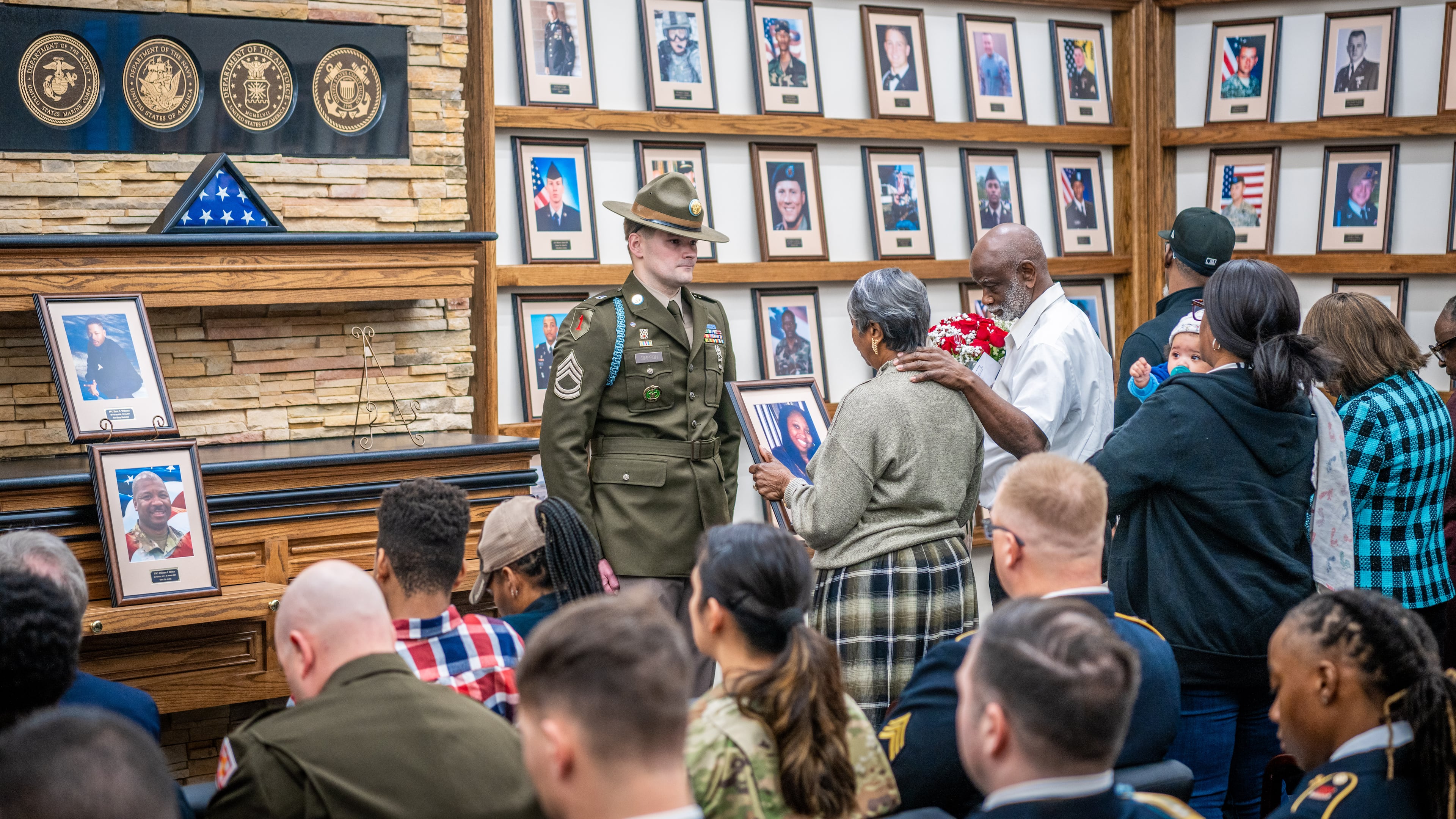

FORT BENNING — Inside a gray-carpeted room in a barn of a building that was once this Army base’s credit union, it is quiet as a vault.
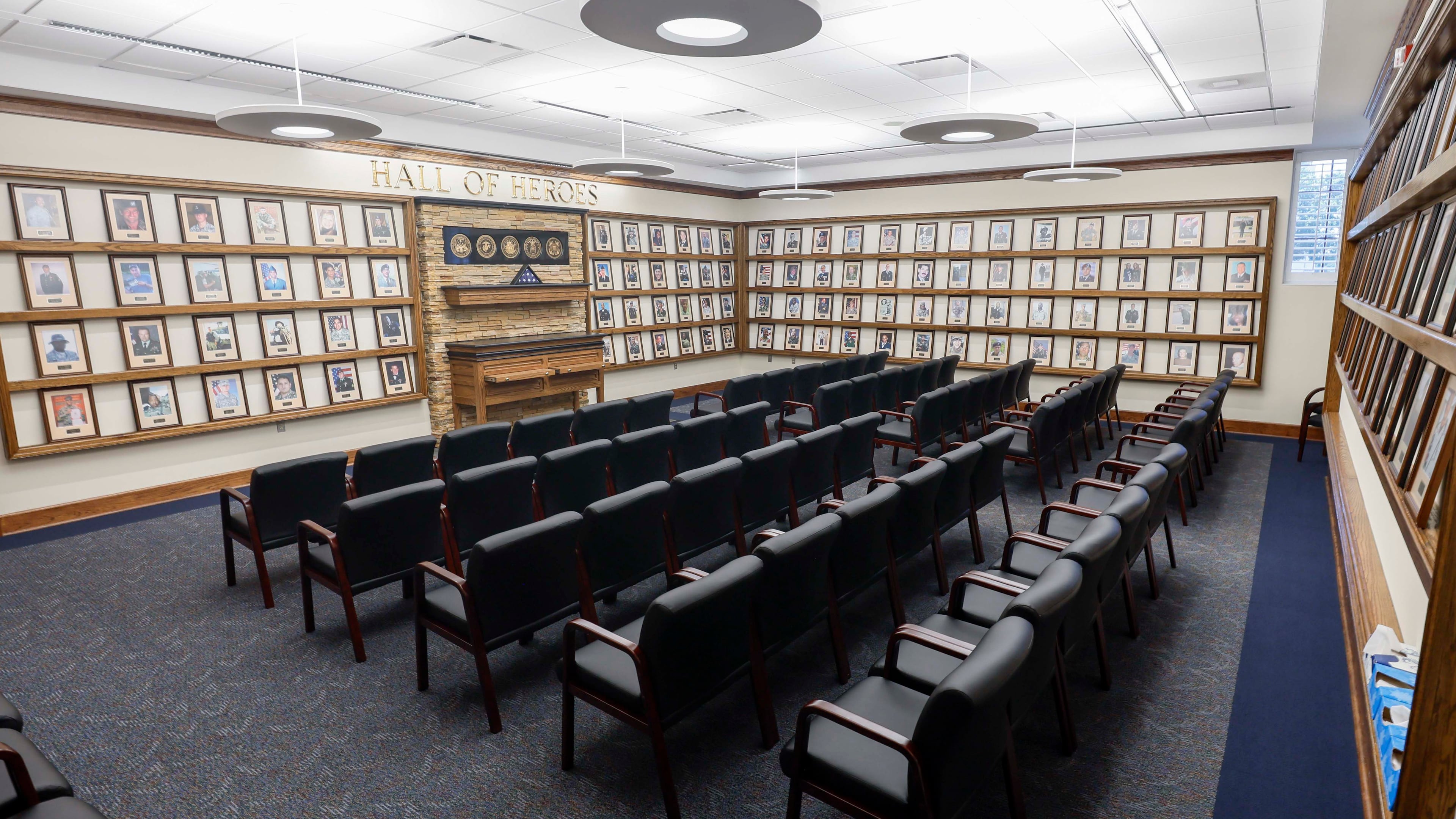
Scores of framed photographs on simple wood-stained shelves line the walls.
They are portraits.
One hundred and eighty-seven faces of the fallen.
The room, just large enough for the 55 chairs at parade rest in its center, was built as a sanctuary and memorial for families of soldiers who died while enlisted. There were five photographs at first, in 2011, when it was dubbed the Wall of Heroes.
It has since become the Hall of Heroes. Some honored here were killed in battle, some in car wrecks. Others died of medical problems, others by suicide. The place is understated, humbling, a room for reflection. The lights are never switched off.
A retired field artilleryman and 17-year vet named Alonzo Stewart, who grew up on a Mississippi farm, has overseen the hall at the post’s Survivor Outreach Services since 2014. Its initials — SOS — are no coincidence. The office lends help in times of distress.
Stewart, who served in Kosovo and the Balkans and was with the 3rd Infantry Division when it invaded Iraq in 2003, told a visitor on a recent morning, “We have a saying here: ‘Never forgotten. Never alone.’ We will forever be connected to that soldier.”

His office caters to some 250 families of fallen troops from roughly a third of Georgia and pockets of Alabama and Florida, offering them support and counseling, be it financial or emotional guidance, and help navigating the paperwork of loss. The office also offers them the chance to have their deceased soldiers’ photographs enshrined in the Hall of Heroes.
While it is open to visitors who can access the base, the hall is not widely known or broadly promoted. Even so, it is the focal point of Building 359, a rectangular edifice 3,500 feet from the Chattahoochee River, next door to Doughboy Stadium, which was built in the mid-1920s as a salute to America’s World War I dead.
Among the faces on the walls is that of Jonathan “Doc” Peney, an Army Ranger combat medic killed in Afghanistan 16 years ago.
His mother, Susan Peney, lives near Fort Benning, where she had, by chance, moved before knowing Jonathan would, for a time, train here. Now friends ask why she stays.
Because, she says, “I can be of assistance to somebody else.”
For her, the SOS center has been a lifeline, a home even, as Georgians mark Memorial Day at a fraught time for U.S. soldiers.
Thirteen American service members have been killed in the Middle East since the U.S. attacked Iran in February. None are from Georgia, but the state is home to several large military bases, including Fort Benning near Columbus. If the war escalates, more of its soldiers could find themselves in harm’s way.
‘Honoring the sacrifice’
One day in mid-May, Stewart, 51, arrived at work in caiman cowboy boots and a soft-blue sports coat, an American flag tacked to its lapel. He seemed to glide into the Hall of Heroes with an at-ease air that seemed to betray the bearing of the drill sergeant he once was. He seemed more a chaplain, a caretaker perhaps of a realm beyond duty. He seemed at home in a room that some who enter find uncomfortable, perhaps unworthy of gracing. Sometimes visitors ask him about the faces on the walls.
They’ll say, “Do you feel like they’re staring at you?”
“Absolutely,” he’ll say, and then explain how for him the feeling runs deeper. How it is as if the fallen are asking him something: “What are you doing to make sure my family is taken care of?”
Some days, he greets them when he steps into their sanctum. “Brothers, what’s going on?” Then he might shut his eyes and meditate.
When he speaks to soldiers climbing the ranks, the Army’s future brass, he is fond of informing them of the work his office does. He might mention how meeting families of the fallen made him realize “what my purpose was.”
“In my world, every day is Memorial Day,” he said. “I don’t get a break from it. I’m honoring the sacrifice of service members to their family members.”
His phone might ring anytime. Gold Star families know him by name. He has never done his first meeting with them by phone. He refuses to.
“I go out to the house, or I meet them at a coffee shop,” Stewart said. “I embrace them to let them know that I’m right here for them. … I don’t see how they keep going. But they do. They’re willing to serve. They’re willing to give back. They’re willing to embrace you and put themselves to the side.”
‘The bravest thing’
Stewart seems to know something about each of the 187 service members honored here.
There is Sgt. 1st Class Todd Holzschuh, pictured in sunglasses, sitting on a Harley-Davidson motorbike. He died of a heart attack in 2018. He was 46. His obituary noted his favorite saying: “Don’t mess with my family, bike or money.” Holzschuh and Stewart were drill sergeants together at Fort Benning. Stewart says they drove recruits hard. In those days, Stewart said, “We were pushing.”
There is an Airman 1st Class from Canton who died at age 20 a decade ago in a car wreck while stationed in Germany. “He had a Bible in the car, in the back seat,” Stewart said. “The entire car burnt up. That Bible didn’t burn. His mother still has that Bible.”
There is Sgt. 1st Class Raymond D. Penland, a Miami native and recruiting officer who married an Opelika woman, Sara Helen May, in 1947. He died at 29, killed in action in North Korea in 1950. His remains were never recovered. After the Hall of Heroes opened, his son gave Stewart his father’s photo — a black-and-white print of Penland in uniform, grinning, Sara on his lap. It is the oldest picture in the room.
Then there is Jonathan Peney, who grew up in Marietta and died in 2010 on his fourth deployment to Afghanistan. He was 22. Peney was killed by a sniper in what the Army later noted as “a hail of bullets pinging all around” while he scaled a ladder to save a wounded soldier on a rooftop. An eyewitness described Peney’s actions as “the bravest thing I’ve ever seen.”
And there is also Peney’s mother, one of the survivors.
‘Closest to my heart’
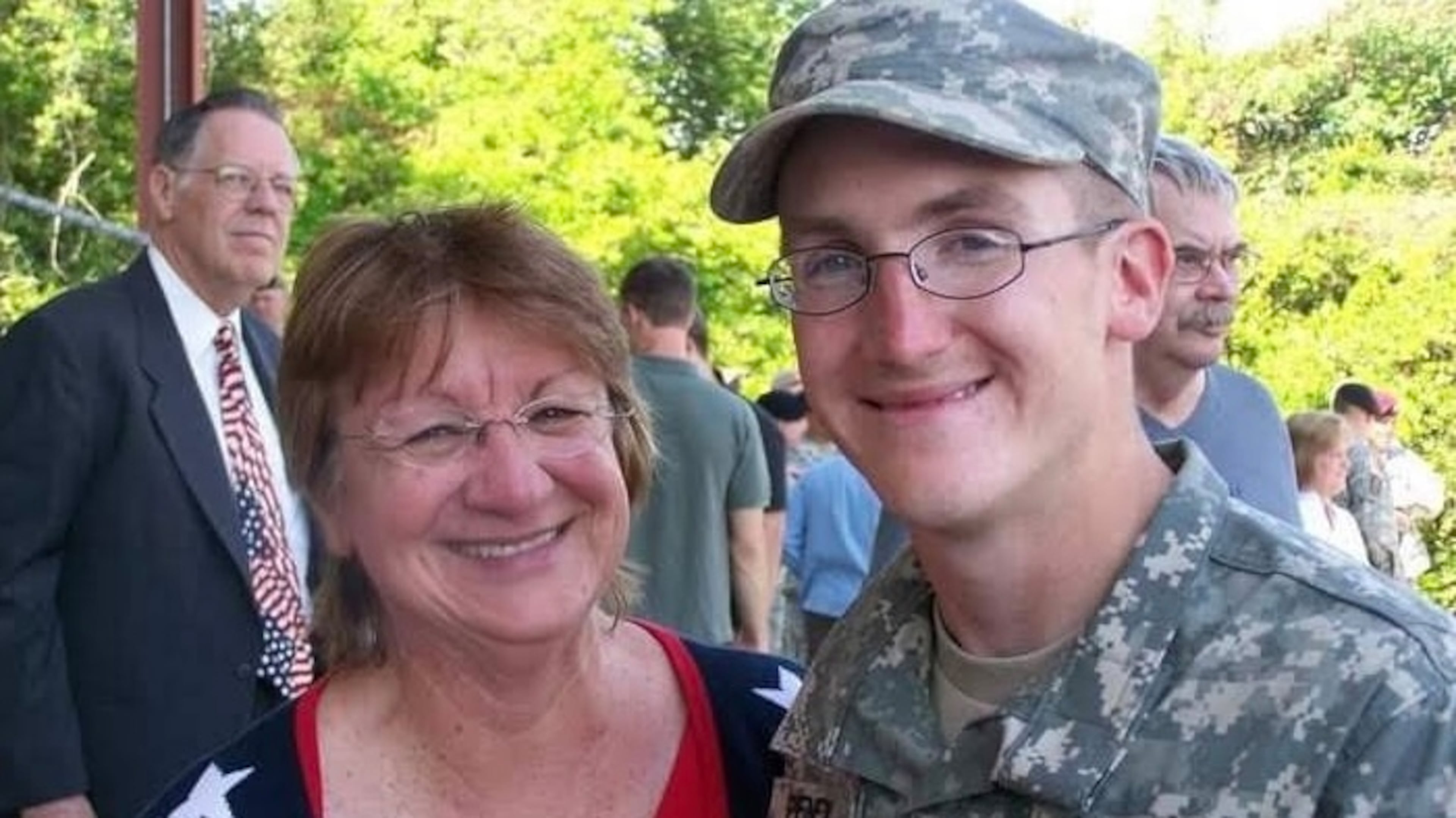
Susan Peney is a regular here, so much so that some around the base know her as “Mama Sue.”
She has been known to, at all hours in the wake of her son’s death, anonymously deliver doughnuts by the dozens to troops in training.
“To feed my boys,” says Peney, 77.
She considers Stewart a son and has told him as much, and that he can never quit his job or “I will track you down.”
“He is the closest to my heart as my son would be,” she said the other day. “He’s a very special personality, a special soul. … He has a very quiet spirit, but a rumbling soul. He will stand up and protect his families.”
She tells of another surviving parent, a father, who had cancer and was near death. The father called and asked Stewart for a favor. He wanted to be buried with his son’s photograph, the one on display in the hall.
“Alonzo took it off the wall,” Peney said, “and personally delivered it.”
Stewart takes her calls around the clock and can put her at ease. “Immediately,” she said. She once called him from California to say she was having a rough day. “He let me babble and babble and babble until I got it all out.”
The Hall of Heroes provides further comfort. Going there and seeing all the pictures of the fallen alongside her boy’s, she said, “It hits you, like, ‘Oh, my gosh, it’s not only my child.’ … He is in such great company.”
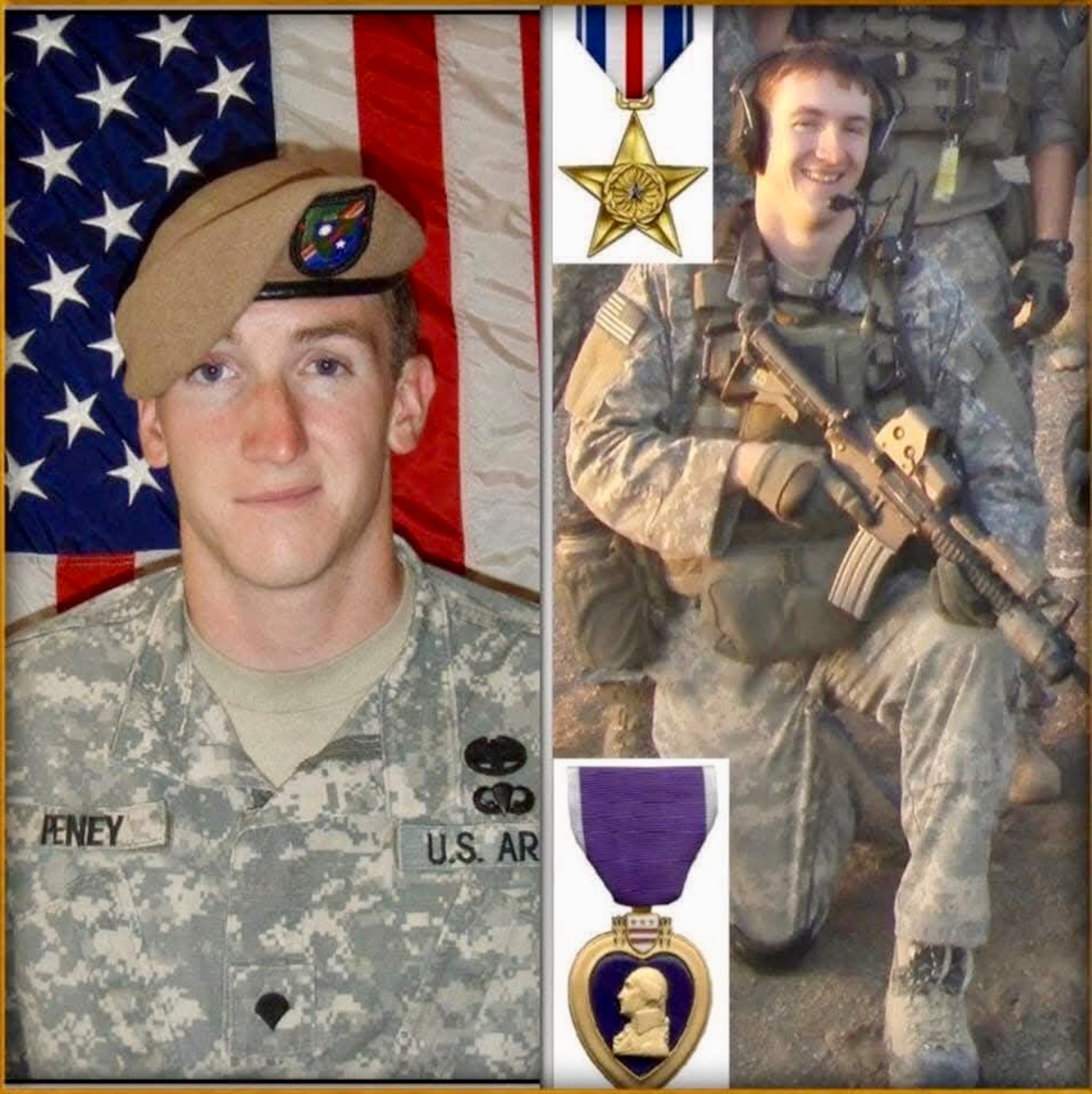
It has been nearly 16 years to the day that she last spoke to her son. They were on the phone. He was in Kandahar. It was Memorial Day weekend 2010. Jonathan was killed June 1.
Susan, as a mother might, told him, “I wish I could see your eyes.” They were blue. Jonathan, as a soldier or a 20-something might, said, “OK, mom, gotta go.” And that was it.
He had always told her, even as a child, that he did not expect to live a long life, that he was never growing old. She sobbed recently when she spoke of this. “Oh, damn,” she said, pushing back tears.
But here is why she keeps going, why she wants the lives of the fallen shared far and wide.
“The story has to be told because a lot of the general public forget what Memorial Day is about. They forget about all the fallen children,” she said. “Whether they’re 18 or 80, they’re somebody’s child or husband or wife. They’re someone that signed their life away to protect America.”