As US plans fewer troops in Germany, Europe sees need for bigger role within NATO

YEREVAN, Armenia (AP) — European leaders on Monday said President Donald Trump’s surprise decision to pull thousands of U.S. troops out of Germany is just the latest signal that Europe must take more responsibility for its security.
The Pentagon announced last week it would pull some 5,000 troops out of Germany, but Trump told reporters on Saturday the U.S. plans on “cutting a lot further.”
Trump offered no reason for the move, which blindsided NATO. But his decision came amid an escalating dispute with German Chancellor Friedrich Merz, who said the U.S. has been humiliated by Iran in talks to end the war it launched with Israel on Feb. 28. Trump has also expressed anger over European allies’ reluctance to get involved in the conflict.
European leaders meeting at a summit in Yerevan, Armenia, sought to both downplay the impact of 5,000 fewer troops in Germany while acknowledging that it provides a useful nudge for the continent to step up its role within NATO.
“I do not see those figures as dramatic, but I think they should be handled in a harmonious way inside the framework of NATO,” said Norwegian Prime Minister Jonas Gahr Støre.
British Prime Minister Keir Starmer said “there needs to be a stronger European element in NATO, I have no doubt about that.”
Tensions within NATO have mounted since the second Trump administration came into office last year warning that European allies would have to defend themselves and Ukraine in the future. Talks on ending the war there, now in its fourth year, have bogged down as the U.S. focuses on Iran.
Taken by surprise
The European Union’s foreign policy chief, Kaja Kallas, said the timing of Trump's announcement came as a surprise, even though there has been “talk about withdrawal of U.S. troops for a long time from Europe."
Asked whether she believes Trump is trying to punish Merz, Kallas said: “I don’t see into the head of President Trump, so he has to explain it himself.”
Merz did not attend the European Political Community summit in Yerevan, which included about 30 European leaders, plus Canadian Prime Minister Mark Carney.
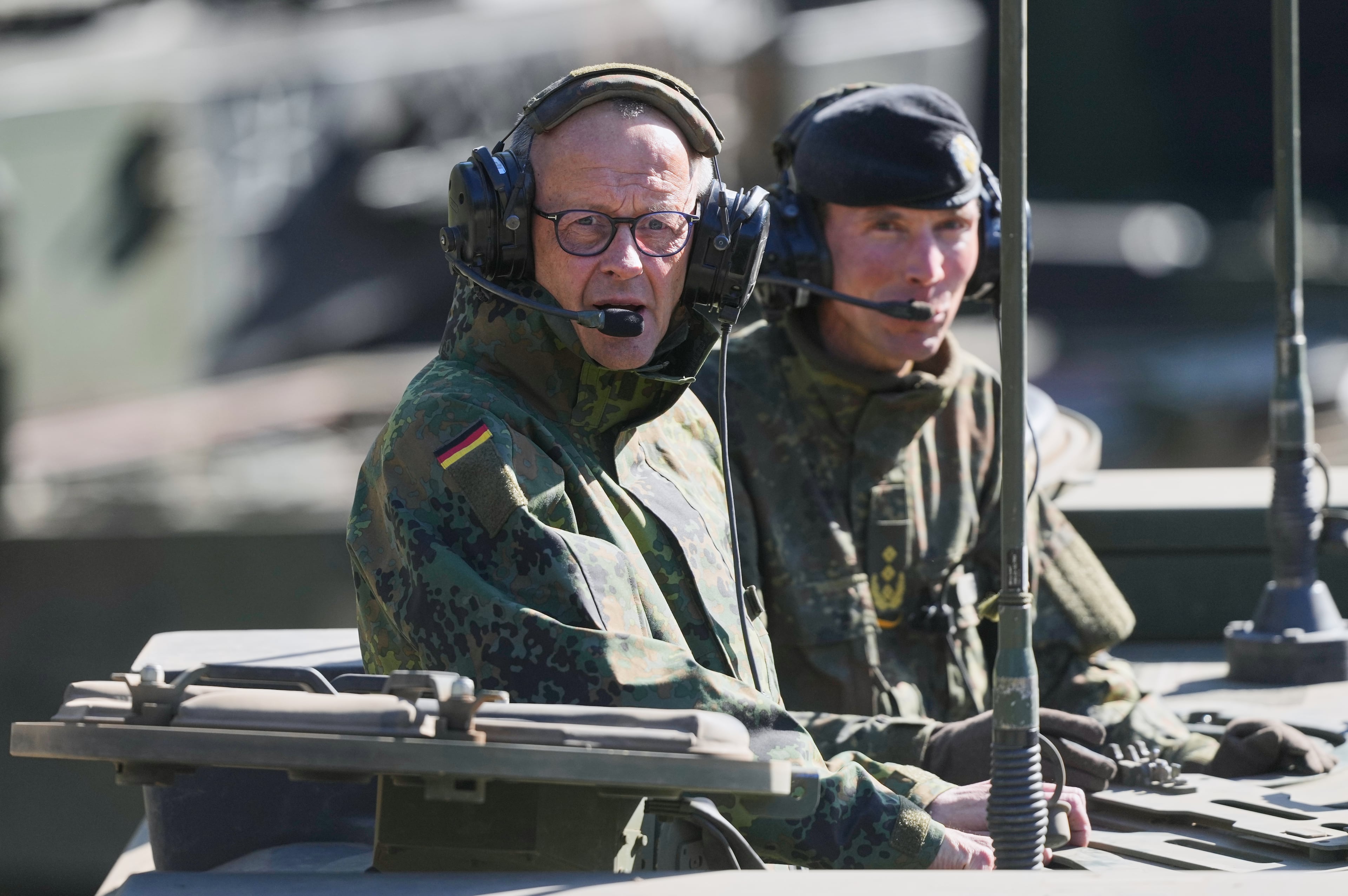
At a military exercise in northern Germany, the country's defense minister, Boris Pistorius, said Berlin has not yet received “official confirmation of when and how this is supposed to happen, on what scale.” The reduction of U.S. troops “would not put into question NATO’s deterrence capability," he added.
European countries and Canada have increased defense spending and military recruitment efforts over the last year in response to Trump’s threats.
NATO seeks clarity
NATO Secretary-General Mark Rutte also played down the significance of fewer U.S. troops in Germany, while acknowledging U.S. “disappointment" about the level of European support for the Iran war.
France and the U.K. have given U.S. forces limited use of bases on their territories to attack Iran. Spain has outright denied U.S. forces the use of its airspace and bases.
Rutte, who has championed Trump’s leadership at NATO despite the U.S. president’s criticism of a majority of the allies, said: “I would say the Europeans have heard a message.”
European allies and Canada have known since early last year that Trump would pull some troops out of Europe — and some were pulled out of Romania in October — but U.S. officials had pledged to coordinate any moves with NATO allies to avoid creating a security vacuum.
NATO spokesperson Allison Hart said over the weekend that officials at the 32-nation military alliance “are working with the U.S. to understand the details of their decision on force posture in Germany.”
Iran and trade trouble
With the ceasefire between the U.S. and Iran looking shakier, Rutte said European nations “have decided to pre-position assets, key assets, close to the theater for the next phase.” He provided no further details.
European leaders have insisted their countries would not help police the Strait of Hormuz, a key energy trade route, until the war is over.
“If the United States is ready to reopen Hormuz, that’s great. That’s what we’ve been asking for since the beginning,” said French President Emmanuel Macron. But he underlined that Europeans are not ready to get involved in any operation “that does not seem clear.”
___
Cook reported from Brussels. Associated Press writer Geir Moulson in Berlin contributed to this report.