5 things we’ve learned so far about the Georgia Guidestones explosion
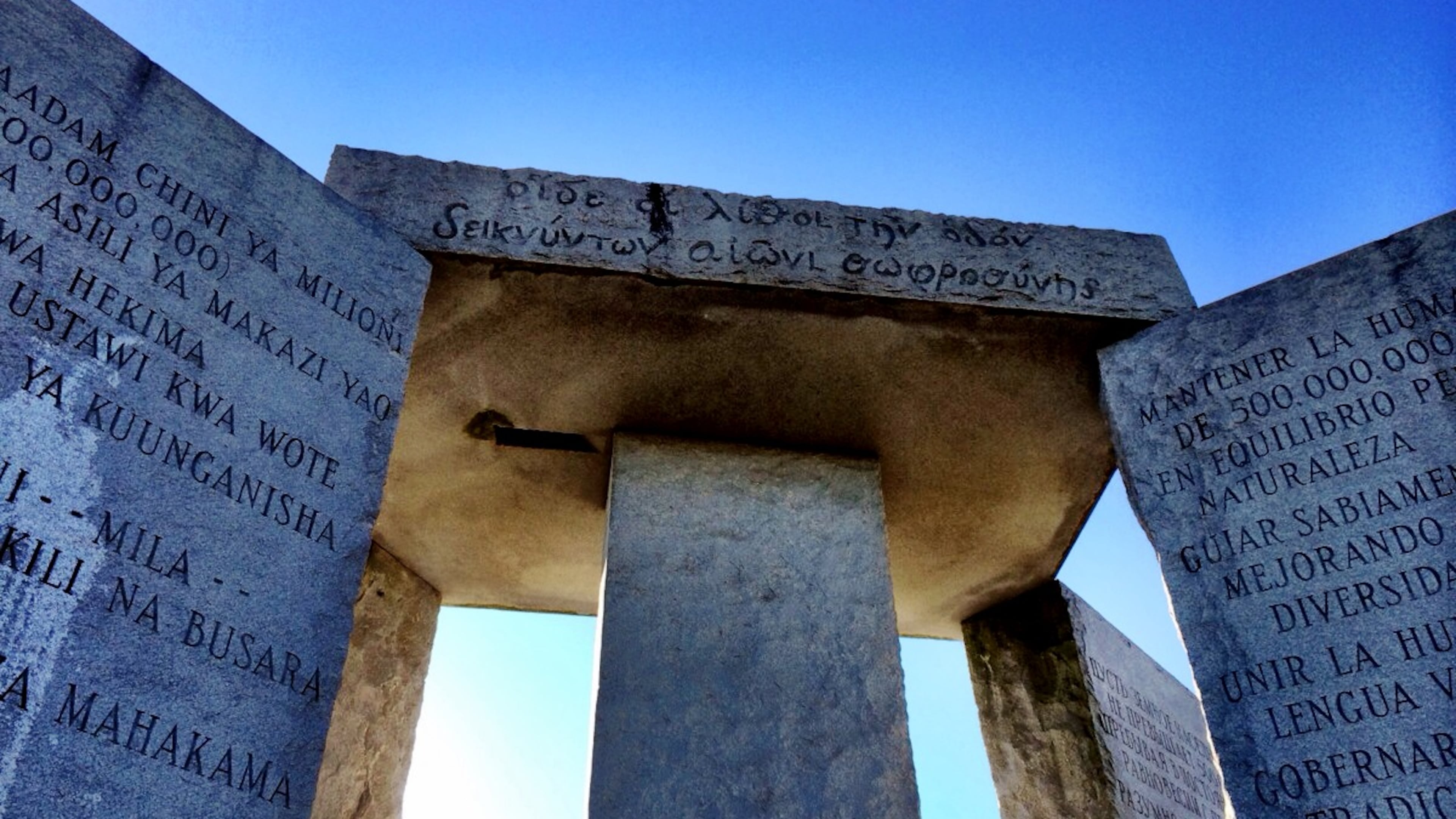
In the nearly four years since the Georgia Guidestones were blown up under the cover of darkness, little has surfaced about the attack.
Authorities have released scant information about the explosion, which sent a cloud of gravel shrapnel across the Elbert County field where they once stood. The only public image of the attacker — or attackers — appears as a speck in a short, grainy clip of the explosion. No one has been arrested or charged.
Mystery has surrounded the Guidestones since the Stonehenge-like granite slabs were erected in 1980 between Athens and the South Carolina state line. They were financed by an anonymous group of professed evangelicals since linked to racist eugenicist beliefs.
The stones carried hand-carved commandments in eight languages. Their first admonition: Keep the world population below 500 million, a guideline that would have required the population to fall by almost 90%.
The messages were a lightning rod of controversy and attracted elements of the occult to the quarry town of Elberton, meaning the lineup of potential suspects in the July 2022 explosion was wide open.
But The Atlanta Journal-Constitution’s podcast “Who Blew Up The Guidestones?” has been methodically narrowing the field. Here’s what the podcast’s investigation has unearthed so far.
1. They were likely destroyed with easy-to-buy explosives.
Blowing up a huge slab of rock requires considerable firepower, and in the aftermath of the Guidestones explosion, speculation focused on an obvious target: the dynamite powering Elberton’s granite quarries.
The self-proclaimed Granite Capital of the World is well-stocked with explosives and people who know how to use them to extract stone for monuments and headstones, the thinking went. Could one of them have absconded with dynamite and used it on the Guidestones?
Apparently not.
The podcast revealed that law enforcement surveyed local quarries and found their explosives were all accounted for. What’s more, explosives expert Scott Sweetow reviewed footage of the explosion for the podcast and quickly homed in on another possibility.
Sweetow, who once ran the Atlanta division of the Bureau of Alcohol, Tobacco, Firearms and Explosives and investigated the Centennial Olympic Park bombing, said the giveaways are the gray smoke and instant damage. Those factors rule out plastic explosives like C-4 and the low explosives often used in pipe bombs.
The more likely explanation, Sweetow told podcast host Tyler McBrien, is an exploding target mixture like Tannerite, which blows up when struck by a bullet or, less commonly, a detonator known as a blasting cap. The podcast team confirmed with a local official that Sweetow was correct: Investigators found Tannerite at the site of the explosion.
Exploding targets are easy to come by: They’re sold at sporting goods stores, and in Georgia, their sale is not restricted.
2. The culprit — or culprits — were likely driving a particular BMW.
The Georgia Bureau of Investigation released short video clips of the explosion soon after it happened. A surveillance camera captured a silver sedan speeding away from the site, but the grainy picture made it hard to see clearly.
But the AJC learned that Elbert County authorities had a higher-quality version — and obtained a copy after requesting it from the county.
That revelation led to a breakthrough. Guidestones podcast producer Ian Enright scrutinized the car’s dimensions and details and determined it was likely a BMW. Then, with help from a Reddit niche community focused on the German carmaker and after comparing the footage to 3D models of the likely options, they made an even more specific ID.
His conclusion: Whoever blew up the Guidestones likely fled in a BMW E90, model year 2006 to 2008, with a moonroof.
3. The Guidestones are still in Elbert County.
Social media yielded another breakthrough in the case: the monument’s resting place.
After the podcast team posted a public call for leads, a tipster named Alton Mercer reached out and said he knew where the granite slabs were taken after the county removed the remnants. They were in his quarry.
In Mercer’s telling, the Guidestones were dropped off without warning while he was on vacation, left in a scrapyard of granite pieces less than five miles from where they once stood. The AJC’s team confirmed his account by traveling back to Elbert County and setting eyes on the stones’ remnants and their hand-inscribed messages, which now lie among weeds and discarded granite projects.
Mercer says the GBI and other authorities haven’t asked to see them.
4. Kandiss Taylor says GBI didn’t contact her about the explosion.
Kandiss Taylor campaigned for the Governor’s Mansion in 2022 in part on a promise to destroy the Georgia Guidestones.
In her first interview on the subject in years, Taylor described her plans to issue an executive order demanding their removal as something of an afterthought. She wanted to unveil 10 orders she’d sign upon taking office, but only had firm plans for nine. The Guidestones filled the last spot.
Her pledge renewed public scrutiny on the monument and the apparently pro-eugenics message it espoused. It sparked a new wave of calls for its removal by Elbert County government, and it predated the explosion by only a couple months.
Nevertheless, Taylor told McBrien she did not hear from GBI about the explosion.
In fact, her first contact with law enforcement about the Guidestones came after she was the victim of a swatting incident several days after the monument was destroyed. Taylor said she received an onslaught of angry calls and messages that week, culminating in a hoax 911 call claiming someone had been shot at her house.
It was Taylor who invoked the potential connection between the swatting hoax and the Guidestones explosion, according to audio of the incident at her home obtained by the AJC. She said she hasn’t heard from GBI since the swatting investigation.
5. The podcast unearthed a lead the GBI is now investigating.
The podcast’s final episode yielded a new line of inquiry in the GBI’s investigation of the Guidestones bombing.
The AJC learned that a man in Elbert County was arrested several years ago in upstate New York on suspicion of making explosive devices. The man, whom the AJC is only identifying as Eric because he has not been accused in connection with the Guidestones explosion, has a troubling online presence.
He listed his job on one profile as “the apocalypse.” He posted often about numerology and terrorism. And he lived on land owned by another man, Kenneth, who had made posts online calling the Guidestones satanic and expressing support for Taylor. Kenneth is in the business of fixing and selling old cars, including at least one BMW. (New York authorities did not prosecute Eric’s 2014 explosives charge.)
In interviews with the podcast, Eric and Kenneth said they had not been contacted by the GBI. Both denied involvement in the Guidestones bombing. But speaking with McBrien, Eric said he came to Elberton to “kill people,” referred to himself as a terrorist and suggested the Guidestones explosion was timed to align with a passage of Scripture.
McBrien reached the former lead agent on the Guidestones case. She said she had never heard of the men. He also spoke with Elbert County’s sheriff, who said he’d been unsuccessfully trying to talk to GBI about the case. He said he wanted to talk with Eric and Kenneth.
In response to the podcast’s questions, the GBI confirmed it is treating the two men as an active lead in the case.