‘Theo of Golden’: The story behind the breakaway novel and its Georgia author


COLUMBUS — About seven years ago in this riverside city, a man walked into a coffee shop. He saw portraits on the walls. And he had the idea that would make him a bestselling novelist.
“Theo of Golden” was self-published in 2023. It was picked up last year by an imprint of Simon & Schuster. Late last week, it was #1 among all the books on Amazon. It has sold more than 750,000 copies.
Allen Levi’s novel does not involve spies or guns or forbidden romance. Indeed, the absence of those things makes the book seem almost radical.
It’s about a mysterious stranger who comes to a town a lot like Columbus, next to a river a lot like the Chattahoochee. The old man walks into a coffee shop and sees portraits on the walls. He buys a portrait of a woman with a kind face, gives it to her, and tells her she is “capable of saintliness.”
The book’s protagonist is a careful observer of the world. He notices the birds and the sunsets. He looks closely at the faces of the people in the portraits that he buys and bestows. In those faces, he sees weariness and loss. “Theo of Golden” is about the importance of seeing each other with clarity and kindness in a world filled with both joy and sadness.

The author does not laugh the way he used to. But he is a cheerful man, and one day in January he returns to Fountain City Coffee in Columbus and looks again at the portraits.
“I recognize that voice,” says a woman he doesn’t know. Her name is Liz Lampton. She remembers hearing him on the audiobook of “Theo of Golden,” where he makes a brief appearance. They have a conversation.
The book says that Theo spent only a year in Golden, “long enough to create a current of his own and to catch others in it.” Levi grew up here in Columbus, went to high school here, practiced law here, played music here, created a world that resembles this place, and to watch him walk around this west Georgia city on a Thursday afternoon is to see the ripples from his own forceful current. People keep coming up to him, talking about the book. On the sidewalk he sees Sheryl Shehane, the inspiration for one of the novel’s characters, and they embrace.
“I love you,” Levi tells her.
“I love you too,” she says.
In the fictional town of Golden, people keep wondering who Theo really is. And if you read the book, you may wonder whether Theo is based on a real person — and who that person might be.
These questions are intertwined with the question of how the book was written, and that one is inseparable from the question of how Allen Levi became the man who could write it.
The book and its backstory blur the lines between life and art. In “Theo of Golden,” the portraits were done by a local artist named Asher Glissen, who becomes friends with Theo and has deep conversations with him about the meaning and purpose of art.
In real life, the portraits were done by a local artist named Garry Pound, an old friend of Levi’s. Pound says some of the conversations in the book sound almost identical to real conversations he had with the author. He drew a portrait of Levi in 2021.
In this pencil drawing, done while Levi’s novel was unfinished, Levi wears a striped button-up shirt with the sleeves rolled up. He holds an acoustic guitar. There is a faint smile on his face, and the residual proof of many other smiles in the lines around his eyes and mouth.
But there is something else in the eyes, some other unspoken feeling. If Theo of Golden looked at Levi’s portrait, he would notice the same thing he noticed about so many other faces.
“Asher,” Theo tells the artist in the novel, “in every face I detect sadness.”

***
While the novel is set in a fictional version of Columbus, Levi lives about 30 miles north, near a town called Hamilton. This is where he wrote the book, and where he drew inspiration for at least one of the main characters. It is also where he found joy in a time of overwhelming sadness.
Early one morning at a Christian outreach center in Hamilton, Levi calls the Front Porch Gang to order. About 30 men sit on folding chairs in a little room with cookies on a side table and a dispenser of coffee on a rolling cart.
They are here to study the Bible and support each other and plan such good works as a luncheon for local elementary-school teachers. Most of the men are over 50, a mixture of white-collar and blue-collar, and Levi embodies this range with his work boots and Carhartt pants contrasting a dress shirt fit for a college professor. The late professor C.S. Lewis is one of his favorite authors, and he holds a copy of “The Quotable Lewis” in his weathered hands.
Today they are studying the Epistle of James, a passage about perseverance in hardship. One man mentions his departed wife. Another brings up his prostate cancer. A third is near tears as he refers to a situation that others in the room seem to know and understand.
“Thank you all for being men who persevere,” Levi says.
Hamilton is the seat of Harris County, about 85 miles southwest of Atlanta. The Front Porch Gang grew out of an unusual project undertaken by a smaller group of men that included Levi’s younger brother, Gary, a missionary whose work took him from Afghanistan to the Peruvian jungle. When Gary wasn’t traveling the world, he lived in a house across a pond from his brother’s house. And he saw Harris County as a mission field.
So, the unusual project. Gary Levi and a few other men wanted to pray for the children at Harris County High School. Not just some of them. All of them.
“And so they prayed, passing a high-school yearbook around and reading names until all fifteen hundred had been spoken out loud,” Allen Levi wrote in “The Last Sweet Mile,” his first book, a memoir published in 2015.
Harris County Sheriff Mike Jolley speaks fondly of both Levi brothers. Gary taught the sheriff to play the banjo and served as his spiritual adviser. All three men stood outside the high school in the mornings, holding open doors and greeting the students. Jolley called it a “ministry of presence,” which is an apt description of Theo’s work in Golden. This friendliness still pays dividends. Sometimes a student will mention an upcoming party, giving Jolley a chance to talk about the dangers of drunk driving. Jolley has been sheriff since 1993. During that time, he says, no local high school student has ever caused a fatal drunk-driving crash.

In 2014, a local probate judge retired. The sheriff knew that Allen Levi had been an attorney in Columbus, and he encouraged him to run for the position. Levi reluctantly agreed. He easily won the election and served two years on the bench, handling estates and various misdemeanors. Judge Levi tried to err on the side of mercy.
“He would dispense justice,” Jolley remembered, “and it was tempered with kindness.”
Near the end of the Front Porch Gang’s weekly meeting, just before the doxology and the closing prayer, a man looks across the room at the reporter seated next to Levi.
“You’re sittin’ by a man who’s very humble,” says Scott Lightsey, a retired paramedic who also serves as a Harris County commissioner.
“He’s very well-loved in this community,” Lightsey says of Levi.
“I think everybody here’d fight for him.”
***
Outside the morning is cool and humid, the horizon softly glowing. Levi gets in his truck and drives down U.S. Highway 27. Thursday is his “catch-all” day, the one weekday he doesn’t spend writing. He parks the truck outside an elementary school.
“This is, without a doubt, my favorite hour of every week,” he says.
He walks into the school, checks in at the desk and goes through a network of halls to a second-grade classroom. It’s hard to describe what happens next, and it may be hard to believe. But this is an eyewitness account. The children come running to him. They hug him. They call out his name. “Mr. Levi! Mr. Levi!” He sits down on the floor, crisscross applesauce just like them, and they fill in around him like the sea around an island.
Levi puts on his glasses and begins to read from “The One and Only Ivan,” by Katherine Applegate, a novel whose narrator is a gorilla. Levi occasionally stops to call on children by name. He pauses to look at them, to emphasize certain lines.
“So,” he says. “Could a gorilla really write a book?”
“No,” the kids say.
Their teacher is Leah Doughman, Harris County’s current teacher of the year. High on one wall is a series of encouraging messages for the children. They were not written by Theo of Golden, but they could have been.
YOU ARE SMART
YOU ARE BEAUTIFUL
YOU ARE STRONG
Levi keeps stopping to ask questions about the text. A boy in a Ronaldo jersey sits in front of him, putting his face down close to the book, as if trying to inhale its power.
Levi finishes the excerpt and moves on to the next book: “Bark, George,” the 1999 classic by Jules Feiffer. This book was a gift to Levi from a woman who read his novel, and the story behind that gift is worth a brief diversion.
Lora Cooley is a retired teacher in Gainesville, Georgia. Last year she heard about “Theo of Golden” from someone in her church book club. She and her husband, Jody, read the book to each other. Jody did most of the reading, because Lora can’t read as well as she used to. She has two terminal illnesses: a brain tumor and leukemia.
The Cooleys loved the book, and Jody got an idea. Time was short. He was running out of chances to do special things for his wife. Jody called up an old friend who knew Levi and made some arrangements. He asked Lora to go on a trip with him. Where were they going? It was a surprise. They drove south and west, into the country.
“I’m thinkin’, where is Jody taking me?” Lora recalled.
When she realized they were approaching Allen Levi’s house, she burst into tears.
“He just bounded off the porch,” Jody said.
“Like a Labrador puppy,” Lora said.

Levi was ready for them. He set out coffee and creamers and cookies and fruit and crisps with cream cheese. They talked about life, and the book. Jody asked Levi to read the ending aloud, and he did. Levi asked Lora to name her three favorite books. She had to think about it. Once she came up with an answer, she sent copies of the three books to Levi: “Pete the Cat,” by James Dean; “The Hundred Dresses,” by Eleanor Estes; and of course “Bark, George,” which Levi now holds as he sits on the carpet of the second-grade classroom.
It’s about a dog who keeps making the wrong noises. Meow. Quack. Oink. Moo. There is a reason for this, a horrifying but somehow hilarious reason, and the children listen to Levi with audible delight. As the veterinarian reaches down George’s throat, pulling out larger and larger animals that he has apparently eaten, the children loudly read along with Levi. The vet reaches DEEP DEEP DEEP down George’s throat.
“DEEP DEEP DEEP,” the children say.
Levi clearly knows something about keeping an audience. The numbers for “Theo of Golden” have been astounding. Kate Nintzel, editorial director of Atria Books, the novel’s publisher since late last year, says sales doubled from the first week to the second. And they didn’t fall off after the holiday giving season. They kept rising.
“Last week we sold the most copies of ‘Theo’ that we have sold in the entire time that we’ve been publishing it,” she said in late January.
Likewise, reader email has proliferated. Levi’s niece Aron Ritchie, who helped him self-publish and market the book, used to respond to all the emails. From 2023 to 2025, she’d get 10 or 20 per day. Then they increased so sharply that Ritchie had to hire a friend so they could keep up.
The stories in those messages hint at an impact for “Theo of Golden” that goes beyond mere numbers. Ritchie says they come from men who cried after reading it, from women who read it after suffering some great loss. One woman read it to her 104-year-old mother. Some people keep reading it to themselves, and some keep buying it for others. Once a month, his niece sends Levi a curated list of readers to contact. He loves making those calls.
Levi said he spoke with a woman in Chicago, a retired teacher named Carol. She was leading a book club over Zoom, but she was sick and had only a few months to live. She wanted “Theo of Golden” to be the last book they read together.
Levi attended one of the Zoom calls and talked about the book. He and Carol kept in touch. One day she called him and said she was going into hospice care. The next time he called her, she didn’t answer. Not long after that, her niece called to say Carol was gone.
“It is another of life’s great mysteries that sadness and joy can coexist so compatibly with one another,” Theo says in the book. “In fact, I wonder if, on this side of heaven, either one can be complete without the other.”
***
Back in the truck on a gray morning, heading for the place where he wrote the book, Levi passes through the town of Hamilton. A small city, technically, with a population of about 1,800. There’s the Circle K, and there’s the First Peoples Bank. Hamilton goes by quickly.
Levi once wrote a song about the people who live here. He called it “People In My Town.”
Every one some fact and fiction
Every one a hungry heart
Every one a first edition
Every one a work of art
Levi has been a writer for most of his adult life. More specifically, a songwriter.
On Nov. 18, 1980, The Red and Black student newspaper published a story about a promising young musician at the University of Georgia. He was a 24-year-old law student who sang and played his guitar around campus. He played at fraternity and sorority houses. He sang for children in hospitals and inmates in the county jail. Friends marveled at his talent.
“He has the uncanny ability to create a story out of a few scribbled words he writes between classes,” staff writer Susan Morris wrote. “The music flows from there.”
The story noted that Levi “projects optimism with each strum of his guitar.” It said he’d written a song for his little brother, Gary. It pointed out the subtle Christian messages in Levi’s songs. It described him as a happy man who makes others happier with his music. It quoted him as saying, “I’m happy ‘cause I’m heaven-bound.”
Levi’s next 40 years are not easily summarized. Seen from a distance, they look a bit like wandering.
He tried being a lawyer, made partner at a firm in Columbus, sharpened his storytelling skills in front of juries. He traveled the world, getting a literature degree in Scotland, sometimes visiting Gary in one distant mission field or another.
He recorded close to two dozen albums in his home recording studio and wrote hundreds of songs, possibly thousands. Not one became a hit.
But Levi found and shared joy with his music. At youth camps and corporate events and house concerts, with a voice reminiscent of James Taylor, he sang about wonder and beauty. He liked to make the audience feel special by writing a new song just for that night.
Three decades later, a man named Zac Slay still remembered a song Levi wrote. Slay was born with cerebral palsy and “just never imagined climbing a mountain,” he wrote in an email. But at a Young Life camp in Colorado in 1996, he joined a group climbing Chrysolite Mountain, whose summit stands at more than 12,000 feet. Slay fell behind his friends. Levi locked arms with him and stayed with him all the way up and all the way down. Then he wrote and sang a song about the experience.
It was like a portrait Theo of Golden might give.
In his email, Zac Slay quoted the song:
The strong made it up with no trouble it seemed
Some made it barely at all
I took it slow with my good brother Zac
And oh what a landscape we saw
Levi was 62 or 63 when he walked into the coffee shop in Columbus and thought about the portraits. A retired lawyer, a former judge, a musician without much fame or fortune. Never married, no children. He was late in his life, and just starting. It was 2019. He told friends he was going to try writing a piece of long fiction.
***
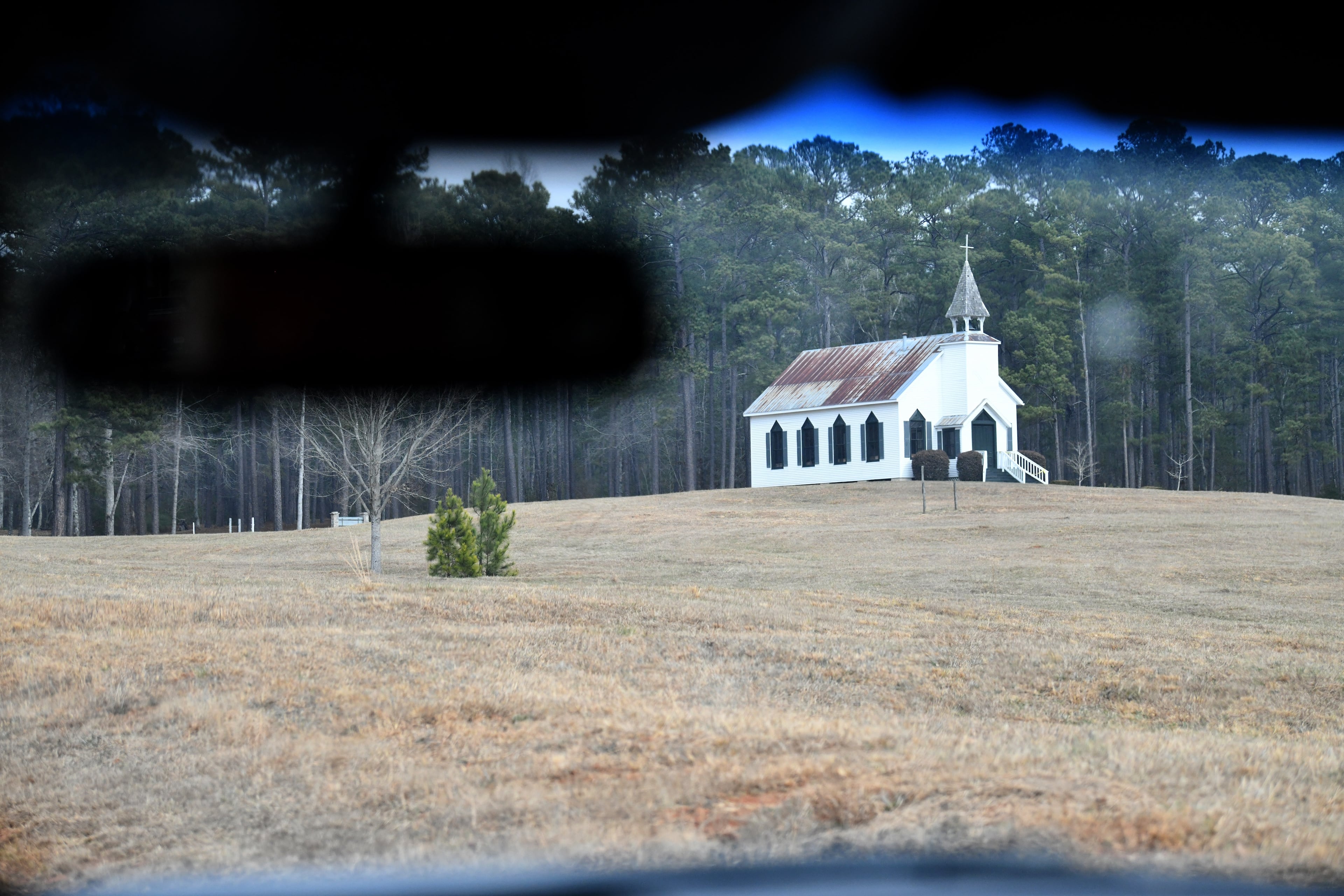
Levi slows down the truck and turns left onto a long gravel driveway. At the top of a rise, a small church is visible in the distance. For decades, before the property was sold, it was the Levi family chapel. It hosted weddings, concerts and other special occasions. Levi’s father, A.C. Levi, who is 98, had it moved to their land from its original location in Alabama.
There is a small cemetery outside the church. One grave belongs to Levi’s mother, Hilda Levi, who died in 2018 at the age of 89.
The truck pulls in by a modest one-story house with a big front porch. Yellow winter fields stretch out to the north. Birds call, and wind chimes ring.
“This is home,” Levi says.
Levi moved here in 1992. His father was a forester, and they owned about 1,500 acres, some of it pasture and some of it pine forest. The parents lived in one house. Allen lived in another. Gary lived in a third. The brothers’ houses were across a pond from each other, close enough that Allen could hear Gary playing his saxophone.
When Allen started his novel, writing with pen on paper before typing it out on a screen, he sometimes wrote at Gary’s house. At the dining-room table, perhaps, or in a rocking chair on the porch. He liked to write with background music. Movie soundtracks were best. Something instrumental and dramatic. “Meet Joe Black” or “Finding Nemo,” both from the composer Thomas Newman.
It took about three years to finish a draft. He didn’t know if he could do it, didn’t know if he had the perseverance, but it turned out he did. He kept building the characters until he fell in love with them. Theo came to life, and with him the ragged saints of Golden. Finally, Levi was ready to share the draft with some friends.
Bart Scarborough got another friend to print the manuscript for him. One night he stayed up late reading it. When he finished, and sent Levi a voicemail or voice memo, he was still crying. The message was so convincing that it helped Levi make up his mind. He called his niece and told her they were going to publish this book.

Aron Ritchie did a lot of things right in the publication and marketing of “Theo of Golden”: She reached out to hundreds of people he knew, built him a good website, promoted the book in various Facebook groups, made sure the cover looked good. But those tactics can only do so much.
“It’s the book that sold itself,” Ritchie said. “It’s the book. You could do everything I did with another book and sell 250 copies in its lifetime.”
At the center of the book is Theo, an 86-year-old Portuguese man who loves good coffee and good conversations. In an interview, Levi’s friend Scarborough was asked about Theo. Does this fictional character remind him of anyone he knows?
“It reminds me of Allen,” Scarborough said, and then chuckled. “He wouldn’t want to say that, but it does.”
Scarborough is right: Levi does not want to say that. In a long conversation over coffee at his table, Levi mentions Golden’s fictional bookstore owner, Tony, a man whose gruffness conceals his lonely desperation.
“And don’t for a minute think that, that I set myself up as the Theo character,” Levi says. “I’m probably a lot closer to Tony than I am to Theo.”
***
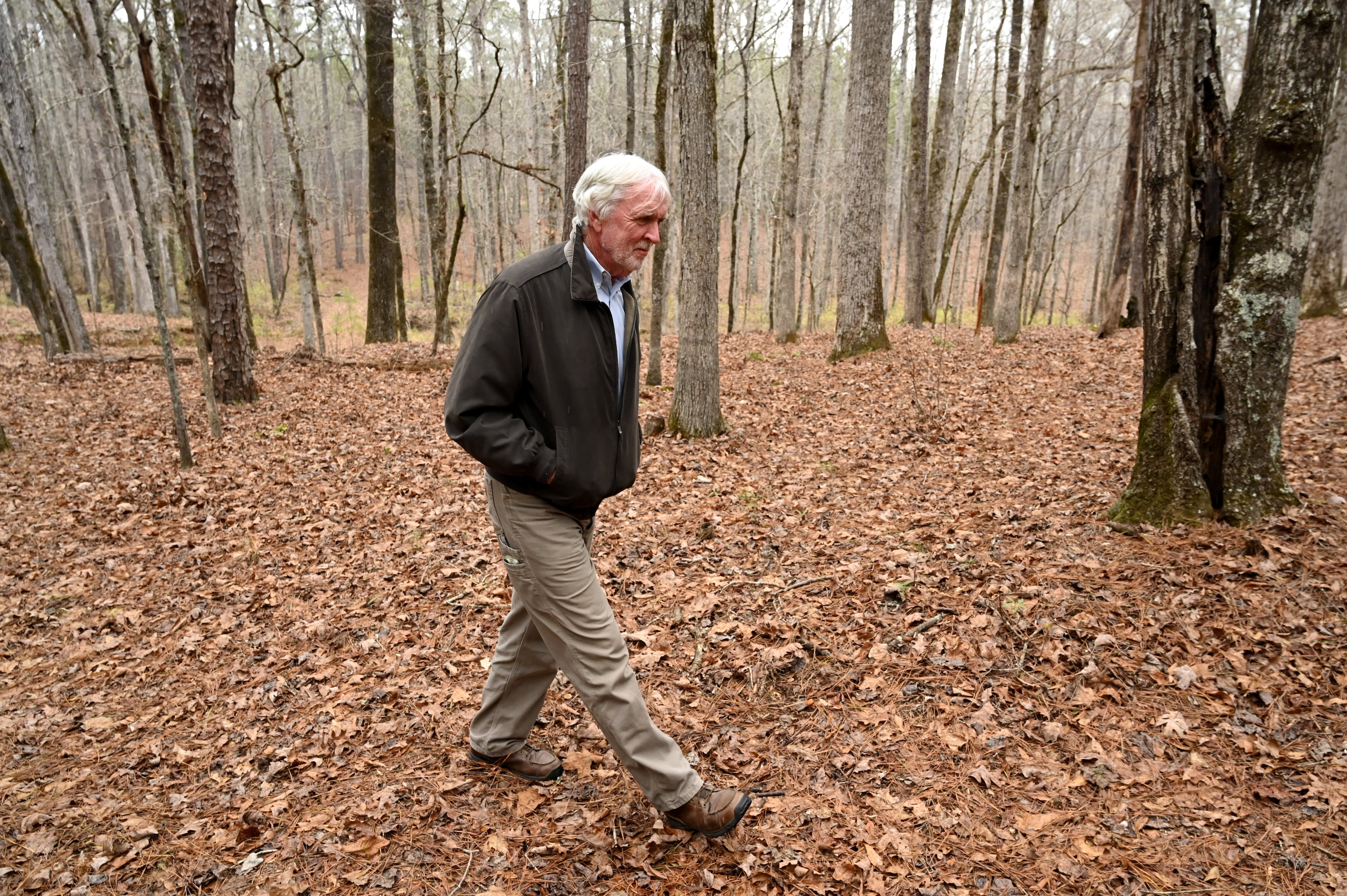
The tour will conclude outside the church, but first it’s time for a walk to the writing cabin. A light rain falls as Levi follows a winding trail through the loblolly pines. He is a tall man with white hair and striking blue eyes. Silvery raindrops collect on the back and shoulders of his brown jacket.

Here is the cabin, overlooking a pond, where Levi writes without internet or smartphone. The cabin has a bed, a guitar, a coffee maker, and plenty of books. Levi buys Pilot Better Retractable fine-point pens by the dozen and writes in journals with lined pages. His handwriting is very small.
For the last two years he has been writing a sequel of sorts, a novel based on one of the characters in “Theo of Golden.” His niece Aron has read a draft.
“Honestly,” she said in a phone interview, “I think it’s better than ‘Theo.’”
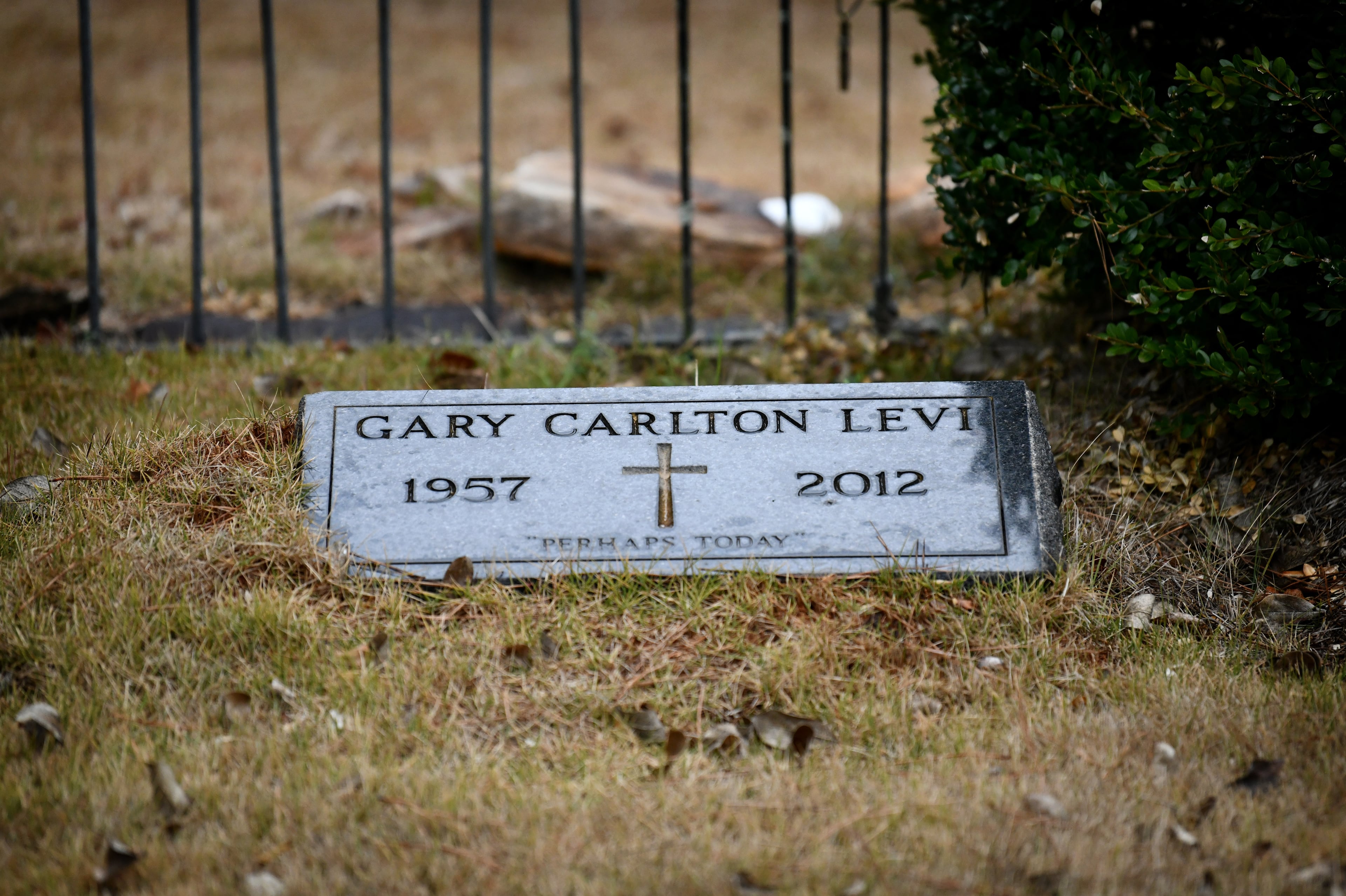
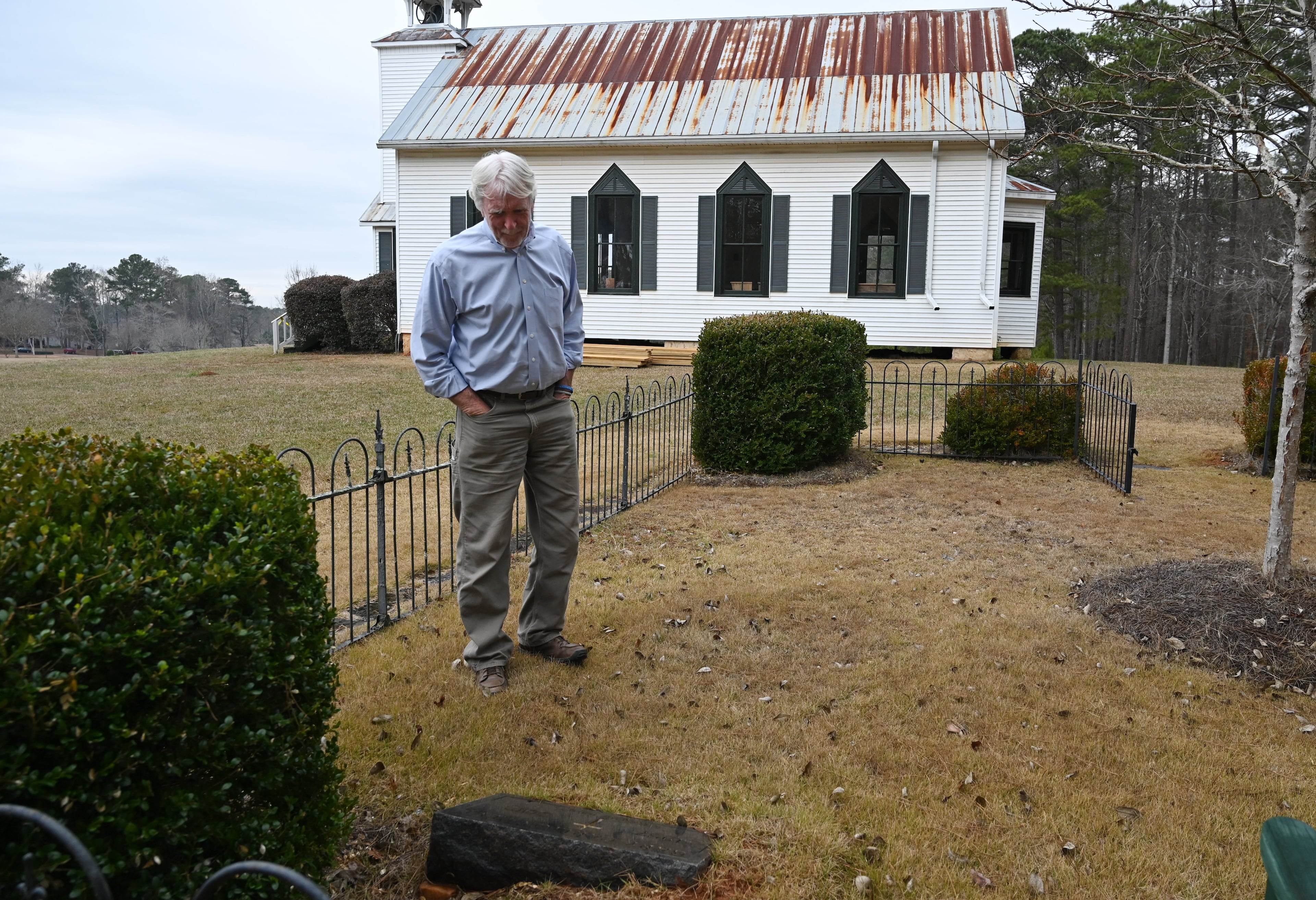
Back through the woods to the house. Levi gets in the truck and drives through the yellow fields to the old white church. He gets out of the truck. Near the church is a small black fence. Inside that fence is Gary’s headstone.
“It’s quiet, isn’t it,” Levi says.
In 2011, when Gary was 54, he was diagnosed with a brain tumor. Allen spent a year caring for his dying brother. They moved together into their parents’ house and slept in single beds a few feet apart. Close enough to reach across and hold hands in the dark.
In 2019, when Allen went to Gary’s house to write “Theo of Golden,” Gary was not there. But Allen felt the lingering presence of a modern-day saint. And there in the quiet, a character took shape. Someone who gave many gifts, and loved music, and saw everyone as a precious child of God. As time went on, Theo began to resemble a real person: Gary Carlton Levi, who died about seven years before Theo came to life.
Now, as he stands outside the church, with Gary’s headstone speckled by fresh raindrops, Allen Levi is asked what he would say to Gary if he could say anything.
“Miss you,” he says. “I love you. Can’t wait to see you.”
The birds are still singing, rainwater dripping from the gutters of the church, and there stands a man with work to do. The stroke of a pen, a chord on the guitar, a prayer from a list of names on a mirror. You can make your life a work of art.