‘Nobody invites friends over to microwave.’ — Big Green Egg CEO Dan Gertsacov
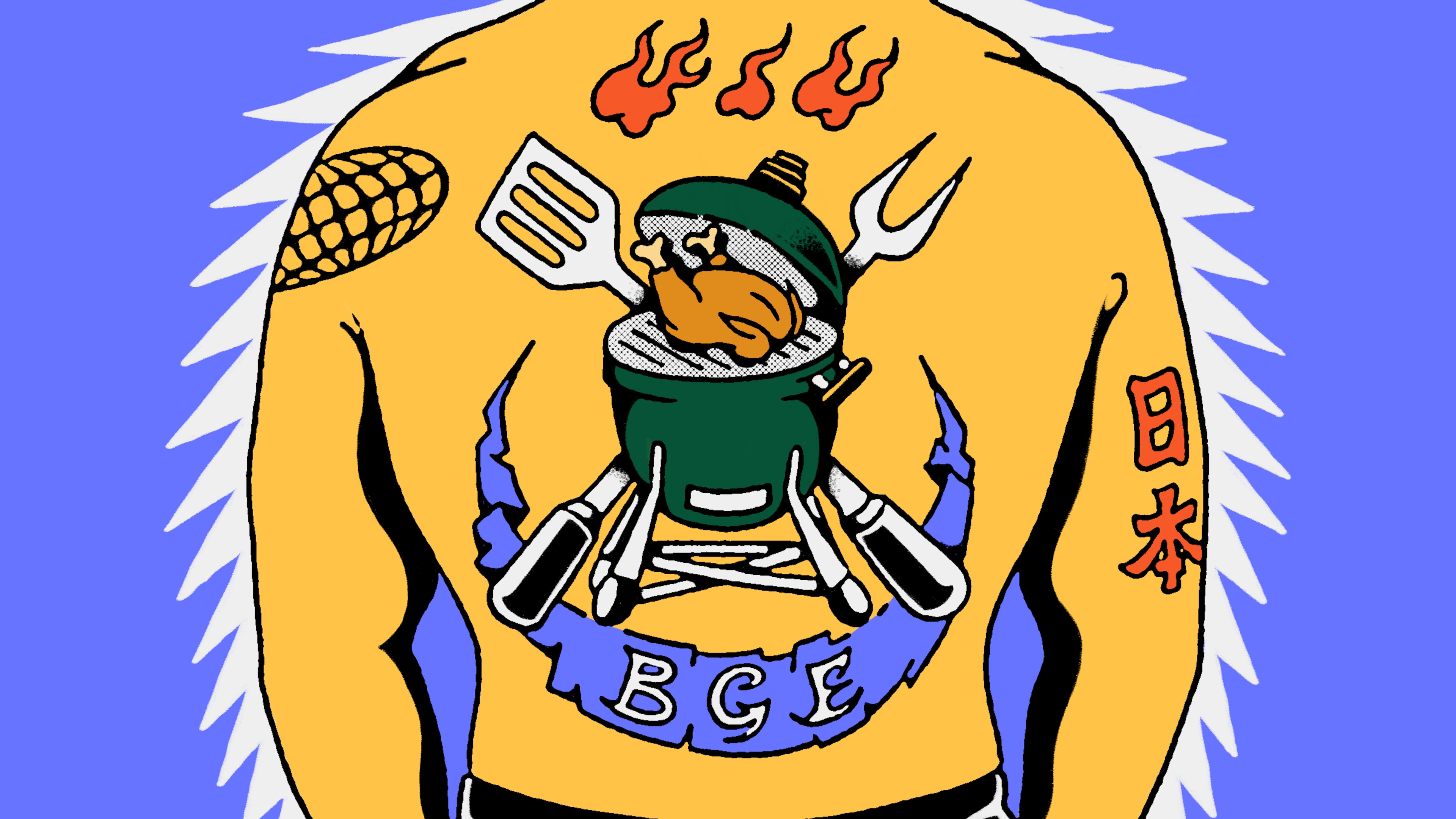

If you pull up your sleeve at the gates of Big Green Egg’s 29th Annual EGGtoberfest on Saturday at Gwinnett Field in Lawrenceville and reveal a permanent tattoo of a Big Green Egg, you do not pay admission for the event. You walk right in.
It is an official corporate gate policy established by the Atlanta-based barbecue icon, whose EGGtoberfest takes over the Gwinnett County minor-league ballpark on Saturday from 11 a.m. to 3 p.m. The flagship gathering resembles a cross between a Mardi Gras parade, an agricultural expo and a secular revival.
Across the outfield concourse of the stadium (formerly known as Coolray Field), more than 300 emerald ceramic domes will be set to temperatures ranging from 200 to 700 degrees. The Seed & Feed Marching Abominable, a street band of tutu-wearing brass players and majorettes, will be blasting through the haze of burning oak and hickory, while upward of 5,000 devotees, many wearing Big Green Egg T-shirts and “Certified EGGhead” aprons, will drift through the smoke, sampling pork belly burnt ends, Dutch oven cobblers, seared wagyu beef and wood-fired pound cakes.
Why Big Green Egg fans get tattoos of their grills
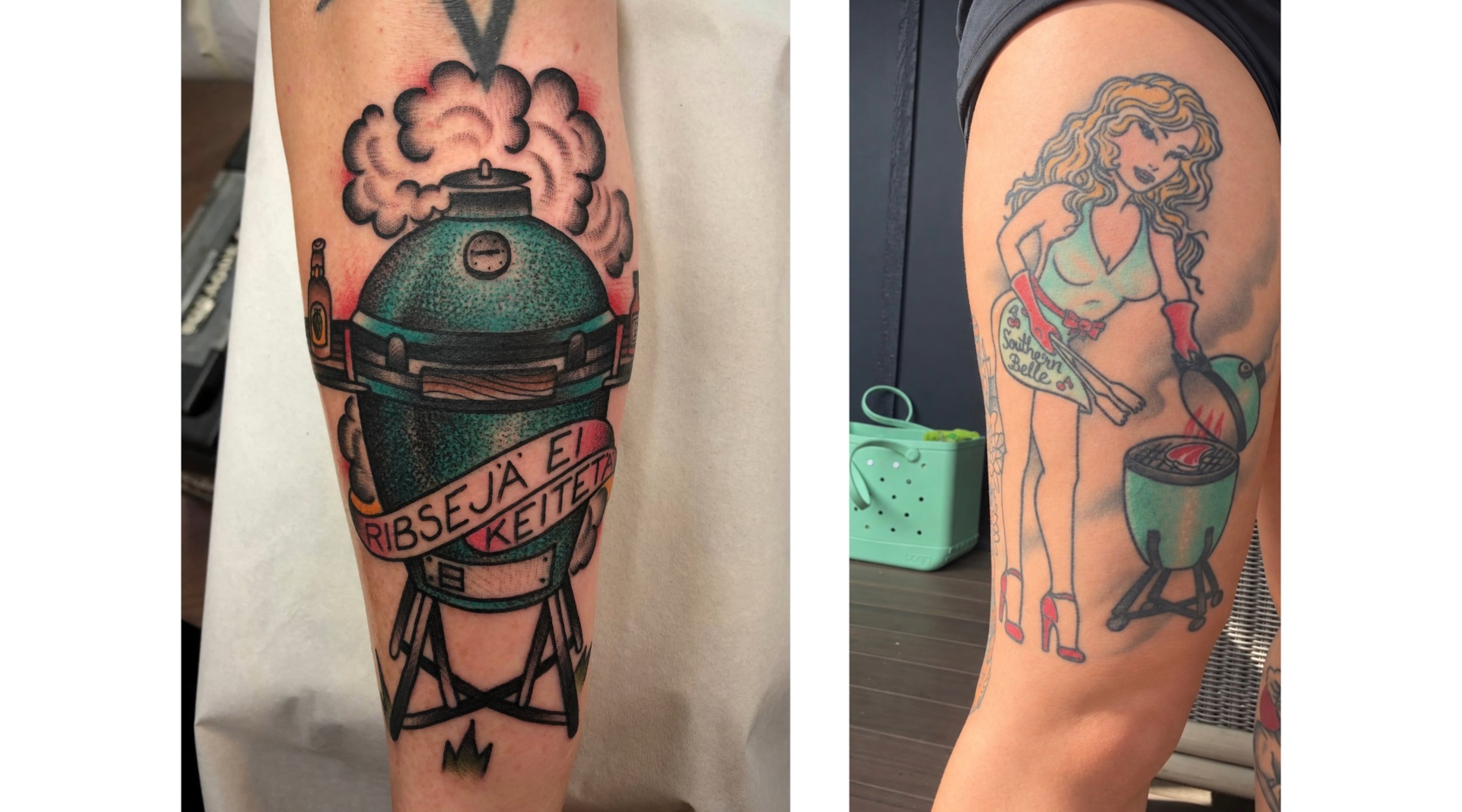
Among the devotees making their plans for October are cooks who have permanently etched the cooker into their flesh.
One of them is chef Taylor Carroll, who cooks on the brand’s namesake cooker (“the Egg,” for short) at the Big Green Egg culinary center in Doraville. She sports a pinup-style “Southern Belle” Egg tattoo on her right leg, which she got before she began working for the culinary center. Carroll got the ink after an off-campus rental house at Kennesaw State University with a cramped kitchen forced her to cook in the backyard on an Egg her father bought her.
Cooking on it every evening and posting her plates to fledgling online forums (she is now an administrator for the 121,000-member “Big Green Egg BBQers” Facebook group) eventually launched her 15-year culinary career.
Across the Atlantic in Helsinki, pitmaster Kaius Gestranius wears his own permanent tribute: a bold, American traditional design of an Egg flanked by flames and a cold beer, wrapped in a banner reading “ribseja ei keiteta” — Finnish for “Don’t boil ribs.”
Gestranius has never been to Gwinnett Field and has no plans to make the trans-Atlantic flight for the free gate pass. He got the tattoo simply because he views the cooker as the pinnacle of live-fire craft.
That devotion is all the more striking given the practical challenges of owning an Egg. The Big Green Egg is neither light nor cheap. Weighing upward of 150 to 200 pounds, it is an unwieldy ceramic monolith easily costing $1,000 to $2,000, a steep sum when mass-market gas and kettle grills sell for significantly less.
It requires muscle to move, cash to acquire and patience to master. Yet rather than dampening enthusiasm, that steep barrier turns a simple backyard appliance into a badge of honor.
To an outsider, it is easy to look at the resulting spectacle — the tattoos, patio rigs, the 100,000-plus-member internet forums — as extreme suburban hobbyism, an oddity of modern consumer culture. But talk to the people tending these ceramic hearths for more than five minutes, and you begin to see the deeper human story behind the obsession.

How cooking on the Big Green Egg became one man’s ‘chicken ministry’
In his office at the company headquarters off I-85, Big Green Egg CEO Dan Gertsacov keeps a running file of notices gathered from Google Alerts. They are not Wall Street mentions or retail analyst notes; they are obituaries.
To date, more than 100 published death notices across the United States have formally memorialized a late father, mother or spouse through their devotion to their Big Green Egg. People are listed as surviving military veterans, church deacons, beloved grandparents and lifelong “EGGheads” who fed their towns.
“Bart loved to entertain ‘at the table’, serving great meats cooked on his Big Green Egg, a compassionate friend who showed his love for others through gifts of food. He had an active chicken ministry,” the obituary for Bart Hotchkiss read.
“Whenever anyone in Midland was saddened by a death, or had surgery, Bart showed his love by taking them a smoked whole chicken off that Egg,” his widow, Sharla Hotchkiss, told The Atlanta Journal-Constitution from her home in Midland, Texas. “People in town started calling it his ‘chicken ministry.’ Folks used to joke that they didn’t want to die to get one, but it was a comforting thing.”
Sharla Hotchkiss said that Bart bought his first Egg at an outdoor expo in Salt Lake City. She initially thought it was the “strangest contraption she had ever laid eyes on,” but she said Bart immediately recognized its potential. He eventually installed an outdoor kitchen with a high-end gas grill, yet he never touched the gas dials.
“He couldn’t get his heart behind that gas grill,” Sharla Hotchkiss said. “He had to have the Egg. And he picked chicken because everybody ate chicken; some folks couldn’t eat beef, but everyone took a chicken.”
Toward the final months of his life, Bart Hotchkiss suffered from chronic heart and lung disease. He shuffled out to the patio to fire up the lump charcoal, smoking chickens to carry to his doctors and nurses as personal thank-you’s.
“Dad was in sales most of his life, but one of our languages of love was food,” said his son, Bret Hotchkiss. “Cooking on the Egg was an expression of love, saying, ‘I’m going to bring you something I’ve invested time in, something I’m proud of, to nourish you.’”
The kind of devotion behind the “chicken ministry” has given rise to an insular, international dialect spoken by Big Green Egg fans. Across message boards like the official EGGhead Forum, Reddit’s r/biggreenegg and Facebook communities, grillers communicate in a vernacular that reads like a cross between mechanical engineering and medieval guild rites.
The Doraville headquarters, where fans make pilgrimages to buy branded merchandise, inspect historic prototypes and replace cracked fireboxes, is spoken of simply as “the Mothership.” Novices are sternly informed about the necessity of “burping” the heavy ceramic lid: cracking it open an inch to introduce oxygen slowly before lifting it entirely, lest a sudden fireball of unspent gases known as a “flashback” singe their eyebrows off.
Ordinary backyard gas grills are dismissed with benign contempt as “gassers,” relegated to serving as outdoor prep tables. Lump hardwood charcoal is dissected with the meticulousness of single-malt scotch, its chunk size, spark tendency and acoustic crackle fiercely debated in endless online threads.
From suburban patios to Michelin stars: The Big Green Egg in American culture and global restaurants
Far from being confined to suburban Atlanta backyards, the Big Green Egg’s reach extends from casual weekend cookouts to the broader pop-cultural mainstream. Dave Grohl of the Foo Fighters has spent 24-hour tour breaks smoking briskets on his Eggs, while talk show host Jimmy Fallon has publicly extolled the green dome via song in social media videos. The vessel cemented its place in general American pop culture trivia when it surfaced as a dedicated clue on “Jeopardy!“
Beyond celebrity backyards, the cooker has become an essential fixture in world-renowned Michelin-starred kitchens. Italian culinary master Massimo Bottura integrates the Big Green Egg into dish development at his 3-starred Osteria Francescana in Modena, Italy, and 2-starred chef Tom Kerridge operates Eggs at the Hand & Flowers in the U.K.
The culinary pull extends all the way to Taipei.
Although the Big Green Egg is sold in over 50 markets around the world, it has no official retail footprint in Taiwan, a detail that didn’t stop Regent Hotel Taipei’s Robin’s Grill. There, Director of Western Cuisine Michael Lin, after seeing how Noma, the famous Danish restaurant, used a Big Green Egg, sent an employee to the United States to bring back a ceramic cooker.
Lin uses the Egg to finish F1 Japanese bone-in steaks at the table. As Regent’s director of culinary strategy, Julia Wang told The Atlanta Journal-Constitution: “We’re not going to let the fact that Big Green Egg doesn’t have any stores in Taiwan stop us,” citing Regent’s motto to bring the best of the world to Taiwan.
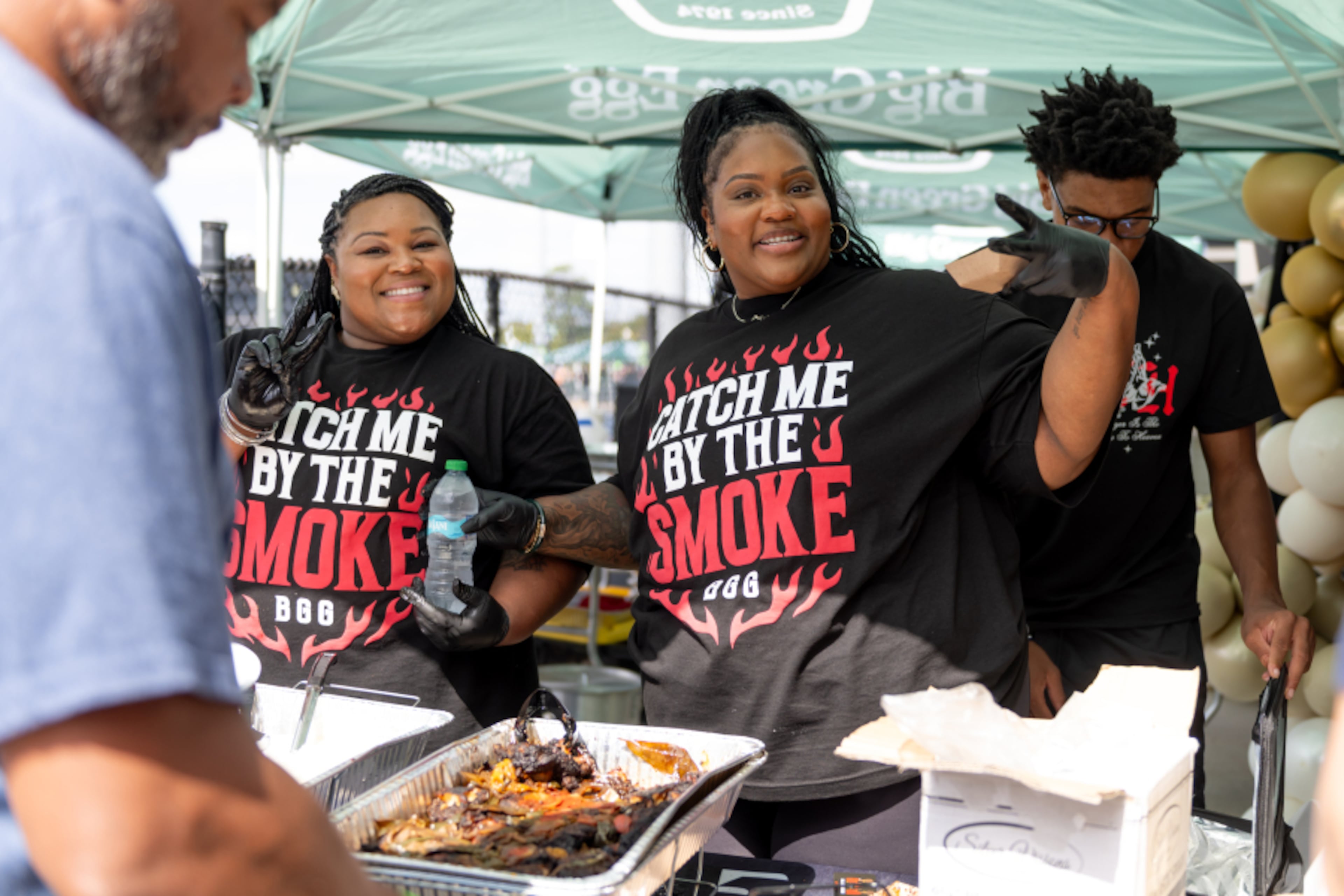
Closer to its Atlanta home, the green ceramic dome forms the hearth for both dynamic pop-ups and acclaimed restaurant kitchens. The sister duo behind Black Girls Grilling regularly haul their cookers to outdoor festivals like Smorgasburg Atlanta and have captured multiple awards at EGGtoberfests in recent years for signature dishes like roasted oxtails over Gouda grits.
The unlikely gathering: An EggFest in Amish country
To understand how thoroughly the Egg transcends cultural boundaries, look to the heart of Indiana’s Amish country in New Haven, Indiana.
There, for 20 years, co-owners Wilmer Graber and Sam Schmucker have hosted an annual EggFest at the BBQ Store & More, drawing around 2,000 Amish families and non-Amish neighbors alike. Schmucker first encountered the cooker two decades ago, long before he and Graber expanded their shop into a 10,000-square-foot outdoor living center with a 4,000-square-foot porch, when a distributor bundled several units into an inventory shipment.
“I called the owner up and I said, ‘Hey, what am I supposed to do with these green grills?’” Schmucker told The Atlanta Journal-Constitution. “He said, ‘Just break a large (Big Green Egg) out of the box. It’s yours to keep and use.’ He told me to cook a boneless, skinless chicken breast at 325 (degrees) for 15 to 18 minutes. At that point, I was impressed.”
Today, Schmucker’s dealership keeps 18 to 20 Eggs on display, has over 7,000 registered customers in its log and sells 85% to 90% of its inventory in the XLarge configuration.
At Schmucker’s annual festival, more than 50 Eggs are fired up simultaneously. Amish cooks and regional pitmasters put everything from breakfast omelets to over 800 scratch-made cream puffs, and even a 6-foot alligator, across the coals.
“The Amish tend to have larger families and tend to socialize more,” Schmucker said. “When we entertain, it’s usually 30 to 40 people for family potlucks and gatherings. I’ve been to every steakhouse in Fort Wayne, and I have yet to have a steak at a restaurant that compares to what I pull off the Big Green Egg. We can cook a steak at home that is totally out of the league of all the restaurants.”
Beyond the cooking results, Schmucker points to customer service as a core driver of customer loyalty: the lifetime warranty.
“If you have a $2,000 grill and you have a base that cracks or an inner part that cracks, bingo, you get a brand-new part because it’s under warranty,” Schmucker said. “That’s what creates that excitement. They know they have a very high-end, quality product.”
How a Japanese rice cooker became Atlanta’s Big Green Egg
The irony of this Southern backyard institution is that it exists entirely because of a centurylong comedy of logistical errors, wartime detours and sidewalk desperation.
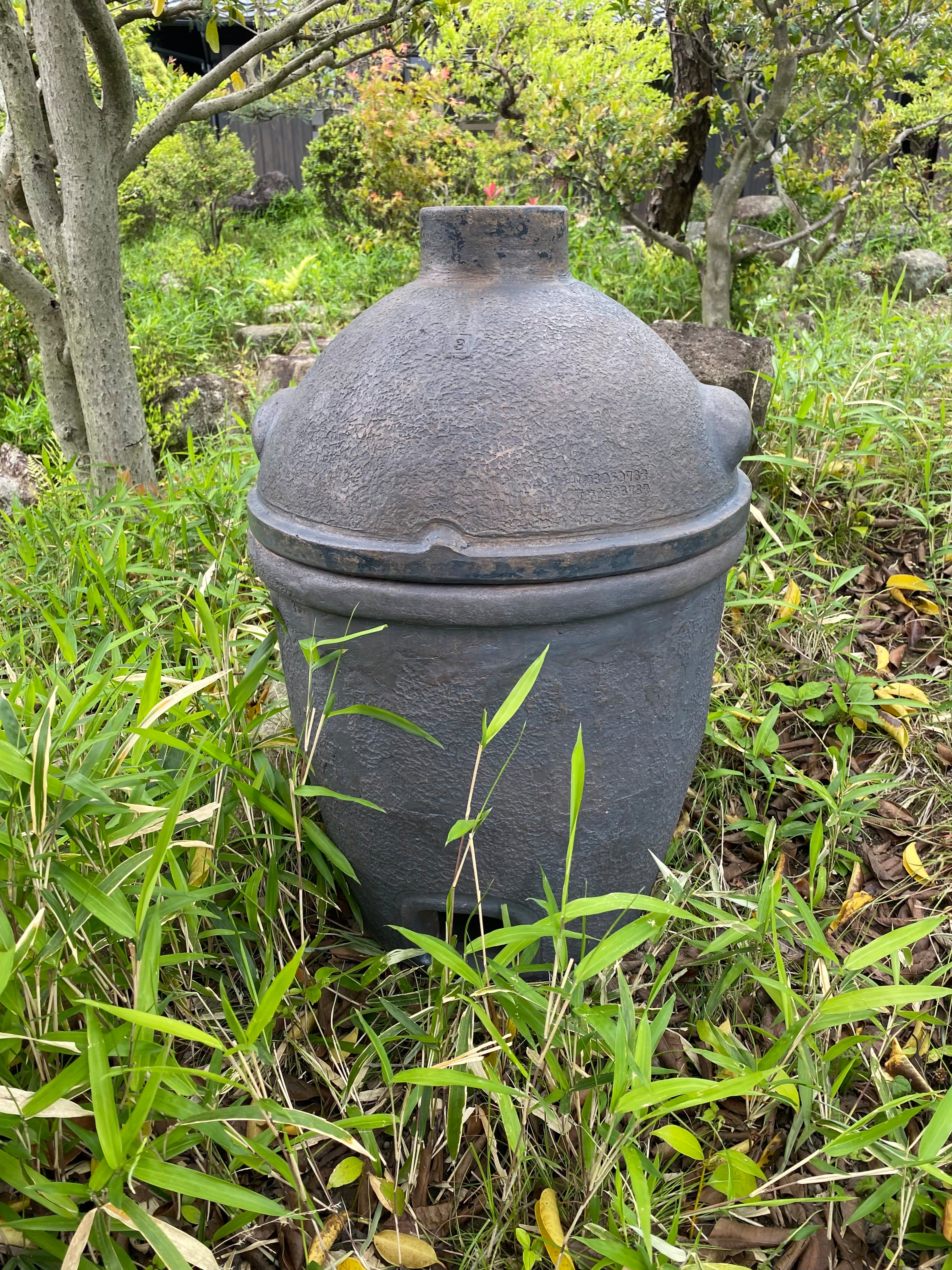
Its lineage traces to 1924 in Fukushima Prefecture, Japan, where an inventor named Kanekichi Kokaji developed the mushikamado (literally “steaming stove”). It was not a barbecue grill, but a portable earthenware pot fitted with a domed lid and damper vents, designed to steam fluffy white rice without scorching the bottom layer like a traditional built-in kitchen range.
For 30 years, it sat in Japanese farmhouses. Then, in 1955, Toshiba released the automated electric rice cooker, and the clay mushikamado was rendered obsolete almost overnight.
The device was saved from extinction by American postwar troops stationed around Tachikawa and Yokota air bases outside Tokyo. GIs wandering surplus markets realized that if you removed the interior rice bowl and dropped a wire mesh screen over the coals, the thick clay walls trapped heat and moisture, producing brisket and ribs of remarkable tenderness.
Pilots began flying the heavy clay pots back across the Pacific in the belly of Douglas C-124 Globemasters, rumbling military transport planes nicknamed “Old Shaky,” with crews using the cookers as flight ballast, even though half of them shattered on rough landings.
Enter Ed Fisher.
In 1974, Fisher opened Pachinko House in an unassuming strip mall off Buford Highway in Doraville, riding the brief American craze for Japanese upright pinball machines.
In addition to Japanese arcade games, Fisher’s California importer, Roy Gelati, also sourced converted mushikamado clay rice steamers, marketed in America under the shortened Japanese term “kamado.” Gelati struck a mandatory deal: If Fisher wanted the lucrative pachinko machines, he had to take the crates of unpainted clay cookers as well.
When arcade machine sales cratered after the holidays, Fisher wheeled an unfamiliar clay cooker onto the sidewalk and started grilling chicken wings.
Lacking any formal barbecue experience, Fisher simply rinsed a batch of raw, unseasoned chicken wings, tossed them onto the grate and shut the lid. He was astonished to discover that doing virtually nothing produced chicken that tasted remarkably delicious.
Smelling the smoke drifting across the asphalt, customers ignored the Japanese pinball machines and bought the cooker right off the sidewalk on Day 1.
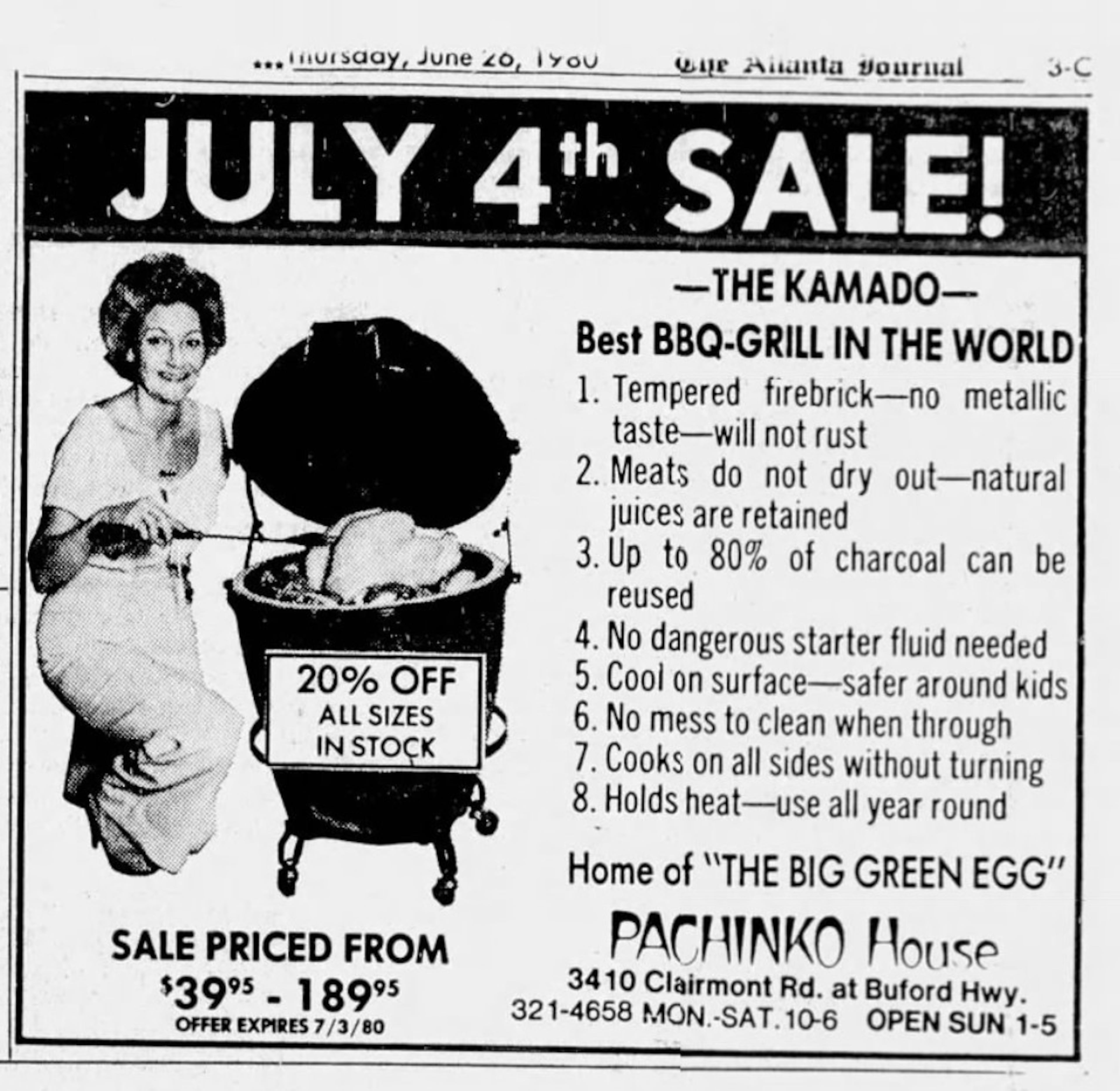
To introduce the cooker to a broader audience, in the late ’70s and into the ’80s, Fisher took out advertisements in The Atlanta Journal and The Atlanta Constitution, first calling the cooker a kamado grill and later branding it as the Big Green Egg. Fisher put the lifetime guarantee on every unit, transforming a fragile curiosity into an indestructible fixture of the suburban South.

The cultural boomerang: Bringing kamado cooking back to Japan
In 2015, Hisashi Kato, a spatial and architectural designer from Nagoya, Japan, was walking through the outdoor exhibits at the World of Concrete trade show in Las Vegas. Catching the scent of wood smoke, he stopped before an American grilling demonstration. When a representative told him the green ceramic vessel was called a “kamado,” Kato stopped in his tracks.
“When it was described to me as a kamado, I asked if they knew that was a Japanese word,” Kato told The Atlanta Journal-Constitution. “The representative told me that in America, kamado was an established English word. I was amazed.”
Kato returned to Japan deeply moved that an appliance invented by Japanese craftsmen had been refined by Americans while largely fading from memory in its homeland. He connected with a Waseda University researcher documenting the history of the mushikamado and said he felt inspired by Hyottoko, the traditional Japanese folk god of fire and good fortune.
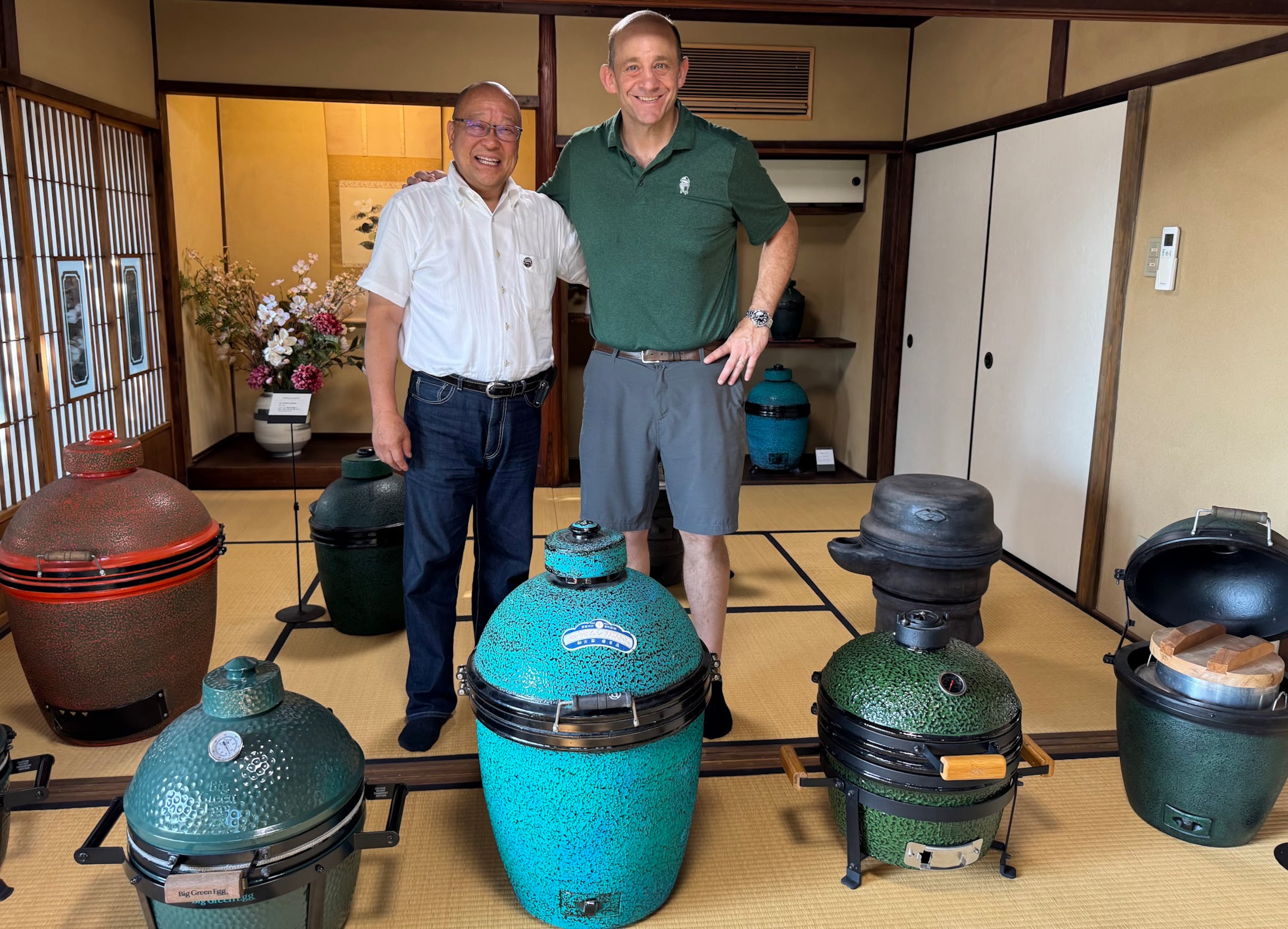
I witnessed this cross-cultural homecoming firsthand in 2025 during a research trip to Japan with Gertsacov, paying my own way to trace the cooker’s origins. On his property in Nagoya, Kato welcomed us to Kamado-an, a museum housing historic, antique mushikamados and kamado grills, including Big Green Eggs.
Initially, Kato sought official distribution rights to bring the Big Green Egg to Japan, but when told the company wasn’t ready for Japanese expansion, he pivoted. Operating out of his nearby Garden Studio Momiji showroom, he launched his own brand, Kamado Q, to reintroduce modern ceramic cookers to Japanese home cooks.
At Gertsacov’s invitation, Kato flew to Atlanta for EGGtoberfest in 2025. Dressed in a T-shirt featuring the Big Green Egg and wearing a Hyottoko fire-god mask on the back of his head, Kato set up a cooker outfitted in full samurai armor at Gwinnett Field, then called Coolray Field. Inside the dome, he wedged a traditional iron hagama rice pot over glowing charcoal, steaming rice to prepare Wagyu beef sushi and bacon-tomato-lettuce pressed sushi (oshi-zushi).
All 600 prepared portions vanished almost immediately.
“While charcoal cooking equipment exists globally, the kamado grill is remarkably self-contained,” Kato said. “Beyond selling grills, Big Green Egg builds a community and spreads a perspective centered on fire and charcoal. Seeing people of all backgrounds — white, Black and Asian — united through barbecue at the festival in Atlanta deeply resonated with me.”

EGGtoberfest: The fellowship of the flame
As October approaches, EGGtoberfest organizers at Gwinnett Field are finalizing the logistics for another massive cookout. The cook teams are prepping recipes, demo cookers are being staged across the concourse and several thousand ticket holders and Egg tattoo-bearers are preparing for their trip to the stadium.
The threads of this subculture — from Gestranius firing his cooker through dark Nordic winters in Helsinki, to Schmucker slicing brisket after an Amish church service in Indiana, to the Hotchkiss family in Texas remembering a father who smoked chickens until the end of his life — all lead back to a simple, heavy ceramic grill.
“Nobody invites friends over to microwave,” Gertsacov told The Atlanta Journal-Constitution. “Cooking is an act of love. The reason why we’re in people’s obituaries is because they were expressing love, not just flipping a switch. It’s the effort that goes into love.”