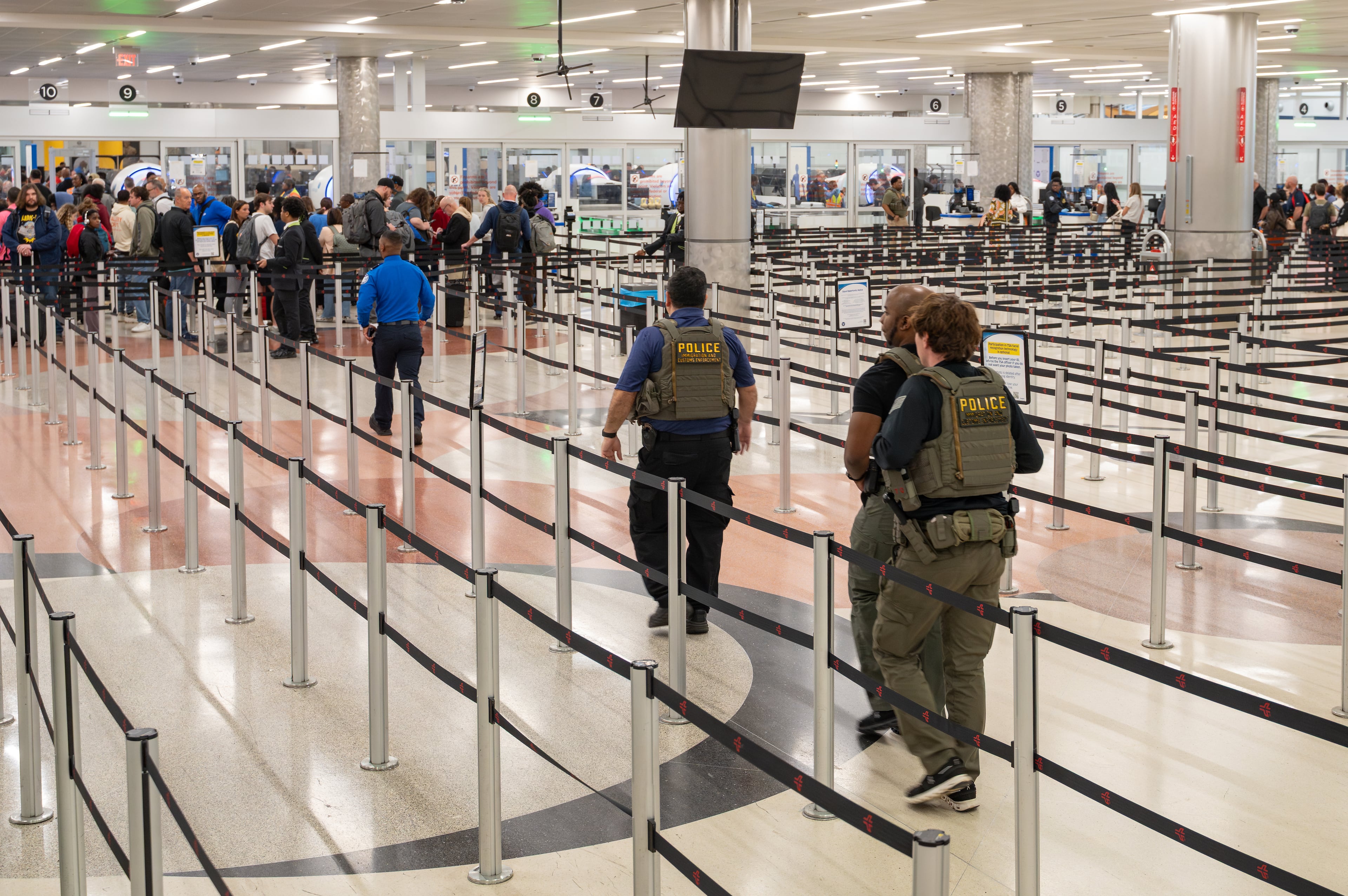
‘They can’t do anything:’ ICE largely standing around at the Atlanta airport

Immigration and Customs Enforcement agents in the last few days have become a common sight at the airport, roaming around the atrium and baggage claim areas, The Atlanta Journal-Constitution has observed.
But they haven’t been observed directly helping with the long security lines bedeviling passengers and their Department of Homeland Security colleagues in the Transportation Security Administration.
President Donald Trump deployed ICE to airports across the country Monday morning to help with line management and crowd control. Atlanta Mayor Andre Dickens said over the weekend the officers are not there for immigration enforcement.
“They’re standing there like Ken and Barbie dolls in the back of us. They can’t do anything. They’re not trained,” said George Borek, an American Federation of Government Employees union steward representing Atlanta TSA employees.
He was told about 64 ICE agents were deployed to the Atlanta airport.
Immigration agents he’s spoken with, Borek said, “are scratching their heads like, ‘What are we doing here?’ That’s the conversation I’ve had: ‘We have no idea what we’re doing here.’”
But there’s a key difference, Borek points out: “They’re getting paid and we’re not.”

ICE officers are largely being paid during the partial shutdown, thanks to an influx of cash from Trump’s big tax breaks and spending bill last year, The Associated Press reports.
TSA officers, meanwhile, have worked more than five weeks without pay. Atlanta saw callout rates surpass 40% over the weekend and more than 37% on Monday as a result, according to DHS.
The world’s busiest airport has been seeing some of the highest callout rates in the country in recent days.
Borek said his colleagues “are in dire need. We’re at the breaking point. The balloon is ready to burst, and it’s probably going to burst this weekend when Friday comes and there’s not another paycheck.”
One co-worker, for example, is about to be evicted, Borek said. She hasn’t been able to come to work.

The ICE deployment has actually added stress for some of his colleagues, Borek said: “I had one officer crying yesterday saying, ‘I don’t want to work with them here.’”
During a Sunday appearance on CNN, White House border czar Tom Homan said ICE agents are not trained for the type of screening done at airport checkpoints and would instead help with other tasks.
“We’re simply there to help TSA do their job in areas that don’t need their specialized expertise,” Homan said. “Screening through the X-ray machine — not trained in that, we won’t do that.”
But there are “certain parts of security that TSA is doing that we can move them off those jobs and put them in the specialized jobs (to) help move those lines,” Homan said.
“Certainly a highly trained ICE law enforcement officer can cover an exit,” to prevent people from entering secure areas through the exits.
About 30 demonstrators gathered outside the Atlanta airport Monday evening to protest the ICE deployment, carrying signs saying, “ICE out of ATL.”
Demonstrator Maria Delgado decried TSA workers not being paid during the partial government shutdown and attributed the ICE deployment as a tactic to build community fear.
“This is not a natural crisis; it is one manufactured and driven by Donald Trump and his administration!” Delgado shouted to the crowd. “The solution is simple: Pay TSA workers — now!”
Several members of the Atlanta Police Department stood on the outskirts of the crowd, but there was no sign of any ICE agents.
Given the ICE deployment, Borek said: “I would ask the question now, if they have all these ICE officers in the airport, I guess there’s no problem with immigration then, correct?”
While Atlanta’s security lines seemed to have calmed down Tuesday after prolonged waits on Sunday and Monday, Borek said 99% of passengers are being patient and “sympathetic” to TSA officers.
“Everyone is being nice to our officers and being thankful, thank you for coming in,” he said.
“Public sentiment is definitely in our corner. But public sentiment doesn’t pay the bill.”
— Staff writers Zachary Hansen, Kelly Yamanouchi, Ernie Suggs and Brooke Howard contributed reporting.
About the Author

As a business reporter, Emma Hurt leads coverage of the Atlanta airport, Delta Air Lines, UPS, Norfolk Southern and other travel and logistics companies. Prior to the Atlanta Journal-Constitution she worked as an editor and Atlanta reporter for Axios, a politics reporter for WABE News and a business reporter for the Arkansas Democrat-Gazette.