RECIPES: A culinary connection to generations past

Opening my copy of the new “Lebanese Cuisine” by Madelain Farah and Leila Habib-Kirske (Hatherleigh Press, $25) unleashed a flood of memories. There were recipes for dishes I hadn’t made in many years — triangle meat pies, raw kibbi, rice cooked with vermicelli, stuffed squash and small eggplants, green bean stew with cubes of lamb. So many dishes I watched my second-generation Syrian mother and her sister prepare in one kitchen or another, but recipes never written down and so lost in time. My mother and my Aunt Lily were of a generation that added “a pinch of this” and “a little of that” and cooked until something looked or smelled right, preparing dishes they had watched their own mother make.
I immediately read the book from one end to the other. Daughter Habib-Kirske wrote the book to celebrate the 50-year anniversary of the original publication of her mother Farah’s “Lebanese Cuisine.” The original spiral-bound cookbook published in 1972 resonated with others who needed guidance to cook the dishes of their heritage and sold more than 100,000 copies in its first 30 years.
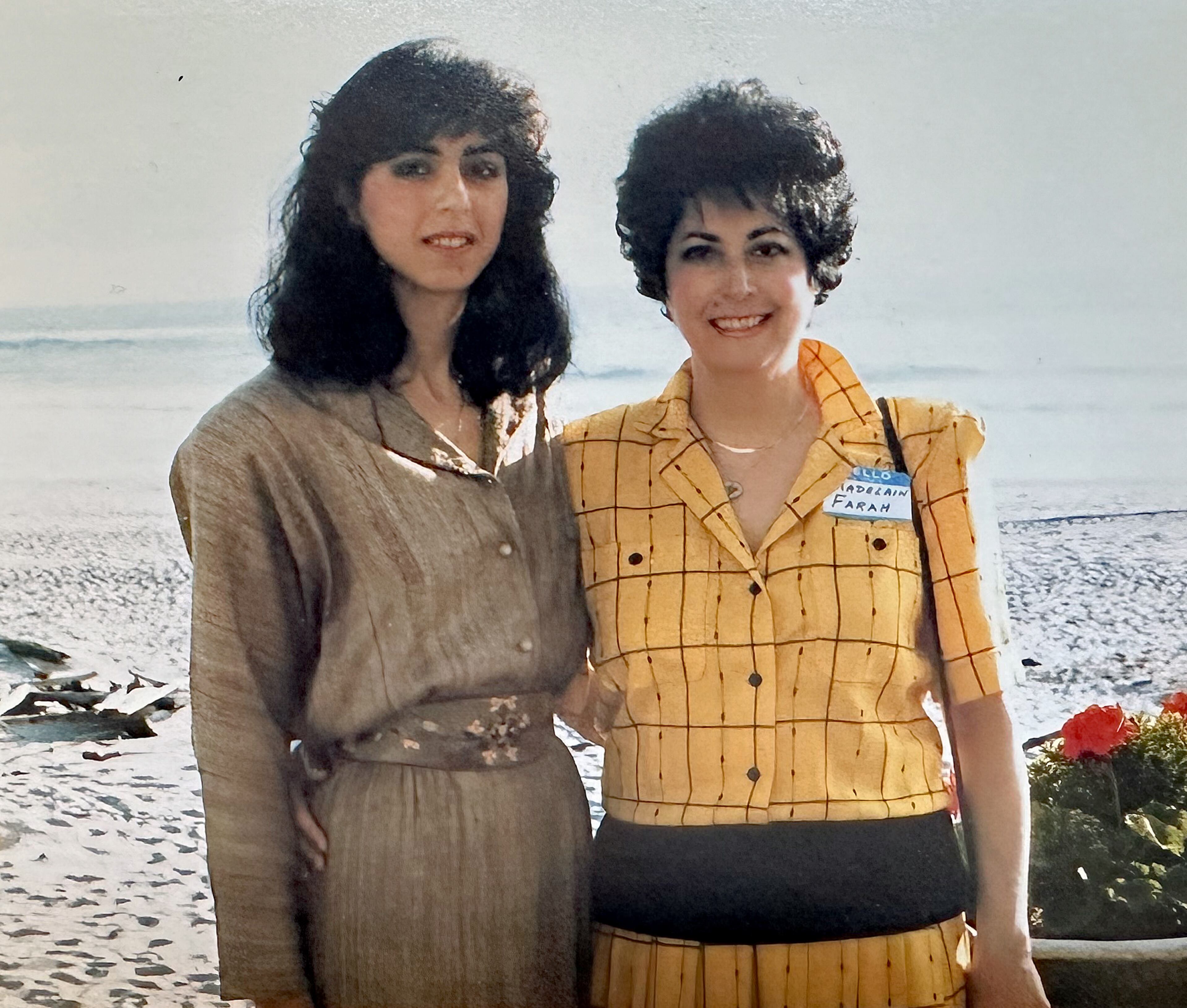
Syria and Lebanon share a border and many elements of their cuisine, so the dishes in the book are generally interchangeable with those of my childhood. It’s food that is often vegetable-forward and, like other dishes prepared around the Mediterranean Sea, there’s liberal use of olive oil and plenty of legumes like lentils and chickpeas. Habib-Kirske modified some of her mother’s recipes to reflect today’s farm-to-table and local produce movements by including things that weren’t as available in the ‘70s like purple potatoes, and substituting Swiss chard where my mother might have used frozen spinach.
Happily for me, with the arrival of this book, many dishes are now back in my dinner rotation. I’m planning meals centered around Lahm Miswi (grilled kebabs of lamb or beef) and Shaykh al-Mihshi (rounds of eggplant stuffed with ground lamb and pine nuts). I’ll be making Lifit Makbus (pickled turnips) like the ones my mother loved. Just sounding out the Arabic names takes me back to my childhood, where the only Arabic spoken was the names of the dishes we were eating.

My mother only made a few Syrian pastries, but my Lebanese godmother would prepare platters of sweets. I have struggled for years to replicate her recipe for Ma’mul, a nut-filled pastry made with farina (farina is sold at the grocery store as Cream of Wheat cereal). The handwritten recipe card disappeared and, after trying every recipe in the dozen Syrian cookbooks in my collection and recipes found online, I think the one from this book finally reproduces the pastries I remember from my childhood.
RECIPES
We’ve adapted three recipes from “Lebanese Cuisine” by Madelain Farah and Leila Habib-Kirske (Hatherleigh Press, $25): a lamb stew that’s very vegetable-forward, leaves of Swiss chard and cabbage stuffed with rice and chickpeas as a vegan alternative to using ground beef or lamb, and nut-filled pastries.
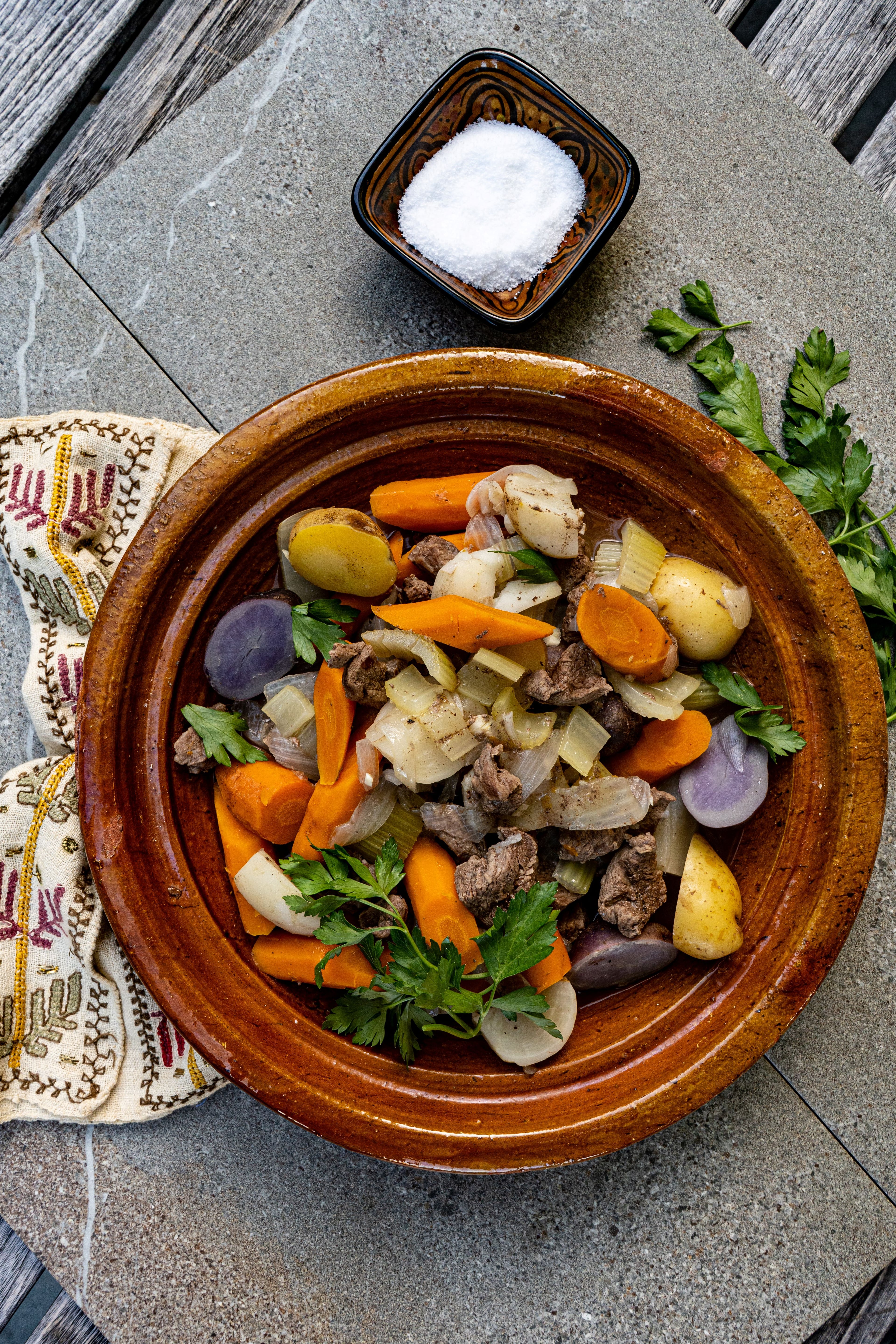
Yakhnit at Khudar bil-Lahm (Lamb-Vegetable Stew)
This stew is an example of how author Leila Habib-Kirske updated a traditional recipe to reflect new ideas of cooking. Growing up, I never saw a purple potato in our kitchen, but their addition to this recipe results in a colorful stew that’s almost the definition of today’s healthy eating mantra, “eat the rainbow.”
- 1 pound lamb shoulder, trimmed, cut into 1 1/2-inch cubes
- 1 large onion, cut into 1-inch pieces
- 3 carrots, peeled and cut diagonally into 1-inch pieces
- 2 small purple potatoes, cut in half
- 2 small Yukon Gold potatoes, cut in half
- 2 ribs celery, cut into 1-inch slices
- 2 small turnips, scrubbed and trimmed, cut into quarters
- 1 parsnip, peeled, quartered if large, cut into 1-inch pieces
- 2 cloves garlic, minced
- Room temperature water to cover
- 1 teaspoon table salt, plus more to taste
- 1 teaspoon pepper, plus more to taste
- 1/8 teaspoon ground allspice
- Combine lamb, onion, carrots, purple potatoes, Yukon Gold potatoes, celery, turnips, parsnip and garlic in a Dutch oven. Add water to cover ingredients by 1/2-inch. Stir in salt, pepper and allspice. Turn heat to medium and bring mixture to a simmer. Cover Dutch oven and cook stew 45 to 60 minutes or until lamb is tender, stirring occasionally. Remove lid and simmer 10 minutes or until liquid is slightly reduced. When stew is ready, check for seasoning, adding more salt and pepper if needed.
Nutritional information
Per serving: Per serving: 321 calories (percent of calories from fat, 41), 17 grams protein, 31 grams carbohydrates, 5 grams total sugars, 5 grams fiber, 15 grams total fat (6 grams saturated), 53 milligrams cholesterol, 505 milligrams sodium.Recipes adapted from “Lebanese Cuisine” © 2023 by Madelain Farah and Leila Habib-Kirske. Reproduced by permission of Hatherleigh Press.

Mihshi Waraq Silq or Malfuf biz-Zayt (Stuffed Swiss Chard or Cabbage Rolls)
You can make this recipe just with Swiss chard or just with cabbage, but we had both on hand and liked the contrast in textures between the rolls. Chopping the chickpeas is not required, but makes the filling easier to roll.
Grains of rice will escape from the rolls as they are cooking. Taste them to tell if the rice is done.
- 12 Swiss chard leaves, stems removed
- 8 green or savoy cabbage leaves
- 1 (15.5-ounce) can chickpeas, rinsed and drained, roughly chopped, if desired
- 1 cup uncooked long-grain rice
- 1 cup finely chopped parsley
- 1 bunch green onions, trimmed and cut into 1/4-inch slices
- 1/2 cup plus 2 tablespoons fresh lemon juice, divided
- 1/4 cup pure olive oil
- 1 tablespoon table salt
- 1 teaspoon pepper
- Cut chard and cabbage leaves into 4-by-6-inch pieces. Large cabbage leaves may make 2 pieces. Put trimmings in the bottom of a large saucepan.
- Bring 4 cups of water to a boil and pour into a medium heatproof bowl. Line a baking sheet with dish towels.
- Soften cabbage and chard: One by one, use tongs to dip cabbage leaves into hot water. Remove when wilted, about 1 minute, and put on prepared baking sheet to drain. It’s fine if they overlap when draining. Do the same thing with the Swiss chard leaves, replenishing hot water as needed. Chard leaves will take only 30 seconds to wilt.
- Make filling: In a medium bowl, stir together chickpeas, rice, parsley and green onions. Stir in 1/2 cup lemon juice, olive oil, salt and pepper.
- Lay 1 piece of cabbage on work surface. Top with 1 tablespoon filling laid out in a small log. Roll cabbage like a burrito, folding in sides to reach filling and then rolling from the wide end to the narrower end. Put cabbage rolls into prepared saucepan as they are made, making a compact layer. As needed, make a second row of rolls, alternating the direction of the rolls. Repeat with chard leaves. When finished, add any remaining liquid from filling, then add enough water to cover the rolls by 1/4-inch. Top with a heatproof saucer to keep the rolls submerged under the liquid.
- Put saucepan on cooktop over medium heat, cover and cook rolls 15 minutes. Remove cover, add remaining 2 tablespoons lemon juice. Keep uncovered and cook 10 minutes or until rice is tender.
- To serve hot, drain any liquid from saucepan and discard liquid. Allow rolls to cool slightly then pull out and arrange on a serving platter. May also be served warm or cold.
Nutritional information
Per serving: Per roll: 226 calories (percent of calories from fat, 57), 4 grams protein, 21 grams carbohydrates, 6 grams total sugars, 1 gram fiber, 15 grams total fat (6 grams saturated), 25 milligrams cholesterol, 20 milligrams sodium.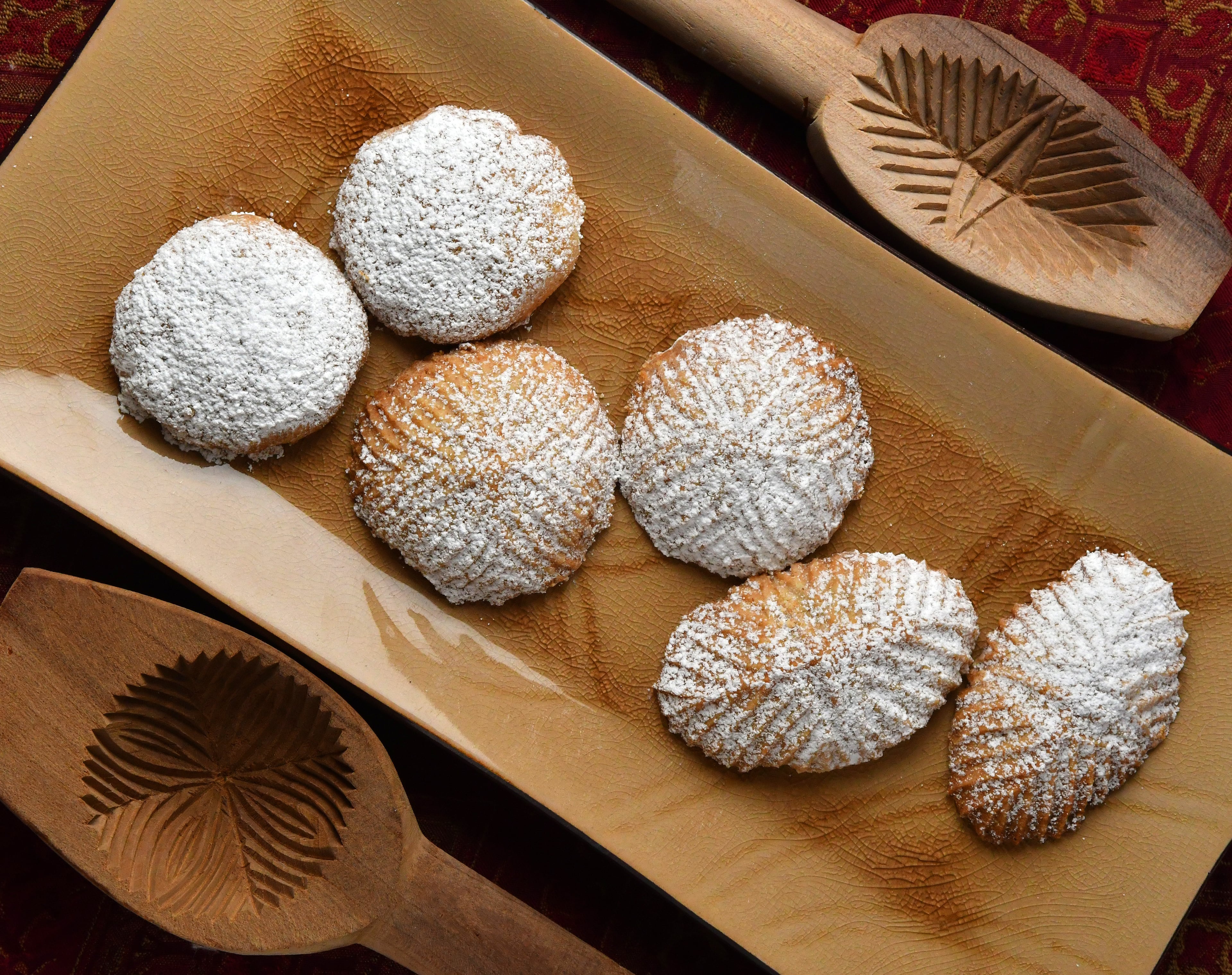
Ma’mul (Nut-filled Pastry)
This recipe shapes the pastries by hand, although they are traditionally made using a carved wooden mold, which produces a ridged pattern that holds powdered sugar perfectly.
- 20 tablespoons (2 1/2 sticks) unsalted butter
- 1 1/2 cups finely chopped walnuts, almonds, pecans or pistachios
- 1/2 cup granulated sugar, divided
- 1 1/2 teaspoons rose water
- 2 cups farina (Cream of Wheat cereal)
- 1 cup all-purpose flour
- 2 tablespoons room temperature low-fat milk
- 1/4 cup powdered sugar
- Make clarified butter: In a small saucepan, melt butter over low heat without stirring until butter has melted and fat has separated from the milk solids. Remove from heat and allow to cool 5 minutes, then slowly pour the clear yellow fat into a measuring cup, leaving behind the transparent liquid and milk solids that have settled to the bottom of the saucepan. Discard liquid and milk solids and allow clarified butter to cool to room temperature.
- Make filling: In a medium bowl, stir together chopped nuts, 1/4 cup sugar and rose water. Set aside.
- Make dough: In the bowl of a stand mixer fitted with the paddle attachment, combine clarified butter and remaining 1/4 cup sugar. Add farina and flour and mix 1 minute on low speed. With mixer running, gradually add milk to make a soft dough. Remove dough from mixer and set aside 1/4 cup. Divide remaining dough into 24 balls. Arrange balls on an unfloured work surface.
- Heat oven to 350 degrees. Line a baking sheet with parchment paper or nonstick silicone baking mat.
- Put a ball in the palm of your hand. Between your palms, press the ball into a 3-inch round. Add 1 teaspoon filling and fold dough over filling. When needed, use a small bit of the reserved 1/4 cup dough to seal the filling. Arrange each pastry on the prepared baking sheet and repeat until all balls of dough are used. Bake 20 to 25 minutes or until bottoms are light brown. Do not overbake. Remove baking sheet to a wire rack and shake powdered sugar over pastries while they are still warm. Let stand on baking sheet until completely cooled. May be made ahead and kept in an airtight container for up to 2 weeks, or frozen for up to 2 months.
Nutritional information
Per serving: Per pastry: 226 calories (percent of calories from fat, 57), 4 grams protein, 21 grams carbohydrates, 6 grams total sugars, 1 gram fiber, 15 grams total fat (6 grams saturated), 25 milligrams cholesterol, 20 milligrams sodium.Read more stories like this by liking Atlanta Restaurant Scene on Facebook, following @ATLDiningNews on Twitter and @ajcdining on Instagram.

