Bisher: Palmer turned the tide for the Masters in 1960
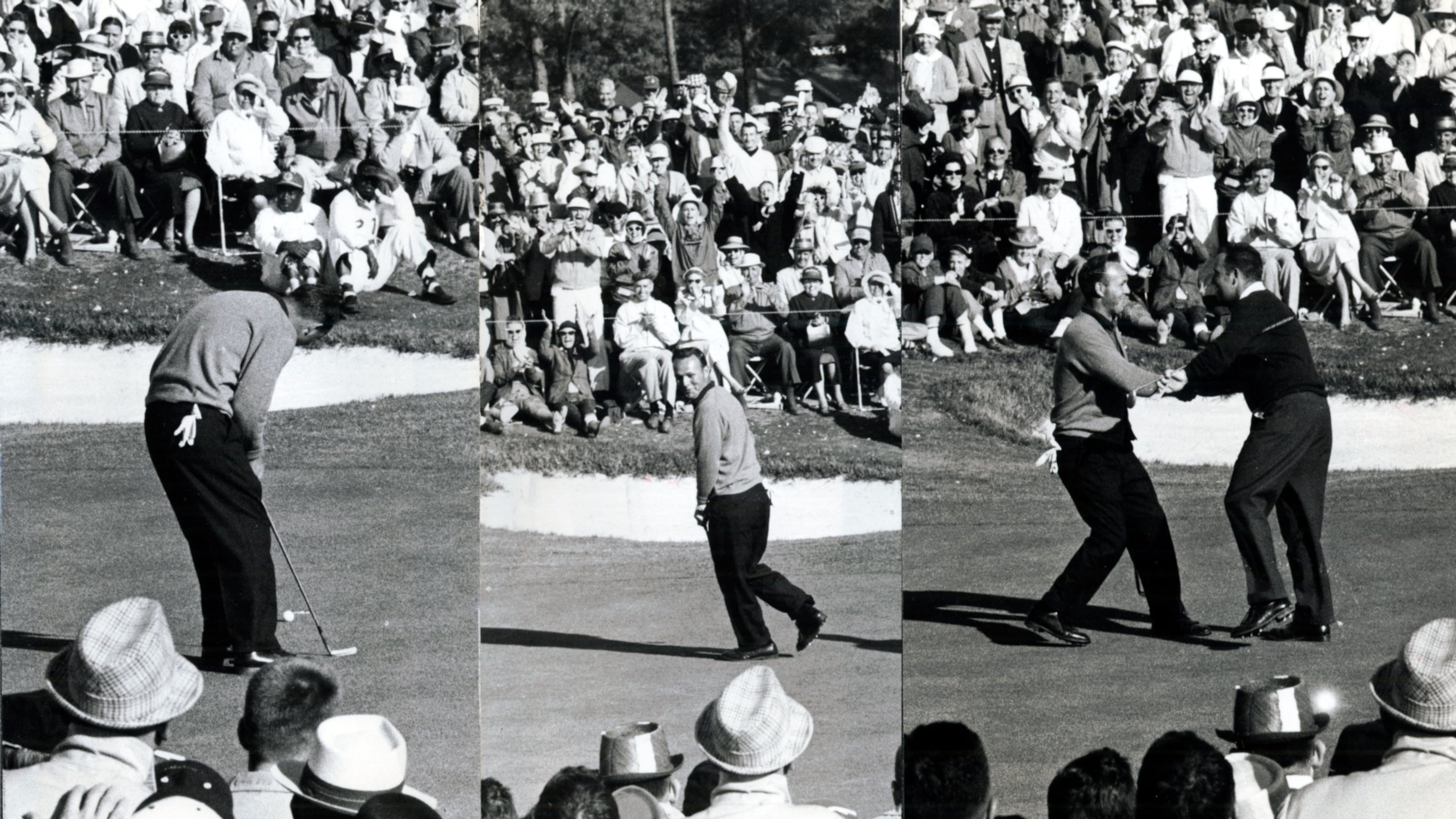
The year was Nineteen-Sixty. Professional golf was just about to blast off across these United States, on the wings of television.
Arnold Palmer rode into Augusta fully charged, and by the time he left town, his affair with the Masters would have been prominently established. It would be the year of "Arnie's Army." It would be the year that the Masters burst into full bloom. It would be one of the last times that a patron might buy a ticket at the gate and drive in. And one of the main reasons was the identity of the champion, for Arnold Palmer became the darling of the Masters.
Oh, he had won the green jacket once before, but in 1958 the victory was marred -- as they write in auto racing -- by controversy.
Controversy at the 12th hole, where Palmer exercised his own ruling on Sunday, an action upheld by the chairman -- to the dismay of Ken Venturi, the defeated. As devilish fate would have it, Venturi was again Palmer's victim in 1960. This time, Arnie would birdie the 17th and 18th holes, leaving nothing to chance.
He strode the course with the assertive stride of an athlete on a mission. And athletic he was, muscular shoulders, knotty biceps, ironing-board stomach and an easy smile that revealed two even rows of ivories. He would put that cigarette to the side, make his putt, retrieve the cigarette and move on. That's right, smoking was no sin in those times, particularly in the vicinity of Tobacco Road.
Palmer had swooped into Augusta dominating the tour that spring. Winner at Palm Springs, the Texas Open, Baton Rouge and Pensacola. Of such was the PGA Tour in those times. He led in everything, especially earnings. He would add $17,500 more at Augusta, then later the U.S Open. At the end of the year, he had won eight times on Tour and added a victory in the Canada Cup and had set a new record for earnings -- $75,263, which would have placed him about 20th in his own recent Arnold Palmer Invitational.
This was the year that the Masters finally began to flex its prestige. Previous years, department stores in Augusta had been required to market a quota of tickets. Ladies staffed booths along Broad Street pushing Masters tickets. Drive-in tickets were available at the gate of Augusta National. The Masters of 1960, though, was a turning point, and at the point man was Palmer. Between 1958 and 1964, he was the star at four green jacket ceremonies.
This one in 1960 was different. The previous champion had not been able to defend his title. Art Wall had birdied five of the last six holes in 1959 and ripped the green jacket right off Cary Middlecoff's back, and Palmer was only two strokes off the lead. Wall, though, was suffering from a knee infection and unable to play in 1960, but he was there to hold the jacket for Palmer after working a press beat. He had written his daily observations for our Atlanta Journal -- for the generous sum of $200.
Three years previous, I had persuaded Bing Crosby -- witnessing his first Masters -- to dictate his daily views. One which remains firm on my mind came after the third round.
"I like the looks of that Palmer kid," said Der Bingle, a three-handicapper himself. There was a man with an eye for talent.
So we raise our hand in salute to the year of Nineteen-Sixty. It was, you might say, the foundation of what is the Masters Tournament today. Palmer will get in one more swing, and Jack Nicklaus joins him on the ceremonial stage Thursday morning. You may have the Tiger Woods beat. This one is mine.