Why the Braves’ offseason could be less active than you expect
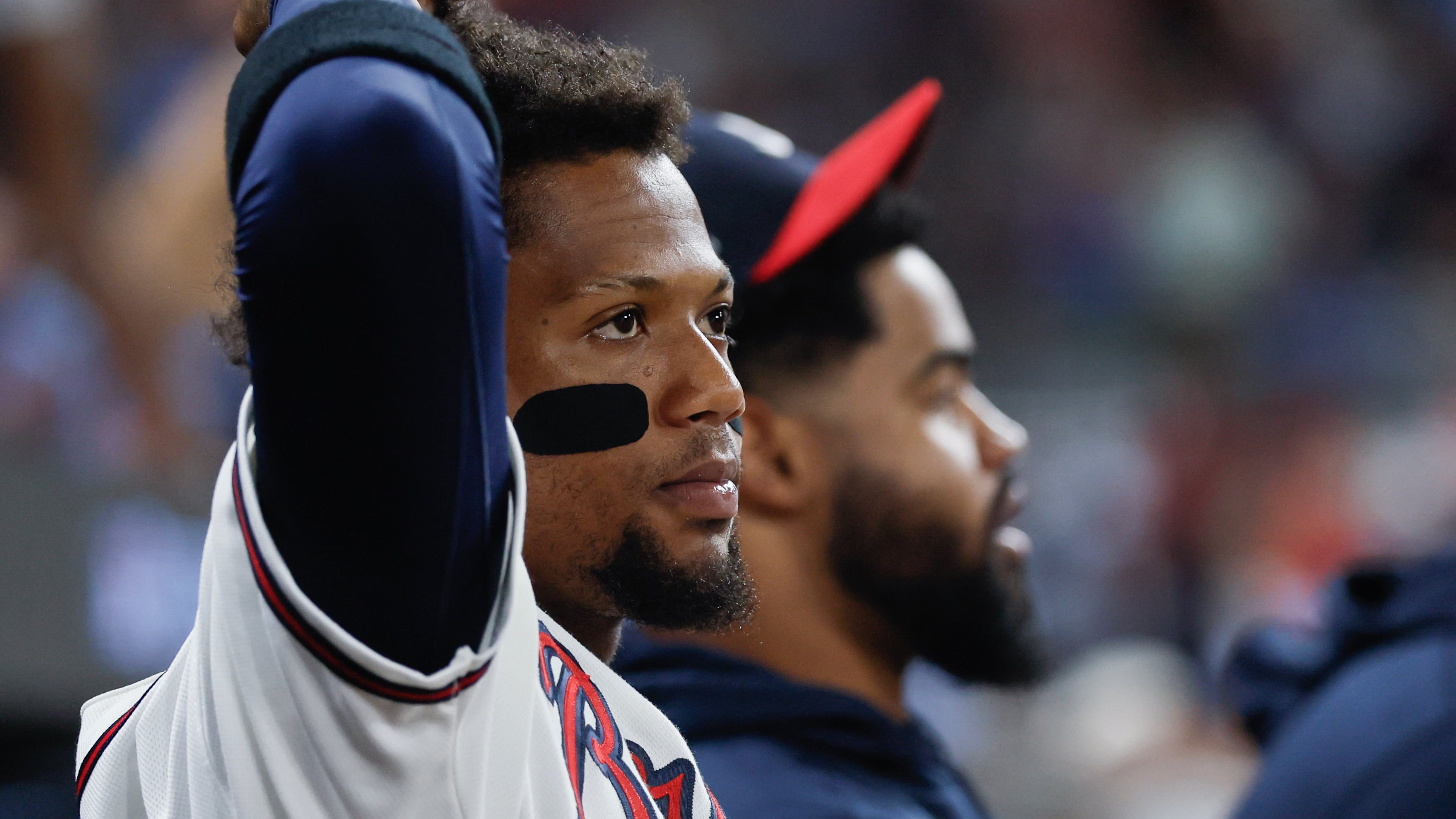

It may feel like the Braves need to do something drastic after losing to the Los Angeles Dodgers in the NLDS and failing to reach the NLCS (or World Series) for the fifth year in a row.
But, whether Braves fans like it or not, that’s probably not what’s going to happen. It’s just not the way that president of baseball operations and general manager Alex Anthopoulos operates.
There is fan sentiment for trading star right fielder Ronald Acuña Jr. after his dismal postseason and injury-shortened regular season. When he spoke with media on Sunday, Anthopoulos even made what was, for him, a fairly candid admission that the former NL MVP’s injury history is “certainly a thing.”
But to move Acuña based on his postseason underperformance would be irrational, as Anthopoulos sees it. The GM essentially said as much when he was asked about the team’s offseason needs.
Could the Braves have been better in the postseason? Of course, he said.
“But I think you have to be careful overall (not) to take small samples and overreact one way or the other,” he said.
Where fans may see Acuña as the guy who came up short again in the postseason, Anthopoulos views him as the player who delivered a .950 OPS in September, when he was fully healthy after two separate stints on the injury list and the season was on the line.
Further, Acuña played in 54 of the team’s final 57 regular-season games, and two of the absences were in the final week after they had clinched the NL East. Manager Walt Weiss sprinkled in DH assignments to protect his legs. Acuña can be retained on team-friendly club options in both 2027 and 2028 at $17 million each.
The Braves will likely try to prioritize outfield depth with Acuña in mind, but they likely believe they can keep him in the lineup more consistently by occasionally keeping him off his legs with DH games.
All that said, Acuña’s recent scrubbing of his Instagram account of Braves-related images could be a wild card in how the offseason proceeds. (Acuña also told The Atlanta Journal-Constitution’s Gabriel Burns after the Braves were eliminated that “I want to stay here my whole career, that hasn’t changed.”)
Anthopoulos’ practicality will also guide how the Braves approach third baseman Austin Riley, even though the sample size of his cratering 2026 season was 630 plate appearances. Anthopoulos acknowledged that the team doesn’t know how to help him recover his form from when he was one of the best third basemen in the game.
“I wish honestly that I had an answer for you that, Hey, we’re one tweak away,” Anthopoulos said.
The thinking (perhaps hoping) with Riley may be that the 2026 season – when his .654 OPS was 126th out of 135 qualified hitters – was an outlier, which isn’t an unreasonable perspective, though it is part of a larger slide since 2023.
If so, the Braves can live with the Riley from 2024 and 2025, when his OPS was .783 and .737. (The MLB averages in those two seasons were .711 and .719, respectively.)
Given that Riley’s market value is as low as it has ever been and that his contract runs through 2032, trading him doesn’t make a lot of sense.
It doesn’t make for the most eventful offseasons. But the approach has also generated seven NL East titles in nine years.
Has it kept the Braves from going further in the playoffs?
It’s impossible to know. But, for example, if the Braves were to trade Acuña, it would figure to only increase the difficulty of making the postseason in the first place.
The Braves desperately need right-handed pop – the team was 27th in righty OPS this season – and few can provide it better than Acuña.
There will be moves. The Braves need a shortstop and a left fielder. They will make a strong bid to keep Mauricio Dubón, who could fill either of those spots. Infield depth behind Riley and second baseman Ozzie Albies, who shined in the first half of the season but scuffled in the second half, will also be a priority.
They need starting pitching help after Chris Sale, Bryce Elder and Grant Holmes. They’ll pursue trade-deadline acquisition Tyler Mahle and also talk with Martín Pérez, a valuable pickup this past offseason who will be a free agent.
The Braves are optimistic about JR Ritchie and AJ Smith-Shawver for next year and there’s the possibility that Didier Fuentes could be stretched out into a starter.
Spencer Schwellenbach and Spencer Strider are possibilities, but, given their injury status, not more than that.
It’s not the most exciting group of candidates. But neither was last year’s, and the Braves ended up finishing sixth in MLB in starting-pitching ERA.
Perhaps the impasse between the MLB Players Association and the owners can spice things up.
The approach has brought the Braves one World Series title and eight postseason berths in nine years. Or, if you will, only one World Series title despite eight postseason appearances in nine years.
The one calling the shots would choose the former.
You can now get my column sent straight to your inbox. Sign up for my newsletter here.