
Falcons know their offensive identity. Can they get back to it vs. 49ers?
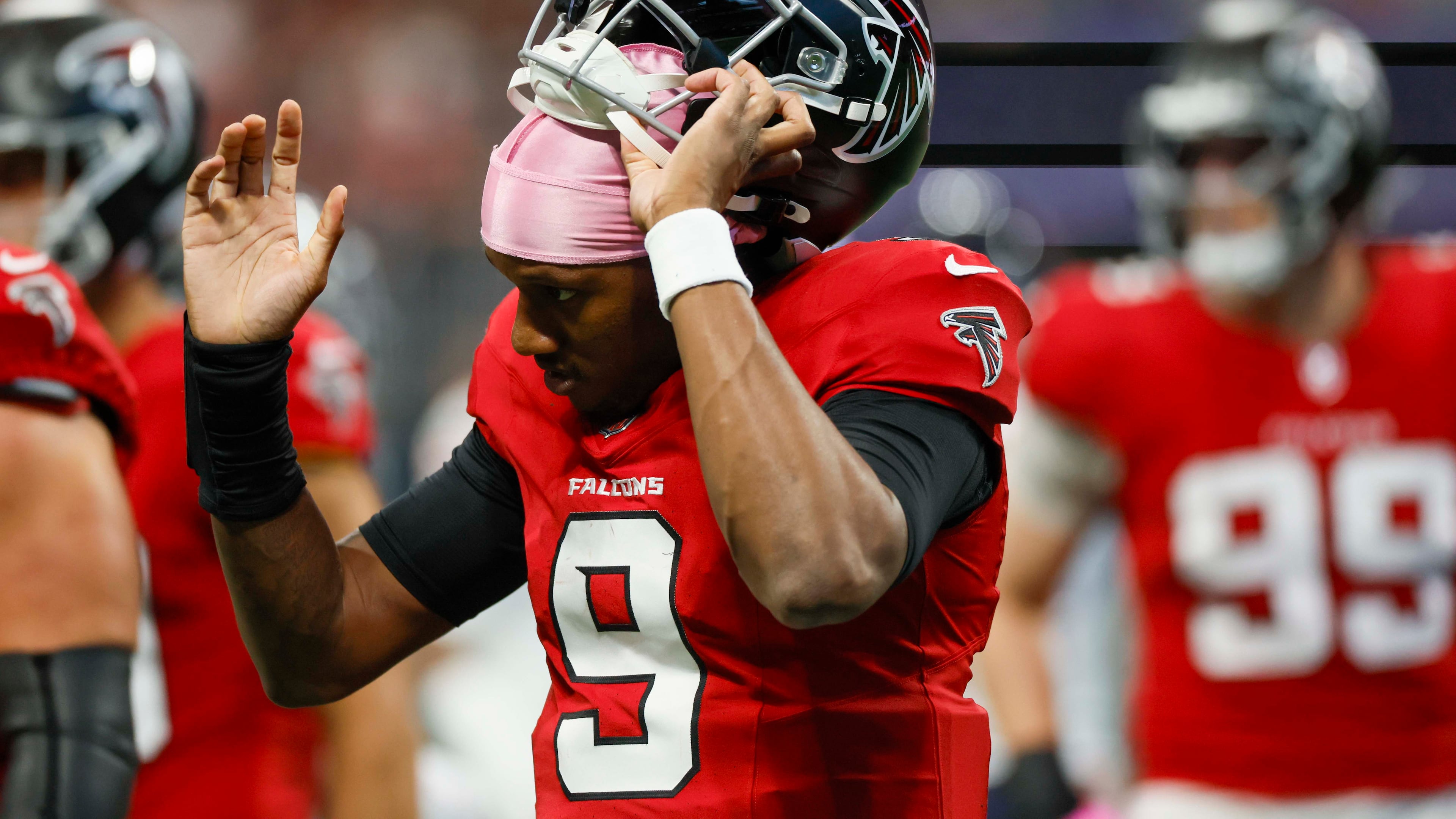

FLOWERY BRANCH — The Falcons set an identity in their offensive meeting room every day. For two games, they lived it.
Spearheaded by the franchise’s first back-to-back 200-yard rushing games since 2016, the Falcons paired a potent ground game with an efficient play-action passing attack and a steady dose of explosive plays through the air to flourish offensively in wins over the Packers and Saints.
And with those games comprising quarterback Michael Penix Jr.’s first two starts back from a torn ACL, the Falcons spoke — and operated — with a not-so-subtle confidence their best was still ahead.
But it hasn’t come yet.
“We got to play up to that identity, and I think we saw how we were supposed to do it Weeks 3 and 4,” running back Bijan Robinson said. “But now it’s just having that mentality, staying consistent with it no matter what the look is on the other side. For us to come in here and play our physical brand of football, I think that’s the biggest thing for us in these next games.”
In the Falcons’ wins over the Packers and Saints, they had 18 full drives and scored 13 times, including 10 touchdowns. They compiled 80 points, most in the league across Weeks 3 and 4, and 918 yards of offense. They were a buzz-saw; a balanced, unrelenting machine.
The last two weeks, however, have been a stark contrast.
In losses to the Ravens and Bears, the Falcons have scored only seven times in 21 possessions. They have the same number of touchdowns (four) as drives that ended with a turnover on downs.
The Falcons are now forced to grapple with the question over whether this is merely the ebbs and flows of an 18-week season, or an execution-based issue in need of immediate improvement. The answer may be somewhere in the middle.
“I just think it’s football,” Penix said. “You’re going to have good days in the office. You’re going to have bad days in the office. But at the same time, we’ve got to control what we can control, so whenever it’s small details, small errors we’re making to not allow us to play to our best, we’ve got to figure those things out and come out with a solution and do those things better so we can win football games and obviously put points on the board.
“But every week is a different week. You can’t look back at last week and think that this week is going to be something different if you don’t change.”
To understand the Falcons’ offensive woes is to first grasp their identity.
“We know where we’ve been good when we’ve played good offensive football,” offensive coordinator Tommy Rees said. “It starts with the run game and we’re certainly aware of that. We just gotta get back to our identity and get back to the things that we do really well.”
They’ve leaned heavily on Robinson and fellow running back Brian Robinson Jr., perhaps the NFL’s best tandem. The Falcons rank fourth in the league in rushing, averaging 149.5 yards per game, but they’ve stacked season-lows in back-to-back weeks.
The Falcons rushed for 110 yards against the Ravens, then followed with just 63 yards on 12 carries against the Bears, a byproduct of a difficult start where they trailed 14-0 after one offensive possession.
Opponents are starting to play the Falcons differently. The Saints experimented with loaded — or heavier — fronts in Week 4, but to little avail. The Ravens broke tendencies and ran them more frequently in Week 5. So, too, did the Bears. Runs were more frequently bottled up.
The Falcons tried to counter with screens to Bijan Robinson on their first two drives, hoping to spread out the Bears and lighten the box. Those plays lost a combined 9 yards. The Falcons spent much of the afternoon in catch-up mode, which rendered the run game futile.
“You’re not going to get as many opportunities when you’re trailing by 14,” right guard Chris Lindstrom told The Atlanta Journal-Constitution. “So, every opportunity gets magnified, and then with the way the game played out, we got behind, then you have to throw it. Coach talks about starting fast, starting fast, and being efficient in that, so we can keep giving ourselves opportunities.
“You’re gonna be hard pressed to find any team who’s down two scores that has a lot of rushing attempts. It’s just the flow of the game, and that happens sometimes. But obviously, you don’t want to be in those positions.”
Avoiding disadvantageous situations is the Falcons’ biggest focus — not only slow starts, but down-and-distance, too. Of their 12 third downs against the Bears, eight were third-and-8 or longer. In each of their first five games, they had at least two plays of third-and-2 or shorter. They had zero against Chicago.
The Falcons were 10-of-19 on third down conversions in Weeks 3 and 4. They were a quality 9-of-17 in Week 5 but a minuscule 3-of-12 in Week 6. They’ve found themselves in more third-down scenarios, and longer ones at that.
So, Lindstrom says, the root of the Falcons’ offensive woes is inefficiency on first and second downs.
“If you’re in a get-back-on-track situation, so second-and-8-plus, it’s a lot harder, and you’re not gonna have as many opportunities,” Lindstrom said. “Just being efficient on first and second down, that keeps us in third-and-manageable. That really is the solution to it.”
The Falcons aren’t particularly unique in their identity. The recipe is quite common across the NFL, Lindstrom said. But the Falcons take pride in doing theirs at a higher level than everybody else.
Opposing defenses have made life difficult, and as the 49ers roll into town with a top-five unit in both yards and points allowed, the road won’t get much easier for the Falcons in Week 7.
But this, coach Kevin Stefanski says, is where the oft-referenced chess match begins. Offenses evolve throughout seasons. So do players. “Anybody worth their salt is constantly evolving,” Stefanski said. But the Falcons are protecting their staples, too. They want to run the same play out of different formations, or find a good complement to their proverbial bread-and-butter.
Balancing evolution with furthering an identity is the tightrope act facing the Falcons’ coaching staff. Their ability to find the right combination of ingredients will ultimately dictate whether the Falcons’ most consistent form is the high-flying offense of Weeks 3 and 4 or the unsatisfactory, substandard unit of Weeks 5 and 6.
This isn’t a question of knowing strengths and weaknesses. The Falcons are already well aware. It’s about execution — and they’re eager for a chance to go again at 1 p.m. Sunday in Mercedes-Benz Stadium.
“Consistency is what you’re searching for constantly,” Stefanski said. “I feel really good about the group we have. I feel good about the things that we’re implementing, but you’ve got to go do it.”