From banned to Black national champions. The Albany State turnaround story.
In March 2000, Albany State was handed a two-year ban on playing postseason football as part of a list of penalties handed out by the NCAA. The Division II Committee on Infractions ruled that Albany State had exceeded the amount of scholarships given to its football, men’s and women’s basketball and volleyball teams, giving the Golden Rams an unfair advantage.
The committee found Albany State had a “lack of institutional control,” the most severe ruling the infractions committee can issue, and the program was put on five years of probation, banned from the postseason for two years and lost 12 football scholarships per year for three years.
Mike White was named head coach ahead of the 2000 football season after spending 16 years as an assistant under legendary coach Hampton Smith, and it was up to White to put together a roster and field a team with not much to play for.
Less than four years after Albany State was put on probation and stripped of scholarships and postseason rights, the Golden Rams were back on top of historically Black college and university football. Albany State, a Division II program in southwest Georgia, won back-to-back Black college football national championships in 2003 and 2004.
The Golden Rams were one of the most dominant teams in Division II for those seasons and, until recently, those teams were lost to history.
Forgotten. Not celebrated.
Over the past couple of years, Tee Johnson produced a documentary, “The Disappearing Ring: An Albany State Story,” that tells of the success of those Golden Rams squads. The film premiered at Albany State’s homecoming earlier this month.
So how does a team go from probation with a new head coach to winning championships?
“We were able to reestablish what Albany State had already built,” said Jarvis Davis, who played defense from 2000 to 2004. “You know, we were just building on top of that, and we’re getting back to what we were used to.”
Rashard Lewis was a high school senior in 1999 and felt like there were two options about what he wanted to do with his life — play football in college or go into the medical field.
Smith showed up to a Cedar Grove High School game to check out the talented defensive lineman. The two talked in the hallway and Smith was impressed with Lewis, so Lewis agreed to go check out Albany State.
He visited on a homecoming weekend and got to see what all the hype was about, in addition to the success of the team on the field.
“When you get down there, you start seeing the guys, start hearing the talks and you start understanding what it means,” Lewis said. “You see the tailgates. You see the sidelines. You hear the pregame speeches that the older guys give, and it was just full force down there.”
Lewis’ decision about college was made, knowing that the first couple of years might be challenging with all the NCAA infractions. But there was still so much history at ASU, and playing college football was something that he couldn’t pass up.
William Felton, a fellow defensive standout, was in a similar boat. He wanted to play college football after a solid career at Macon County, but there weren’t many teams calling him.
That was until former Albany State star running back Antonio Leroy showed up at his house and offered him a scholarship. Leroy, whose number was retired by the Golden Rams in 2021, told Felton there was a spot for him and they wanted him to be a Golden Ram.
“I didn’t have anybody in my family to help guide me on college,” Felton said. “I’m a first-generation person. I’m the first person in my family to go to college on any side, dad or mom. I didn’t have anybody that guided me in that process. So I was still green to a lot of that next level stuff.”
Felton said that despite starting to get letters from Football Championship Subdivision and smaller Division I schools, he committed to Albany State and joined the program amid what was expected to be trying times.
Albany State went 4-6 in both 2000 and 2001.
“We took our lumps, man, because in 2000 most of us redshirted,” Davis said. “Then in 2001, we were all redshirt freshmen playing, and we took our lumps.”
They turned a corner in 2002, finishing tied for second place in the Southern Intercollegiate Athletic Conference with a 7-4 record.
Heading into the 2003 season, the Golden Rams were eligible for the postseason and felt like their team could be pretty good. They needed a quarterback, though, and fortunately for them, there was an available one right down the road.
The wins start stacking
For Uyl Joyner, it was a shorter trip to get to ASU than for many of his teammates, but it wasn’t as straight forward a path.
A standout quarterback on the 1998 state champion Dougherty Trojans, Joyner spent two seasons at Troy State (now Troy University). He had credibility in Albany before he put on that blue and gold uniform. He’d given the town one of their only football state championships and left to go play Division I football.
Joyner missed home, though. After two years at Troy, he went back home to be with his family. He was sitting around the house when his dad came to him and bluntly said he needed to do something with his life, so he went and practiced with the Golden Rams in 2002, as he had to sit out for a year after transferring.
“I could only practice, but I could see at that point we could be a really good team because the team that I was practicing with, the scout team, we had some ballers on there,” Joyner said. “I just knew then with the defense that we play against every day, who was the No. 1 defense in the nation at that time, and how we are playing and offensively, what we can bring to the table. This is gonna be a pretty good team, and that’s what happened, man.”
Albany State’s 2003 season began with a 21-3 loss at No. 2 Valdosta State. The Golden Rams won a couple more road games before losing the home opener to conference foe Kentucky State, 19-13.
Lewis said that the lack of cohesion came from the defense being further along than the offense at that point in the season.
“Our defense was always pretty dominant,” Lewis said. “The offense just wasn’t clicking like it should, right? I think it was a transition era at that point, too. It was more of a power game — run the ball, control the clock type of deal, right? And that’s where you got your great NFL running backs who pretty much dominated the offensive structure. And I think it trickled down into college, too. We had to transition out of that to the air attack that you start seeing in those 2000s, 2010s era. You know that’s where you got your you know Greatest Show on Turf (the Rams under Dick Vermeil and Mike Martz), right? You know you got your Tom Brady type of air attack with Randy Moss and those guys. So you start seeing that transition.”
In Week 5 at Lane College in Jackson, Tennessee, the offense clicked. Joyner and the Golden Rams scored 52 points and the defense held their foes to a touchdown.
Albany State never looked back. They would score at least 40 points five more times that season and ended up averaging 36 points on the season.
The Golden Rams were soaring up the national rankings and conference standings.
“We were a team that I think just came out of nowhere,” Joyner said. “Nobody really expected us to be as good as we were. We always knew that we had very good players, so we wanted to be great.”
Albany State faced Fort Valley State for the regular-season finale — the Fountain City Classic. The Golden Rams entered the day in a tie with Miles and Kentucky State for the SIAC championship, though Kentucky State held the edge because of head-to-head games.
White led his team out onto the field at AJ McClung Memorial Stadium in Columbus to play its rival. It wasn’t as dominant a performance as they’d grown accustomed in the recent months, but the Golden Rams won the game, 27-17. They celebrated like they’d just won the championship.
“After that game, of course, it’s kind of like one of these big SEC games,” Felton said. “Where you beat your rival, that’s all that mattered to you in some cases.”
Less than 10 minutes after the Fountain City Classic went final, a man went on the public address speaker and delivered a bit of news: Kentucky State lost to Tuskegee, which meant Albany State was the SIAC champion.
The celebration picked back up.
“We had to win the game, we won the game, and then like literally as soon as the buzzer hit, like two minutes later, they went across the speakers and were like, ‘Kentucky State lost, Albany State are champions,’” Lewis said. “The guys rush the field. It’s always one of those things where it’s just special. It’s hard. They’re playing ‘We Are the Champions.’ It’s been a while since we had one, so I mean that was probably one of the most memorable games that will probably ever be won.”
“We hear everybody and just re-created celebratory stuff all over again,” Felton said. “So we ran around the field again as if we done won another game. You know, we just celebrated that we just won our first conference championship as a group.”
In the same ceremony, Joyner was named MVP for both the Fountain City Classic and the SIAC.
“We went crazy, man,” Joyner said. “It was like, so that’s another 30 minutes on the field. Cause now we’re celebrating that win, but now we celebrate something much bigger than this. Winning this rival game, so that was another 30 minutes out there on the field having a good time, man. And then we realized that ‘Oh, we’re gonna get another game.’”
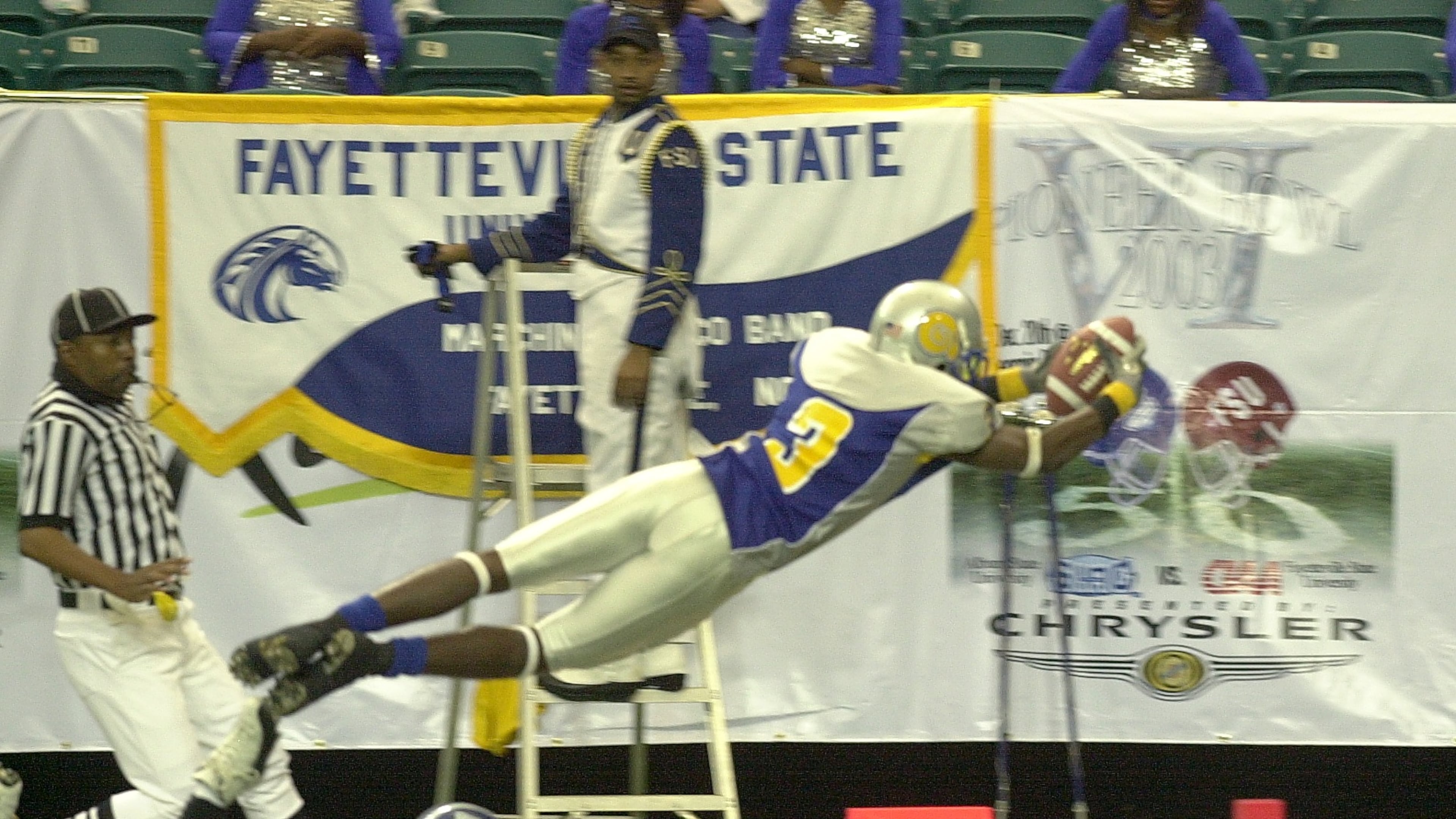
As conference champion, Albany State earned a spot in the Pioneer Bowl at the Georgia Dome and they blew out Fayetteville State 52-30 to cap a 10-2 season.
By winning the Pioneer Bowl, the Golden Rams won the Black national championship for the first time in program history.
“One thing about Albany State is, the standard is so freaking high when it comes to football because we have a lot of the old heads come around talking about, ‘Y’all weren’t better than us,’” Davis said.
Honoring the rebuild
Albany State followed up its 2003 championship win with a 24-22 win against No. 3 Valdosta State in Week 2 of the 2004 season. It was a huge performance internally, showing the Golden Rams that they could play with anyone. It was also a huge outcome nationally because it showed that 2003 wasn’t a fluke.
The Blazers had strung together four straight 10-win seasons and were one of the powerhouses of Division II college football.
By the end of the 2004 regular season, Albany State was on an 18-game winning streak. The Golden Rams won the SIAC for a second straight year and were ranked No. 2 nationally going into the Division II playoffs.
Again, before the postseason even began, they were named Black college national champions.
Albany State won its second-round game against Arkansas Tech before losing to Valdosta State in the quarterfinals, 38-24. Valdosta State ended up winning the national championship that season, its first of four.
Twenty years later, Davis and Johnson, his cousin, started tracking down members from those championship teams to put together the documentary and bring recognition to the two-time Black national champions.
There hadn’t been a ring ceremony or much honoring of the program’s success until they received their rings at halftime of the 2025 homecoming game.
“I like jewelry,” Davis said. “(Johnson) put together the ceremony, and basically they honored us at halftime. Had all of us down there on the field and everything. Honored us at halftime, and it was just a really beautiful thing, man. There were guys that had come back that hadn’t been back to campus since they had graduated, and this was over 20 years ago.”
White retired as head coach in 2014 after compiling a 112-51 record and five SIAC championship titles in 15 years. His 112 wins are second in school history behind his mentor, Smith.
Several players from the 2003 and 2004 Albany State teams have stayed around Georgia football. Joyner is the head coach at his alma mater and Felton is head coach at Decatur. Lewis’ brother is on Felton’s staff.
“I think for a lot of us, coaching finds you,” Felton said. “Unless you grew up with your dad coaching or being in a family of coaches, a lot of us inadvertently end up in this profession.”
But unlike many of his peers across high school football in Georgia, Felton has two national championship rings. As does Davis and the rest of those Albany State squads.
And the rings and memories will outlive the people who played.
“The thing that made it special was the connection,” Davis said. “This knowledge that you have of the game that you gain from coach White, that you gain from Albany State, you have to share it. If you don’t share it, it’s going to die with you.”