
Falcons see ‘huge difference’ in new regime
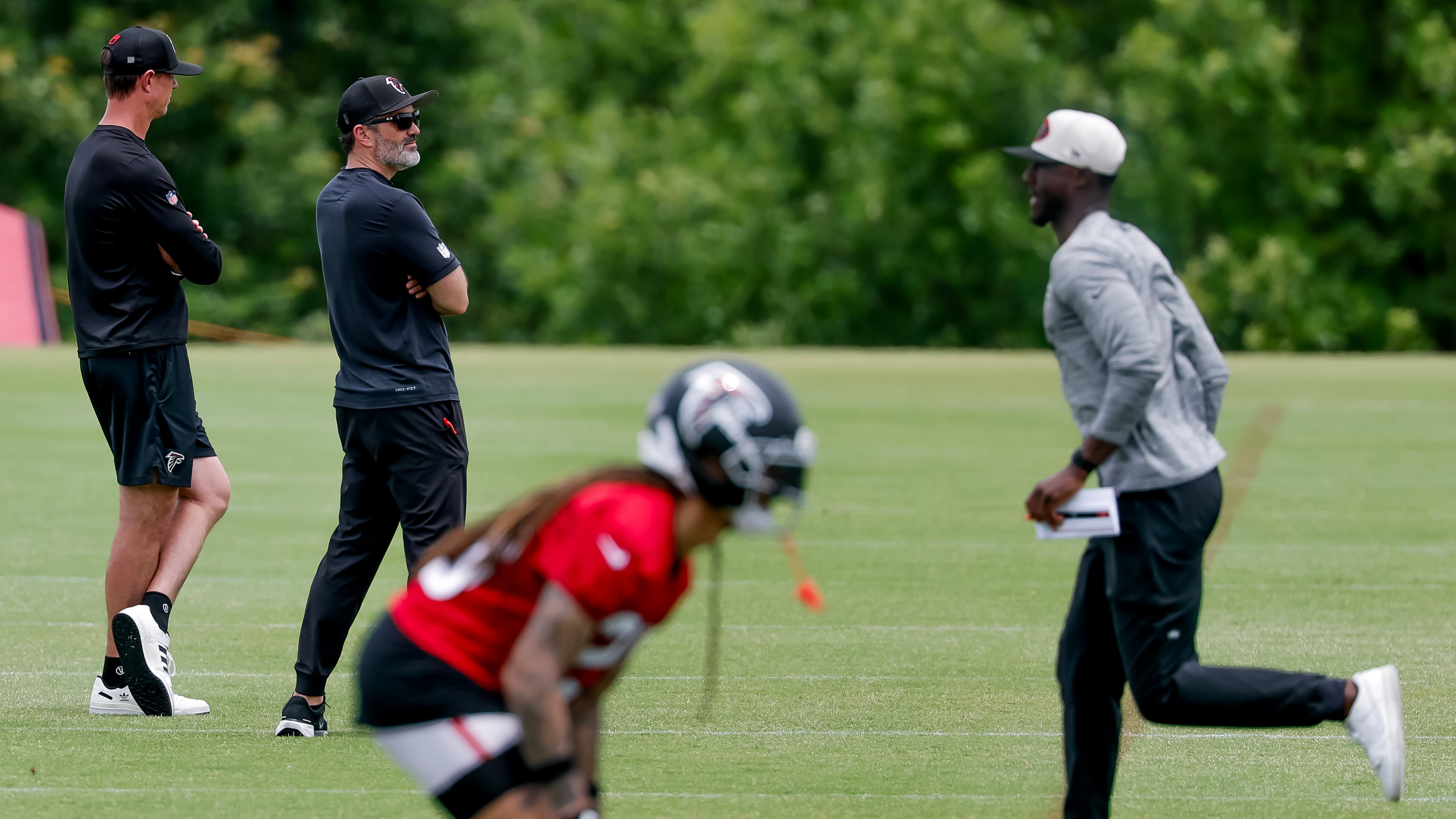

FLOWERY BRANCH — Take a glance to the side of the Falcons’ practice field, and the signs, receiver Jahan Dotson says, are there.
There’s a small hill separating the field from the locker room. Most players climb it on their way back after steamy afternoon practices in Flowery Branch. That area, as much for necessity as anything, becomes highly populated once the final practice whistle blows.
But for several minutes, perhaps up to a half-hour, the crowd only dissipates, not disappears. The number of bystanders sustains around 15 to 20 players. There’s JUGS talk — think water-cooler talk, but professional athletes and a football-firing machine — and post-practice work. They talk about life, about practice. They catch lefty-spiraled passes. They bond.
“Those conversations and things like that, those go very far,” Dotson said. “Further than you guys could ever imagine. The deeper you go into the season, you’re going to need those connections when things go south to bring the team up.”
Dotson, entering his fifth NFL season and first with the Falcons, is a qualified source. He spent the past two years with the Philadelphia Eagles, winning the Super Bowl his first season and losing in the wild card round his second. Including the postseason, the Eagles went 29-10 during Dotson’s tenure.
It’s still too early to tell, Dotson said, whether the Falcons have traits that are consistent with winning teams. But those JUGS talks, and the relationships being cultivated across a roster with more newcomers than returners, are encouraging indicators.
“The biggest thing with us in Philly was how close our locker room was,” Dotson said. “When we hit adversity, we got the guys together in the locker room to not put a panic on anything and really come together and realize we’re working for the same common goal.”
Falcons defensive coordinator Jeff Ulbrich knows it sounds crazy, but the last concept Dotson alluded to — alignment — is rare to find within the walls of billion-dollar organizations, especially between coaches and general managers.
Ulbrich, who played a decade in the NFL and is entering his 14th season coaching in the league, has been part of Super Bowl runs. He’s also been on multiple staffs that led to housecleaning organizational decisions.
Exposed to both extremes, Ulbrich knows what’s good and what isn’t. And after a spring spent evaluating free agents and draft prospects together, he’s confident the Falcons’ new regime, spearheaded by coach Kevin Stefanski and general manager Ian Cunningham, “absolutely” is aligned.
“The relationship I think Ian and Kevin have is tremendous,” Ulbrich said during OTAs. “There’s respect. There’s a level of — you can see them just playing off each other and making decisions in regard to free agency, the draft and everything in between.
“It’s one of those rare occurrences that exists here.”
The reason? Aside from the lessons he’s learned and “great environment” he’s found himself nestled within, Ulbrich said the Falcons’ new leadership came in asking the right questions.
“Whenever that’s the start of the conversation, I think you’ve got a chance to be special and build it the right way,” Ulbrich said. “When you come in just dictating, I think sometimes things can get a little wonky, but it wasn’t that way at all, and I’ve enjoyed it.”
A semblance of continuity exists in Flowery Branch, too. In Ulbrich’s defensive silo, only two assistant coaches — outside linebackers coach Jacquies Smith and defensive pass game coordinator Mike Rutenberg — left this offseason. The Falcons replaced Smith internally, promoting defensive assistant John Timu, while hiring Ole Miss defensive coordinator Patrick Toney to fill Rutenberg’s spot.
But the overwhelming theme around the Falcons’ facility is newness. Secondary coach Justin Hood estimated two-thirds of the people within the building are new. There’s familiarity, Hood said, but it’s “definitely different” from last season.
The Falcons will largely have a new roster, too.
Of the 91 players currently under contract, 47 are new — a 51.6% clip. Think that’s misleading, given the nature of offseason rosters and the abundance of undrafted free agents? In the AJC’s 53-man roster projection after minicamp, there were 12 new players on offense, 12 on defense and two on special teams, which equals a 49% ratio.
Stefanski, recapping the work done between the start of the offseason program April 7 through the end of minicamp June 17, said the Falcons had over 12 hours of team meetings and a similar number of offense-defense specific meetings.
The wealth of contact points left Stefanski convinced about at least one aspect of his team: The Falcons, if nothing else, will work.
“You watch the best players in this football team work the hardest, and they push each other. That’s been impressive for me to watch,” Stefanski said during minicamp. “There’s been a lot thrown at them, and the guys have attacked it. They’ve pushed each other, and I appreciate that.
“It’s a group that is not shy about the work that is required.”
Perhaps the mentality starts at the top, because such commitment to the work, star receiver Drake London said, is the biggest separator in this regime to the prior staff — along with organizational alignment, too.
“I would honestly just say we’re working. It’s a huge difference,” London said in June. “We’re working right now. We’re getting after it. Everybody’s here at the moment, and we all have the same goal in mind. We’re just pushing and pulling people along as we go.
“I think that’s the biggest difference right now is genuinely the same goals [are] in play.”
The Falcons return four of their six captains from last season in quarterback Michael Penix Jr., left tackle Jake Matthews, right guard Chris Lindstrom and safety Jessie Bates III. And while they lost captains in linebacker Kaden Elliss and punter Bradley Pinion this spring, there’s no shortage of leaders.
London threw cornerback A.J. Terrell and tight end Kyle Pitts into the mix. There are older veterans, London said, “who really, really work hard and don’t let anything get in their way, whether it’s the money, the status, whatever it is.”
The group sets an easy example to follow, London said, and the rest of the roster takes it to heart.
“I think it’s really, really dope that we have that culture here,” London said.
Falcons cornerback Mike Hughes said buy-in is the biggest piece to establishing culture. Hughes spent 2018 with Stefanski in the Minnesota Vikings organization — the former was a rookie, the latter was the offensive coordinator, so they didn’t often cross paths.
But in their lone year together, Hughes gleaned a valuable lesson about Stefanski: He’s a good leader, and if the Falcons rally behind him, “things will get turned around pretty good” this fall.
Early returns in the buy-in department were positive during OTAs and minicamp. Star running back Bijan Robinson said the intensity will ramp up during training camp, which brings longer days and greater demands.
But the Falcons’ new regime has built a heightened level of urgency. Practices from this earlier summer featured plenty of focus, Robinson said, and no “lollygagging” or extensive break periods. There’s an added goal to maximize effort and efficiency while on the field.
“That’s what I like about them a lot,” Robinson said. “And them teaching us the little details of everything is definitely a cool thing to see.”
There’s forever a degree of believe-it-when-I-see-it attached to a new Falcons season, let alone a new regime. The franchise hasn’t finished above .500 since the 2017 campaign, which doubled as its last playoff appearance. There have been three coaches and two general managers to roll through the building in that span.
Stefanski and Cunningham, along with president of football Matt Ryan, are tasked with flipping the script on an organization that’s grown synonymous to close-but-no-cigar seasons. The players feel a difference. The coaches do, too.
Perhaps the results, at long last, will prove different as well.
“We all know as a team what our goals are this year,” Terrell said, “as far as getting to the playoffs and having a chance at the dance.”