Georgia Democrats poised to push Medicaid expansion in 2027



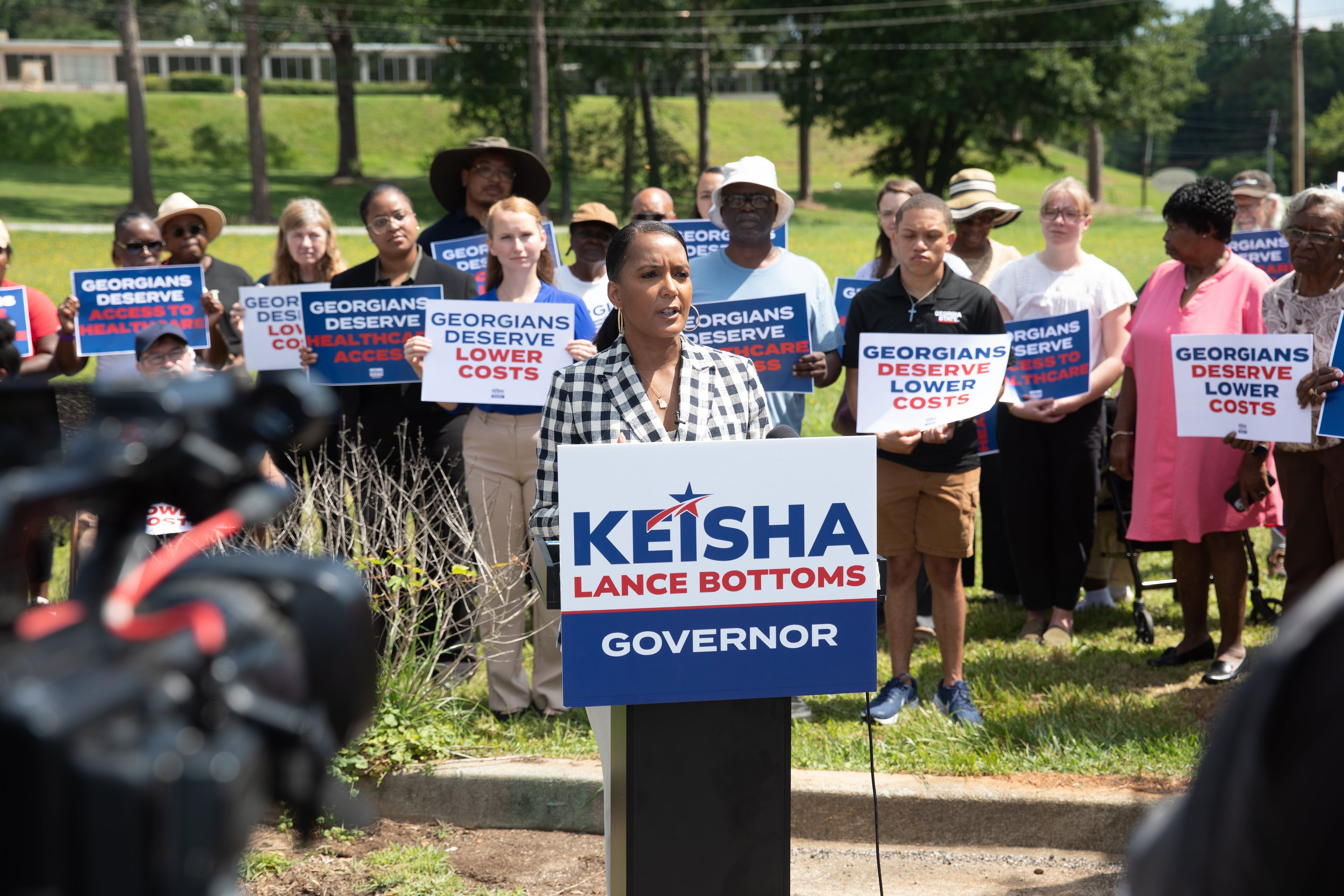
The day after Republican voters decided her opponent for November, Keisha Lance Bottoms stood outside a shuttered hospital in Commerce and pledged that, if elected, she would work to make more people eligible for Medicaid, the government-funded health insurance program.
The declaration put Medicaid expansion at the center of her general election campaign. And it positioned Bottoms as the torchbearer of a cause Georgia Democrats have championed for more than a decade — and one Republican governors have repeatedly blocked.
Four months after her remarks in Commerce and a day after making history as Georgia’s first Democrat to be elected governor since 1998 — Bottoms reaffirmed her commitment to expanding Medicaid, expressing hope that Republicans will get on board.
“The need for healthcare transcends party lines. It transcends geographical lines,” she said. “I truly believe that this is an issue we can get bipartisan support with.”
“I’m an optimist,” Bottoms added. “I think it will get done.”
Georgia is one of 10 states that did not expand Medicaid coverage under the Affordable Care Act. An expansion would cover adults with incomes making up to 138% of the federal poverty level, or roughly $22,000 per year for an individual.
Proponents believe Bottoms, backed up by Democrats’ brand-new majority in the state House, could bring Medicaid expansion to fruition in the months ahead.
“There’s no question that we have the political path to get there,” said Harry Heiman, a health policy professor at Georgia State University’s School of Public Health.
But getting the proposal through the General Assembly will be more complicated than meets the eye.
When the Legislature convenes in January, Republicans will hold a narrow, two-seat majority in the Senate, and the party could make its own set of demands in exchange for its members’ support — if they fall in line at all.
Lt. Gov.-elect Josh McLaurin, the first Democrat to lead the state Senate since 2006, told The Atlanta Journal-Constitution he is confident efforts to reduce healthcare costs will draw a “strong bipartisan coalition.”
“I strongly believe that there will be a majority sufficient to pass Medicaid expansion in 2027,” he said.
In the days following Democrats’ major political wins, GOP lawmakers who were once open to the idea stayed silent while the caucus hashed out its political strategy.
The AJC reached out to a half-dozen Senate Republicans who signaled openness to expansion or signed on as cosponsors to expansion legislation in 2024 and 2025.
Only one offered a reserved comment.
“We need to work together where we can and stand up for conservative values where we can’t,” said state Sen. Russ Goodman, who previously indicated he’d consider expansion.
Signs of support
As pressure mounts on Georgia’s rural healthcare system and polling showed expansion popular with voters, some GOP legislators have increased their willingness to explore the issue.
Legislative debate over expansion in 2024 advanced farther than expected with the support of a handful of Republican senators. That year, the Legislature considered following an expansion model adopted in Republican-led Arkansas as part of a compromise to roll back hospital regulations.
The Georgia Senate nearly allowed the bill to pass out of a committee for a full Senate vote. Two Republicans joined with Democrats to vote in favor of the measure, but the committee’s chair broke the tie and voted against it.
“My feeling was we need to support our governor and his approach, and let’s give it a chance to work,” said Republican state Sen. Bill Cowsert, the committee chair who cast the deciding vote against it. “If it fails, then we’ll be back in here next year talking about other alternatives.”
The AJC reported at the time that Kemp’s aides had sent word to lawmakers he was skeptical of expansion.
For Democrats, it was both a major step forward and frustrating defeat.
“There were obviously rural Republicans who were interested in talking about this issue,” said Democratic state Rep. Michelle Au. “They didn’t have to hear the bill at all — and they certainly didn’t have to vote on it.”
The following year, four GOP senators also signed on as cosponsors of another expansion bill.
But for major pieces of legislation like Medicaid expansion, Au said, “the most important thing is having a governor that supports it.”
“We’ve seen that even when there’s an appetite in the Legislature — a bipartisan appetite — to pass such a thing, that simply having a Republican governor say, ‘No, kill it’ is enough to ensure that it won’t pass,” she said.
GOP governors push back
Gov. Nathan Deal, and later Kemp, argued that, even with Washington picking up 90% of the cost, expansion would still be too expensive and a bad deal for the state in the long term, especially if federal funding disappeared.
“That’s just not good policy,” Kemp said in Athens in 2024 shortly after the expansion effort was blocked under the Gold Dome.
“It doesn’t matter if you’re a Republican or a Democrat. I’m in the no camp,” he said.
Kemp said the state needed more time to implement his Pathways program, a limited expansion of Medicaid benefits that was contingent on recipients working. But it has enrolled only a fraction of the 90,000 Georgians the governor’s office once projected it would.
Bottoms called the program on the campaign trail a “costly boondoggle” with “lots of red tape, very little real coverage.”
Supporters argue expansion would cover hundreds of thousands of Georgians with no health insurance while offering a lifeline to the state’s rural healthcare system, which is being strained by the surge of uninsured patients seeking care in emergency rooms who cannot pay their bills.
Stacey Abrams used Medicaid expansion as a rallying cry for Democrats in her two unsuccessful bids for governor in 2018 and 2022. But Brian Kemp’s consecutive victories effectively put the issue on ice.
Heiman, with Georgia State University, said with Democrats increased political power, he has “no doubt” the Legislature will opt to finally expand.
“We basically had governors that did everything in their power to avoid going down that path,” Heiman said. “But the Legislature was ready to go there two years ago, and the governor pulled them back.”
Democrats also saw new opportunity to focus on healthcare access this election cycle with affordability — including rising healthcare costs — the dominating issue.
Upward of 400,000 Georgians recently lost coverage when the Affordable Care Act’s enhanced federal subsidies expired at the end of last year, and premiums soared for those who were able to hold onto their plans.
Au also pointed to the insurance open enrollment period coinciding with the midterm election.
“The sticker shock of that is being shown to voters right when they’re deciding how to vote,” she said. “People are making those calculations literally as they’re walking to the ballot box.”
Caylee Noggle, president and CEO of the Georgia Hospital Association, said the state needs to act urgently to stem some of the problems hospitals face as a result of the increase in the number of uninsured Georgians.
“We are ready to sit down with (Bottoms’) team and get to work and find a way to some solutions in that healthcare space the moment she’s ready to do that,” she said.
— Chief political reporter Greg Bluestein contributed to this report.