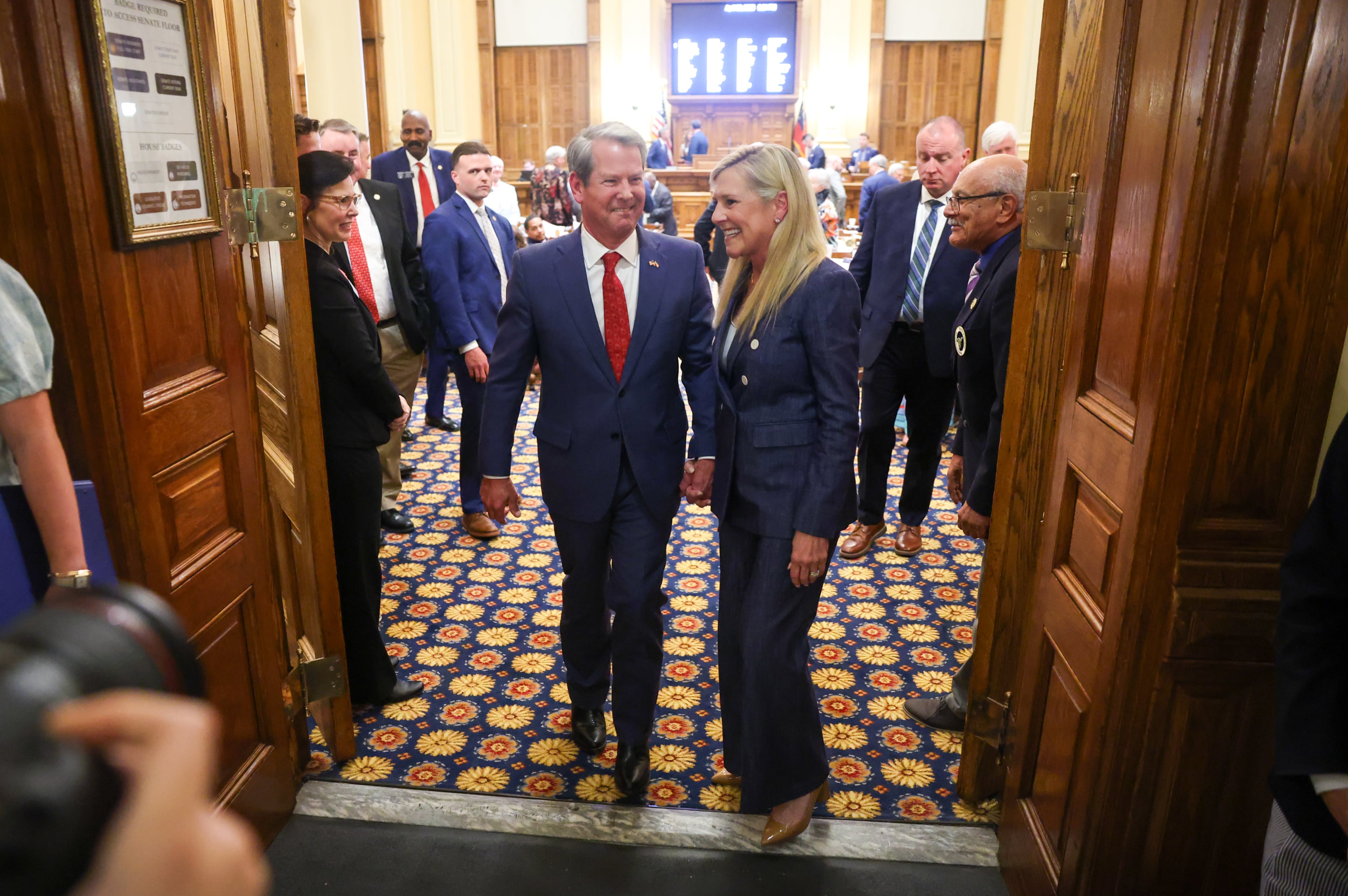
At state Capitol, affordability was the agenda. Now it’s the campaign battle.

Just about everyone under the Gold Dome began this session agreeing that affordability would define the year’s debate.
What became even clearer over the 40-day sprint that ended Friday is just how far apart the parties are over how to bring down prices — and how divided Republicans are within their own ranks.
Republicans spent much of the session sparring over competing measures to slash the income tax and cap property taxes. Some leaders insisted they could deliver sweeping action on both fronts.
Instead, hours of late-night wrangling again exposed deep fissures within the GOP.
After a revolt by Senate Republican leaders scuttled a bill to impose a 3% cap on property tax levies, the House reluctantly agreed to a scaled-back measure that only limits the growth of assessments.
Georgia’s 2026 legislative session wraps up
Major bills: Georgia lawmakers approve income tax cut, property tax relief
What’s next: At state Capitol, affordability was the agenda. Now it’s the campaign battle.
Time zone: Georgia won’t switch to Atlantic Standard Time after all
Opinion: Gov. Brian Kemp takes one last lap at the Georgia Legislature
Bad blood: Burt Jones putting the squeeze on top GOP rival Rick Jackson
Recap: How Sine Die unfolded at Georgia Capitol
Bill tracker: What lawmakers voted on
Opinion: The good, the bad and the truly ugly of the 2026 legislative session
Sine Die Seder: Why this night was different from all others
Confederate monuments: Bill to protect Confederate memorials narrowly fails in Georgia House
Complete coverage: Georgia legislative session
Democrats, meanwhile, warned the state could not afford more sweeping tax cuts that would blow multibillion-dollar holes in the budget and further strain local governments and school systems.
Now that divide moves from the Capitol to the campaign trail.
Ambitious lawmakers and statewide contenders who have been bottled up under the Gold Dome for the last three months can now hit the stump, raise money and make the case for what passed — and what didn’t.
Republicans aimed to telegraph their focus on the economy by largely shelving the familiar culture-war clashes over guns, abortion and transgender rights that fire up the party’s base but can repel middle-of-the-road voters, and turning instead to pocketbook issues.
Both Republican-controlled chambers agreed to reduce the state’s income tax rate from 5.19% to 4.99% this year, with a pathway to lower it to 3.99% over the next eight years if the state meets certain fiscal benchmarks.

They also approved more than $2 billion in tax relief, gave bonuses for teachers and state employees, and dipped deeper into the state surplus to suspend the sales tax on gas and bankroll infrastructure projects.
“That keeps people working in our state, keeps money in their pocket, and lets them fight through these difficult times that we’re in,” Gov. Brian Kemp said.
Democrats backed some of those budget measures, too. But they drew the line at deeper tax cuts, warning they could shift more pressure onto schools and local governments to make up the difference.
“I am mad about this because Democrats have to bear the burden of voting no on a bunch of legislation,” said state Sen. Josh McLaurin, a Democratic candidate for lieutenant governor. “We have to deal with the disconnect between the narrative that happens in this room and reality.”

Instead, Democrats countered with proposals that went nowhere in the GOP-led chambers: tax cuts specifically targeting teachers and other public employees, hiking the minimum wage, expanding the state’s Medicaid program, and calls to tap the surplus to help more Georgians afford housing and child care.
How that divide translates into policy and politics will shape an election season already dominated by economic anxiety — from rising gas prices tied to the U.S. war with Iran to growing concern that conditions are worsening under President Donald Trump.
‘Do something’
For Republicans, projecting a united front after another tumultuous finale will not be easy.
The closing days echoed last year’s chaos, when Lt. Gov. Burt Jones infuriated House leaders by abruptly gaveling out the Senate earlier than expected.
This year, a surprise revolt by Senate GOP leaders over the sweeping property tax bill again left Speaker Jon Burns and his allies smarting.
Election-year politics only heightened the tension as Jones sought to punish his top GOP rival, billionaire Rick Jackson, and a rift over House Speaker Jon Burns’ sweeping literacy overhaul loomed over the session’s end.

A private meeting last week helped cool tensions, and the Senate ultimately backed away from its push to rewrite the speaker’s signature bill.
But those strains flared again on Sine Die, when the tax fight was only one of several unresolved divides. The session ended with the real prospect of a special session to overhaul election policy after lawmakers failed to meet a self-imposed deadline to remove QR codes.
Still, GOP leaders tried to make the final takeaway less about their internal skirmishes and more about what they could tell voters back home: that they had done something on affordability.
“We are going to do what’s best for the taxpayer regardless of where that comes from,” said a dejected state Rep. Shaw Blackmon, R-Bonaire, after agreeing to scale back his property tax bill.
Republican state Sen. Blake Tillery, R-Vidalia, said the goal was to show voters lawmakers were willing to act.
The income tax cut he helped engineer falls short of the deeper rate cut he wanted, but it still chips away at the tax while adding breaks for some tips and overtime pay.
“I’m tired of watching my neighbors, watching my colleagues, watching people who I don’t know that I passed in a grocery store having a hard time making ends meet and not being willing to do something,” he said. “This bill does something.”

About the Author

Greg Bluestein is the Atlanta Journal Constitution's chief political reporter. He is also an author, TV analyst and co-host of the Politically Georgia podcast.