New Fulton commissioner gets $500K approval for gun violence prevention


At his first meeting as a Fulton County commissioner, Rohit Malhotra won approval of legislation directing the county manager to find at least $500,000 for community-based, gun-violence intervention in the county’s budget for calendar year 2027.
“Passing this legislation was more important to me than Election Day,” Malhotra told The Atlanta Journal-Constitution. “I made a commitment and promise to the families — the mothers and fathers and families — who lost their loved ones to unfathomable tragedy.
“I made a commitment that we would show up for them on Day One, and we kept our word.”

The resolution, approved Nov. 18, underscores that gun violence is a public health crisis that Fulton County must prevent by intervening with victims injured by gunfire. That includes through hospital visits from people who come from the same communities as many of the gunshot survivors, and who themselves may have been past victims of community gun violence.
These “credible messengers” offer services and options that could help them avoid future violence, and they help affected family members and others get the support services they need, Malhotra said.
Multiple studies have indicated such programs in American cities can lower the chances that participants will be injured again by violence, and can save taxpayers some of the exorbitant financial costs of shootings and gun-related homicides, not to mention the societal impact gun violence brings to generations of families, schools and neighborhoods.
For example, research by the Center for Gun Violence Solutions at the Johns Hopkins Bloomberg School of Public Health shows Safe Streets Baltimore, a community violence intervention program, was associated with a reduction in homicides and nonfatal shootings from 2007 to 2022. The report linked Safe Streets to a 23% reduction in nonfatal shootings during that period across 11 neighborhoods.
In the 2023 report, the center also estimated an economic benefit of about $7 to $19 for every $1 invested in Safe Streets.
“Gun violence is expensive,” Malhotra said at the Nov. 18 meeting, noting the $500,000 is only a fraction of how much some cities spend on such programs. “We are going to pay for it one way or another. You can either pay for it now in the investments that we can make to prevent it, and we will prevent the rippling effect that comes after that.
“Or we will pay for it later.”
Malhotra, a self-proclaimed “policy nerd” who is founder and executive director of The Civic Center for Innovation, said the issue has been his top priority for years — long before he ran in this year’s special election to fill the commission’s vacant District 4 seat.

The mechanics of exactly how the funding will work are still being hashed out. But Malhotra said $500,000 to $1 million will be distributed in partnership with the Interrupting Violence in Youth and Young Adults Project at Grady Memorial Hospital.
Grady is Atlanta’s only Level 1 trauma center and has seen more than 1,260 patients injured by gun violence over the past 12 months.
Dr. Randi Smith, a trauma surgeon at Grady and creator of the violence interruption project, said the funds could help with some of the program’s gaps. Opportunities include expanding the program’s hours, which generally are from 7 a.m. to 11 p.m. The project also could expand to serve all ages, and people injured by violence that is not gun-related.
“If we could actually have enough personnel to deal with the volume, I think that’s how we would utilize the funding,” Smith said.
The program has served more than 1,200 gun violence victims, ages 14 to 34, and their families, since it enrolled its first participant in January 2023, Smith said.
Only about 3.4% of program participants have come back to Grady Memorial with other injuries from violence, compared to the roughly 30% of gunshot victims across the U.S. who are injured again within five years, according to Smith.
The violence intervention project makes bedside visits to shooting victims, after medical providers have treated their wounds, and assesses root causes of the shooting to figure out what resources they need. A patient might need food, housing, transportation, legal help or strategies to cope with conflict.
The program then finds ways to meet those needs. Participants in the program also can return to the hospital’s clinic to receive mental health treatment or other services.
The Circle of Safety initiative hands off participants to community-based programs that can help them further. Sometimes that means relocating them from a dangerous living situation or supporting mothers of small children who need things like diapers or a crib.
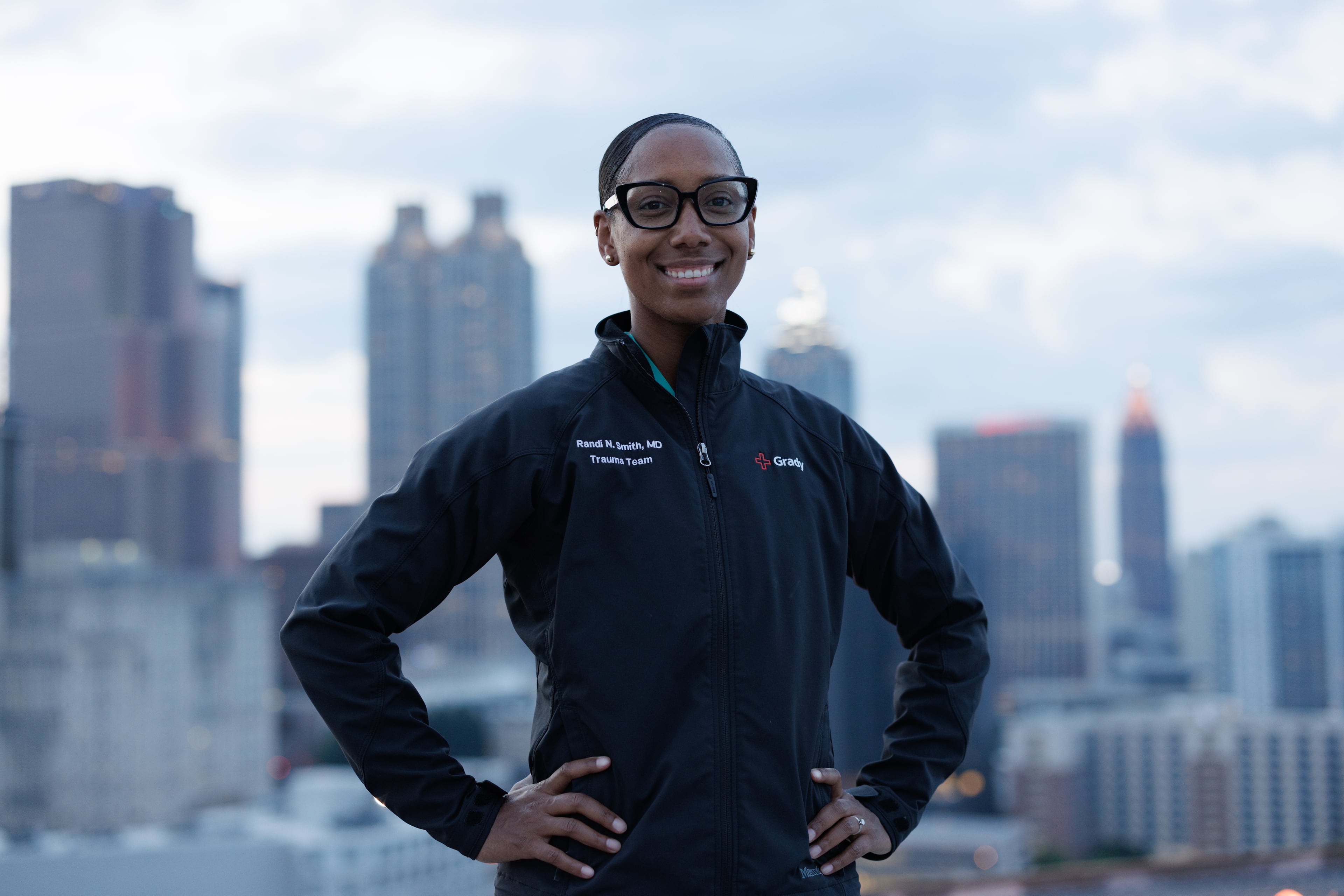
Many of the trained violence-prevention professionals have been victims of gunfire or have relatives or neighbors who have been injured, and they are experts at gaining the trust of the patients, Smith said.
“So it’s really near and dear to their heart, and then they come to work every day where they could be retraumatized by walking through the journey of somebody else who’s injured,” Smith said, adding: “They are so connected in the community that it’s an easy, seamless transition when people leave from the hospital, so they don’t fall through the cracks.”
Statistics speak to the scale of gun violence in Fulton County.
The Fulton medical examiner’s office investigated 192 gun-related homicides in 2024, according to its most recent annual report. The county had 764 gun homicides from 2021 to 2025, according to the Center for Gun Violence Solutions at Johns Hopkins.
Nationwide, gun violence kills 40,000 people and wounds twice as many in an average year at a cost of $557 billion, according to the advocacy group Everytown for Gun Safety. The costs include police investigations, medical treatment, long-term physical and mental healthcare, earnings lost to disability or death, criminal justice costs, and value estimates for lost quality of life.
In Virginia, hospital-based violence intervention programs have served nearly 10,000 patients since 2019 and avoided nearly $102 million in healthcare costs, according to the Virginia Hospital & Healthcare Association.
“Violence is a really complex, multi-generational issue that needs deep structural and long-term investment,” said Carla Tilchin, a researcher for the Center for Gun Violence Solutions in Baltimore. “So every dollar invested in prevention is a good dollar invested.”

In urging the Fulton Commission to approve Malhotra’s legislation, Georgia Rep.-elect Kenn Collier shared how generational violence has affected him.
Collier said he never met his grandfather, who died from gun violence. The mother of Collier’s son was killed in 2017 in the city, and then Collier’s son, Kenneth Collier Jr., was fatally shot last year at age 17 in Cobb County.
Collier is founder of the nonprofit Futures Without Fear, which works to help young people and families overcome adversity and recover from trauma.
“We oftentimes talk about the victim, the person that was affected, but we don’t think about the other people around them, the kids that are affected, that now have to be raised by that older sibling because the mom is gone,” Collier told the AJC.
Other Fulton commissioners voting to support Malhotra’s resolution were Bob Ellis, Marvin S. Arrington Jr. and Vice-Chair Khadijah Abdur-Rahman. Arrington and Abdur-Rahman asked to be cosponsors.
Bridget Thorne abstained. Dana Barrett and Chair Robb Pitts did not vote. The three questioned from where in the budget the money would come, given how many other worthy programs are competing for funds, and said they were not given enough time to properly consider the proposal.