Grayer, larger, more diverse: Big changes on deck for Georgia’s population



The face of Georgia will change substantially in the decades ahead as the state continues to grow older and more diverse.
That’s according to the latest long-term population projections recently released by the Governor’s Office of Planning and Budget. Completed by the University of Georgia’s Carl Vinson Institute of Government, the demographic estimates are aimed at helping state officials plan for future infrastructure and public service needs, from transportation to hospitals and schools.
The projections show that recent population trends will continue. More people will come to the Peach State, particularly people of color. More counties will become majority-minority. And the population of seniors will grow at a far faster clip than school-aged children.
Each of those factors could have a major impact on who Georgians vote for, the kinds of policies officeholders promote and what the state’s future ultimately looks like.
“Georgians want policymakers who reflect their priorities and who give attention to the issues that they care about,” said Daniel Kanso, vice president of public policy at the left-leaning Georgia Budget and Policy Institute.
More diverse than ever
Last year, Georgia became a majority-minority state for the first time in its modern history.
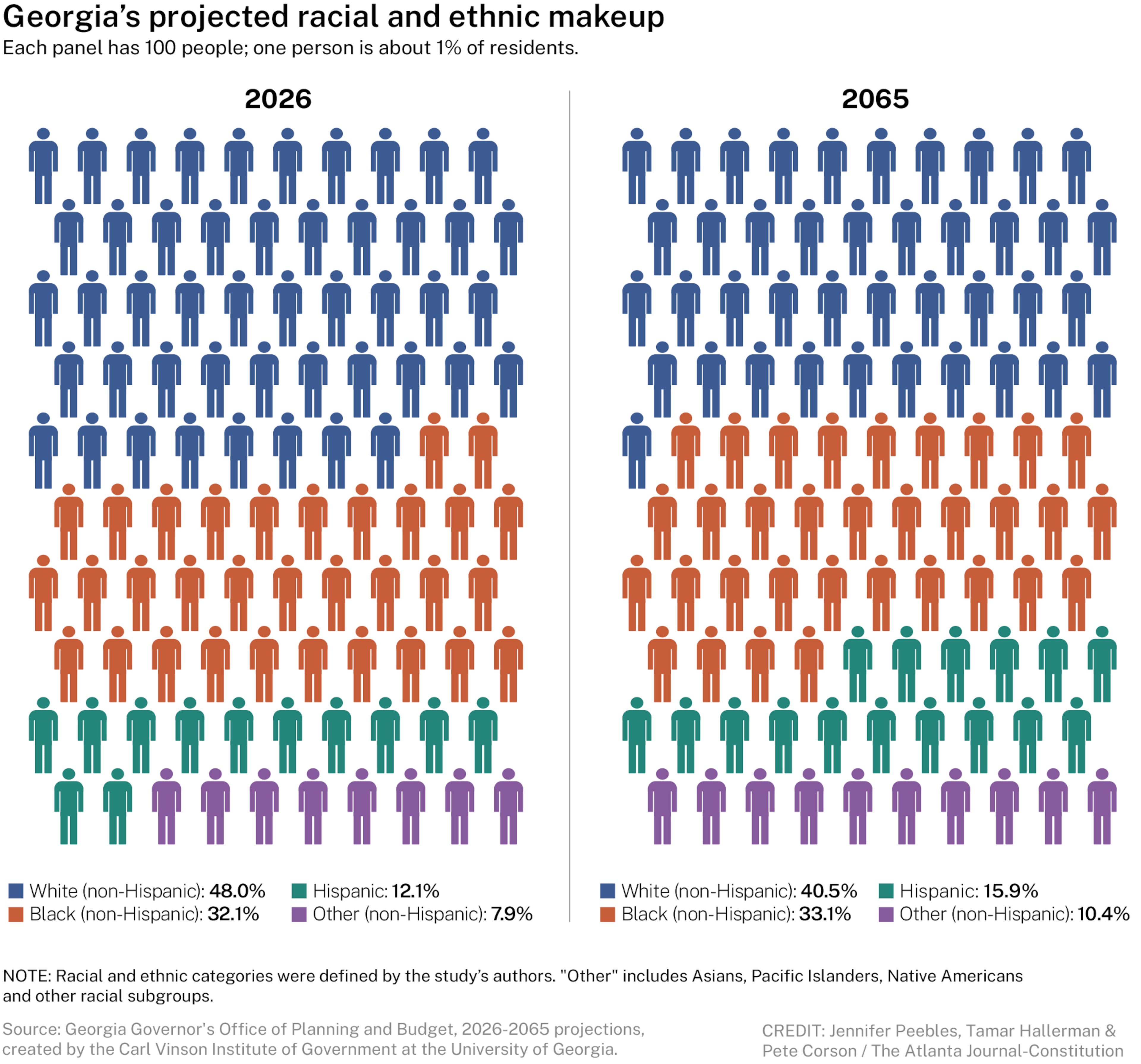
White residents made up 48% of Georgia’s population of 11.3 million in 2025, according to U.S. Census data, while Black residents were 32% and Hispanics 12%. In recent years, people of color have driven much of the state’s population growth.
The new projections show those same trends continuing over the next four decades.
In 2065, Georgia is expected to be home to 14 million people. About 40% will be white, 33% Black and 15% Hispanic, the state data predicts.
By that year, 64 of Georgia’s 159 counties will be majority-minority, compared to 38 today.
All five of the counties that comprise metro Atlanta’s urban and suburban core are already majority non-white, but two will see important shifts in the future.
Gwinnett will switch from a Black plurality to Hispanic plurality by 2046, and Cobb will transition from a white plurality to Black plurality in 2053.
Big changes are also coming for several exurban counties on the outskirts of the metro area.
South of the city, Spalding County is expected to become majority non-white in 2030 and Fayette will join three years later. Paulding is projected to flip in 2037, and Hall County, which includes the city of Gainesville, will become majority non-white in 2042.
In far northwestern Georgia, Whitfield County is predicted to become Georgia’s first county where Hispanics make up the largest single racial or ethnic group in 2039. The county will be 58% Hispanic by 2065, according to the projections.

Whitfield, on the Tennessee border, is home to Dalton and known for its carpet and rug manufacturing. It is currently 40% Hispanic.
Closer to Atlanta, Forsyth County, which has seen a large influx of Asian residents in recent decades, is on track to become majority non-white by 2044, the projection says. And by 2059, the county will see the “other” racial grouping, a category that includes Asians, gain a plurality over white residents.
Grayer population
The projections also show a state that is, on average, growing older.
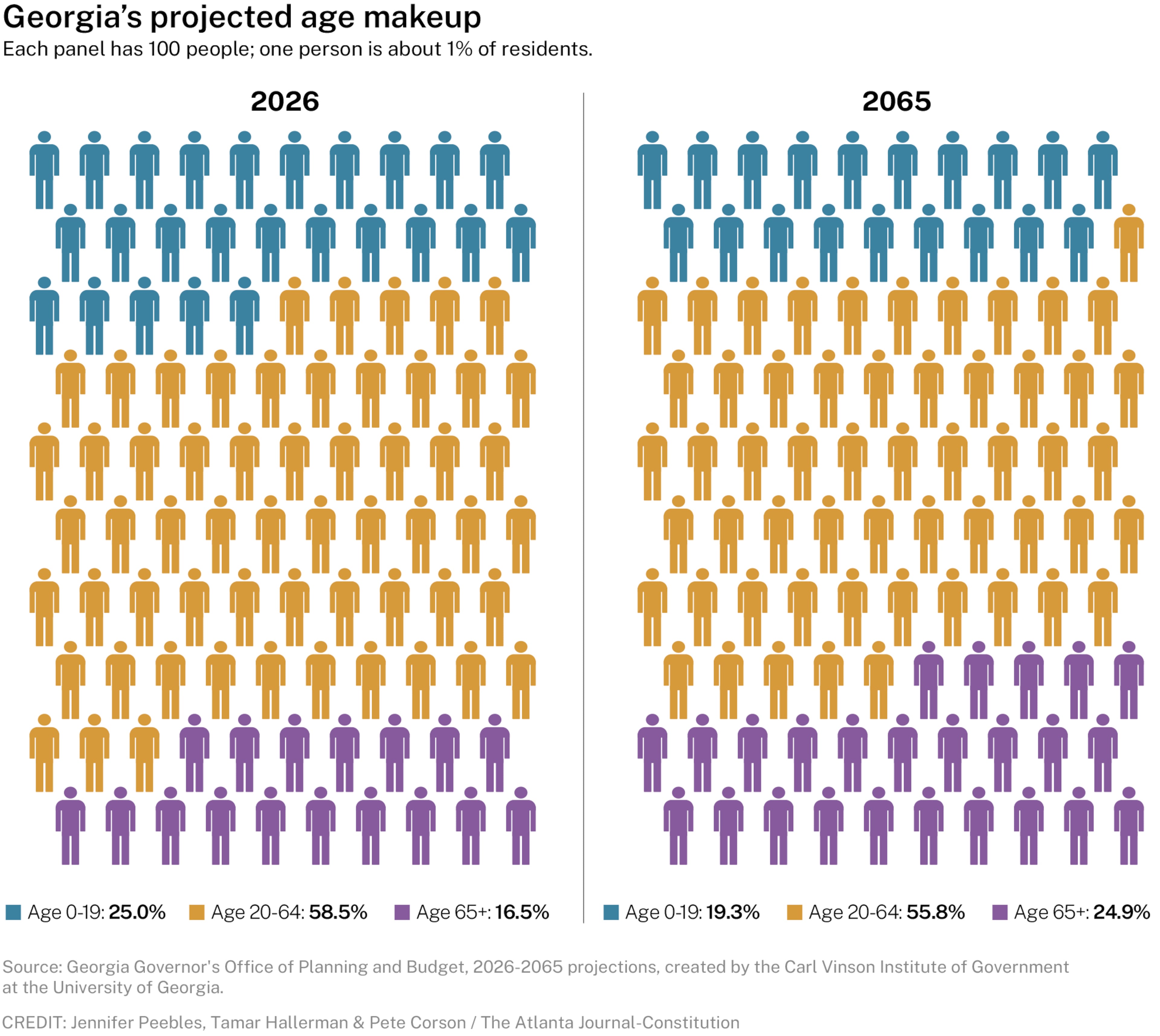
Today, about one in four Georgians, on average, is a young person. In 40 years, the projection is that slightly less than one in five will be in their teens or younger.
During the same period, the number of seniors is expected to skyrocket.
Today, about one in six Georgians is 65 or older. By 2065, that ratio will increase to roughly one in four.
Kyle Wingfield, president and CEO of the right-leaning Georgia Public Policy Foundation, said the decrease in the number of school-aged children will lead to “massive culture change” as policymakers plan for Georgia’s future.
“When you think about the single largest thing the state of Georgia spends its money on it’s K through 12 education. If you add higher ed, you’re talking about a majority of the state general fund budget,” he said.
Educating the state’s young people likely won’t fall down the list of priorities, but it could prompt debates surrounding how schools are funded, Wingfield said.
“Do we need a dedicated sales tax that exists in most parts of the state for capital improvements when you’re going to have an increasing number of empty buildings around the state or emptying buildings?” he asked.
An older population overall also means healthcare will continue to be a top issue: where Georgians can find it, how affordable it is and who will provide that care.
Georgia already has a doctor shortage. Wingfield said the state needs to find ways to increase residency slots in Georgia, and to make other changes to build healthcare capacity — including, in his view, scrapping the state’s contentious “certificate of need” system that requires state approval before hospitals and other healthcare facilities build new facilities or major expansions.
Kanso, of the Georgia Budget & Policy Institute, said the state should expand Medicaid, invest in public health programs and take other actions to expand access to care.
He said policy leaders should also invest some of the state’s budget surplus into creating a childcare trust fund to address a sector where there are both supply and affordability issues.
“That’s something that really does affect younger families in our state and is something that’s really essential to our economic future,” he said.
Housing crunch
Georgia’s population has nearly doubled over the past 40 years. The growth over the next four decades won’t be as explosive, according to the analysis, but metro Atlanta’s population will continue to swell.
Kristin Allin, senior planner and housing specialist at the Atlanta Regional Commission, said the region needs to implement a housing strategy that both keeps up with the growth and provides options for people at every price point — particularly more affordable options that have long been in lower supply.
“What we have now is a situation where we have been building in a certain direction for many decades, which is predominantly single-family homes, and we have seen this over time in our region lead to a crunch,” said Allin.
She said governments could make changes around zoning and funding mechanisms, as well as focus on better utilizing vacant and underutilized lots to build closer to transit and job centers. That will help keep up with growing populations, aid economic mobility and limit sprawl, she said.
“What we really want to see is each community having a healthy supply of housing across the income spectrum and across housing types for all stages of life,” Allin said.