What’s as long as 5 football fields? Private docks likely headed to Georgia coast.
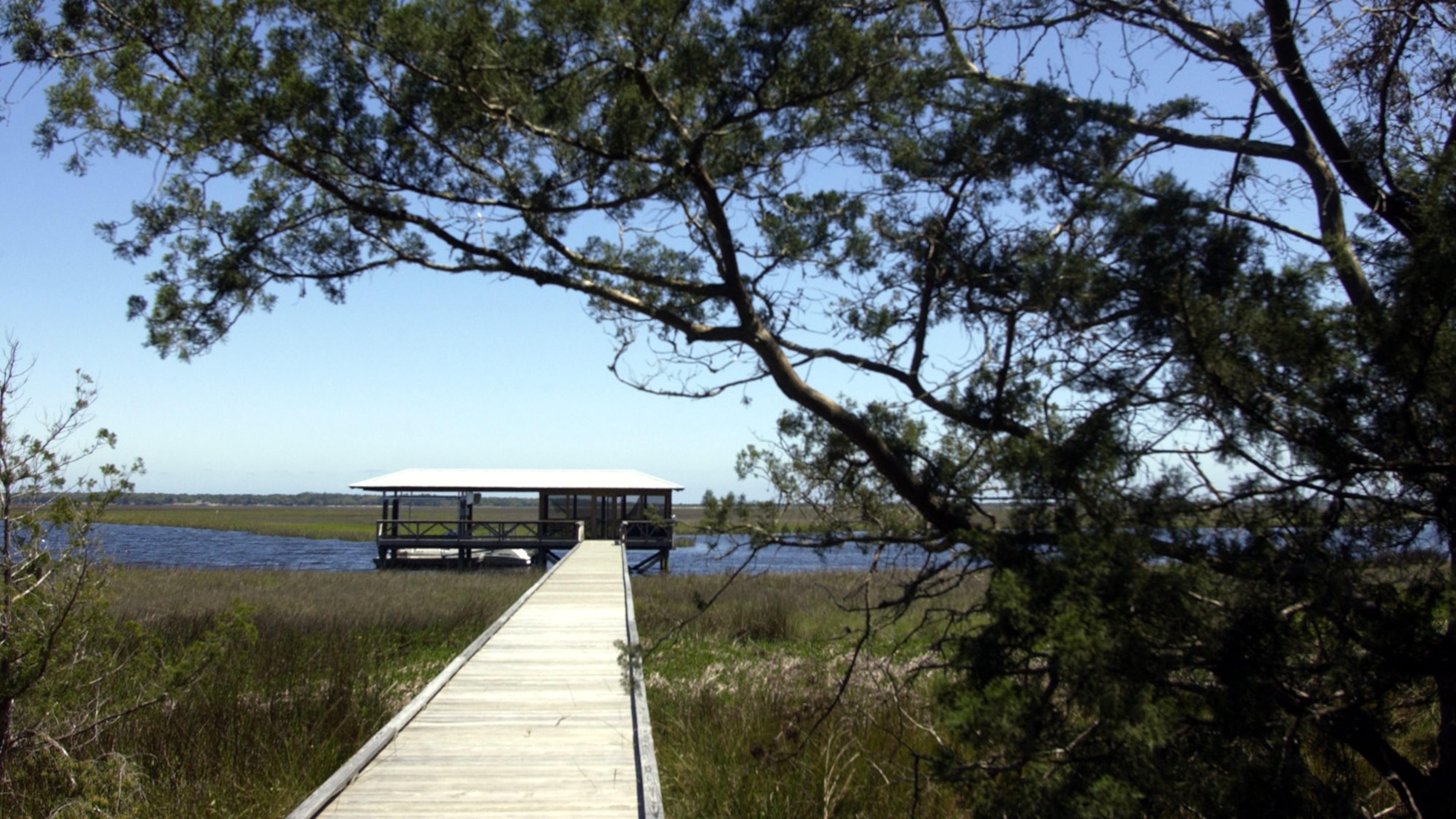

Viewed from the waters of Turner Creek, a serpentine tributary east of Savannah, the dock stretches so far across the marsh that even those with 20-20 vision must squint to see where planking meets terra firma.
The long, wooden structure is a favorite landmark of those who grew up nearby. It’s part of a church retreat center that hosts a summer camp popular for generations. Many an alum fondly remembers trekking the 950-foot walkway to go for a swim on a hot, sticky July day.
“It was definitely a very long walk that most didn’t enjoy,” said Alice McCuen, a teenager who first “walked the planks” along with her sister Piper about a decade ago. “The walk was worth it.”
Come next week, that dock’s days as one of the longest on the Georgia coast could be numbered. The board of the Georgia Department of Natural Resources is poised to decide whether to adopt regulations allowing private docks to extend to 1,500 feet in length — 1,650 feet in special circumstances — along the state’s 2,400 miles of tidal shoreline.
For context, 1,500 feet is the length of five football fields, 1½ times the height of Atlanta’s Bank of America Plaza skyscraper and slightly longer than the Tybee Pier, which stretches into the Atlantic Ocean. It’s 400 feet longer than the world’s longest aircraft carriers.

The proposed length is also 50% greater than the current 1,000-foot limit for privately owned docks that cross the state-owned marshlands.
Tuesday’s expected vote is the culmination of a contentious two-year effort by the state agency to revise permitting rules for docks that provide deep-water access to nearly 3,500 marshfront property owners.
Many Georgians oppose the change. Of 325 public comments recently submitted to the DNR, only four supported the proposed rule. Some critics allege it’s the product of backroom dealings after an email exchange advocating for longer docks went public.
Conservationists and environmentalists have been particularly vocal. They say the new rule would benefit a privileged few at a steep ecological cost. Scientific studies show bigger docks cast shade that harms the robust marsh ecosystem.
Proponents downplay the threat. A review of the existing docks revealed they only cover 89 of Georgia’s 368,000 marshland acres.
Pat Farrell, a former Chatham County commissioner who represented hundreds of waterfront homeowners while in office, spoke in favor of relaxed limits at a public meeting this summer.
He said very few docks that exceed 1,000 feet would be built because of financial constraints, with costs measured in the hundreds of thousands of dollars.
“I don’t want to destroy the marsh; I love the marsh,” Farrell said in a telephone interview with The Atlanta Journal-Constitution. “But I don’t want to tell people they can’t enjoy something that’s been enjoyed for hundreds of years.”
Dock Length Comps
Football field: 300 feet
MARTA subway (6 cars): 450 feet
Current Georgia dock length limit: 1,000 feet
Bank of America Plaza (Atlanta): 1,023 feet
U.S. aircraft carriers: 1,100 feet
Tybee Beach Pier: 1,490 feet
Tiger Woods’ longest (golf) drive on PGA Tour: 1,494 feet
Proposed Georgia dock length limit: 1,500 feet; 1,650 feet in special circumstances
Sources: Georgia Department of Natural Resources (dock lengths); various online estimates
The revision could reshape the shoreline by increasing the number of dockable properties, boosting values and giving longtime marshside dwellers the potential to access deep water for the first time.
The change would also establish a maximum width of 6 feet, wide enough for golf carts and ATVs that many dock owners use to move gear or older or disabled family members along the walkway. Under the current regulations, dock width is part of a total footprint calculation, limiting the longest docks to around 3 feet in width.
Adding to the outcry are shifts in the maximum dock lengths as the rule has neared a final vote. The initial proposal would have allowed wider docks but maintained the 1,000-foot limit. Before 1,500 feet became the new standard, there was brief discussion of not imposing a cap, allowing for docks of unlimited lengths.
The maneuverings drew sharp rebukes, including from the retired director of the DNR’s Coastal Resources Division, Susan Shipman. In a public comment and in a letter to the editor published in the Brunswick News, Shipman reminded the DNR board that “the Georgia coast we want for our grandchildren’s enjoyment is too valuable to be carved up by larger private docks without stronger safeguards.”
In a telephone interview with the AJC, Shipman said the 11th-hour loosening of the length limit appears to have “tipped toward private interests.”

Allegations of cronyism have grown in volume since the late September emergence of email communications that suggest representatives of would-be builders of 1,000-foot-plus docks were quietly lobbying at least one DNR board member for a more lenient rule.
The Current, a coastal Georgia-based online news organization, was the first to obtain those emails under the Georgia Open Records Act.
The emails were written in June when the initial proposal, with the 1,000-foot cap, was under review and about to be published for public comment. The correspondence culminates in an appeal to the coastal district’s DNR board representative, Bill Jones III, citing shoreline-wide dock statistics and that “anyway you slice this it’s an insignificant impact on our coastal marsh.”
Jones told the AJC such direct petitions are both appropriate and welcome but that he does his “own research and make my own decisions.” His priority is for the rule to accommodate access in ways that are “safe and practical.”
Jones said the 1,500-foot length was proposed by DNR’s senior leaders and that he pushed for a length-related limit that restricts docks from crossing creeks 20 feet or wider.
A DNR spokesperson said the staff and board considered input from stakeholders and evaluated existing processes in formulating the proposed rule. She added the board will review the regulations and the public comments before a vote.
The proposed rule is the first action item on the agenda for the 9 a.m. Tuesday meeting at the Sloppy Floyd state office building in downtown Atlanta.
One member of the stakeholder committee that gave input on the dock regulations, Alice Keyes with the Brunswick-based environmental nonprofit One Hundred Miles, said she is discouraged.
“We’ve been shocked,” she said. “There was no indication that they’d go bigger on the docks, especially in the face of all the negative comments. And there doesn’t seem to be much concern over those outed by the emails. The DNR seems bent on giving the powerful what they want.”