A driver passed too close to cyclists. Now he could die in prison.


WOODSTOCK — He is a villain to bicyclists, a fascination to impatient motorists, a criminal in the eyes of the local authorities. Outside the metal armor of his notorious Honda Pilot, Jerry Ross is a fragile man.
Ross is 73 years old, weakened by stroke and heart attack, with a scar down the middle of his chest and a collection of pills on the kitchen counter. Beta blockers, blood thinners and so forth. Sometimes he gets dizzy coming up the stairs in the garage and he leans so hard against the wall that he scrapes his arm and leaves a little trail of his thinned-out blood.
Eight days after the incident on Sugar Pike Road, which was captured on video and viewed millions of times on the internet, Ross was released from the Cherokee County jail on $24,540 bond. He was indicted last week for aggravated battery, two counts of aggravated assault, and leaving the scene of an accident, among other charges, which means, if convicted, he could be sent to prison long enough to die there. He’s on the arraignment calendar for Nov. 4.
It all started with a complication that most drivers know well. Ross described it in a 911 call just after the incident. He said bicycles had blocked the lane. They were riding three wide, he said, holding up traffic and refusing to move over.
“I apologize for having to burden you up,” he told the dispatcher. “You know, just tired of it, man. They just, you know. Do what the hell they want.”
If the authorities are correct, a 14-second video taken by one of the cyclists shows Ross committing multiple felonies. But in the court of public opinion, the cyclists have not been found entirely innocent.
A news segment from WSB-TV drew more than 5,000 comments on YouTube. While many commenters denounced Ross, others vented their own frustrations about cyclists. Some insisted the cyclists should ride in single file. At least one blamed the cyclist who collided with the Honda Pilot. Another said Ross should get a medal.
The cyclist who took the video posted it on Instagram, where it racked up more than 2.7 million views.
After a while, he turned off the comments.
The incident made national headlines in April and May. It was covered by TMZ, People, and the New York Post. Ross finally told his side of the story in October, in extensive interviews with The Atlanta Journal-Constitution, where he made it clear he has no intention of going to prison. He plans to spend his final years in the same house where he’s lived since 1986, up a hill on a cul-de-sac between the Woodstock city limits and the Fulton County line, with his Florida Gators doorbell and his Gators shower curtain and an easy chair where he can sit and watch Florida Gators football.
Ross insists he did nothing wrong on Sugar Pike Road that day in April. He will fight to prove that claim.
“I’ll take this to the Supreme Court,” he said.

Not first run-in between cyclists and motorists on Sugar Pike Road
Late in the afternoon on April 23, 10 cyclists left Whitetail Bicycles in downtown Milton for their regular Thursday ride. This was not the fastest group at Whitetail, but they were serious riders. They planned a loop to the north and west of about 33 miles.
There are several definitions in metro Atlanta, of the line between the advancing suburbs and the retreating countryside, and parts of this ride seemed close to that line. Along Sugar Pike Road in the green hills of southeastern Cherokee County, housing subdivisions share the land with grazing cattle.
Shaune Huysamen, the owner of Whitetail Bicycles, was not on that ride. But he knew the road well. He kept a copy of a police report from 2021 in which a local teenager admitted driving past Huysamen in a pickup truck on Sugar Pike and throwing a water bottle at his head.
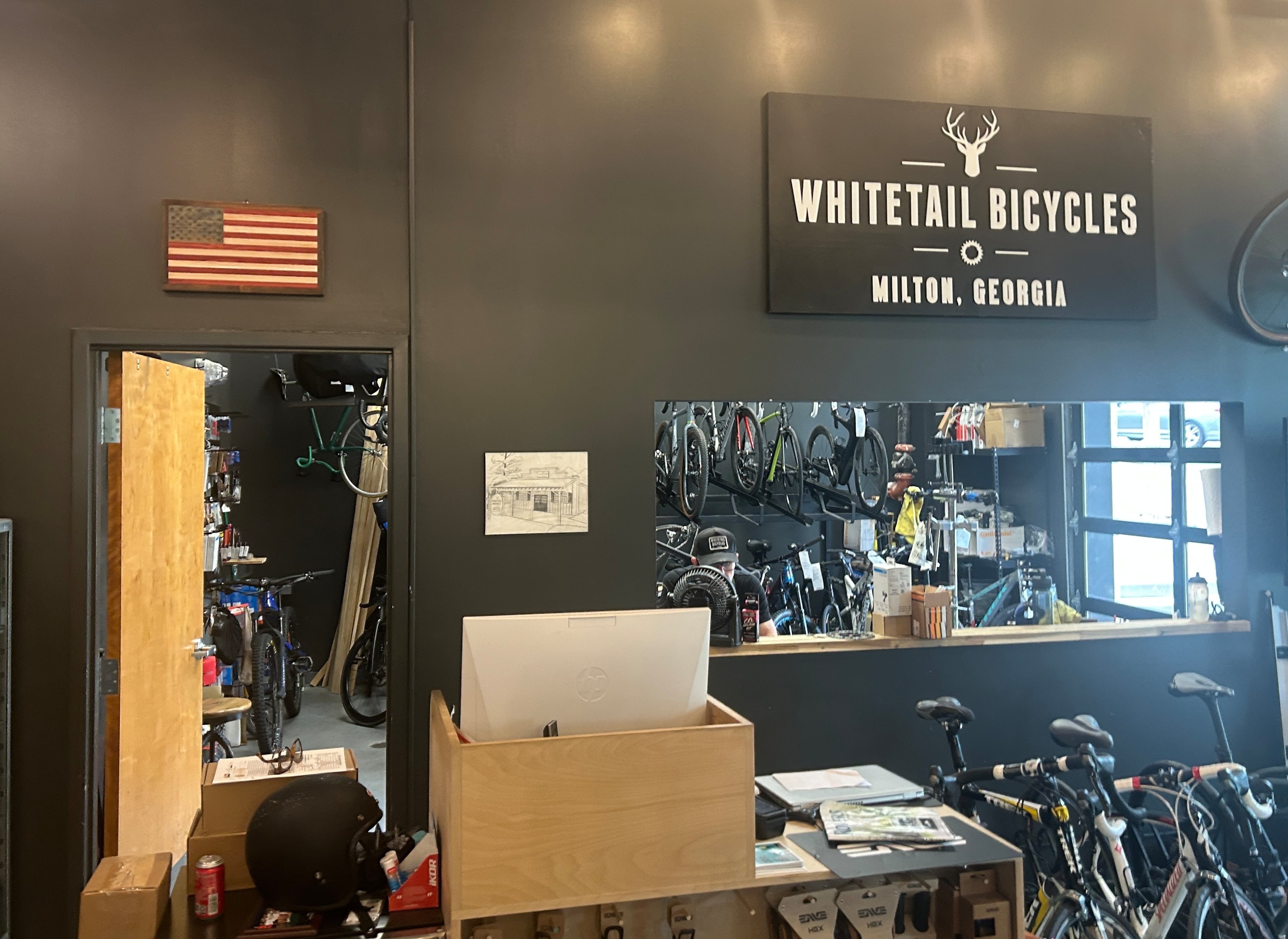
One of the Thursday riders, Joel Eaby, acknowledged the uneasy relationship between cyclists and motorists. Just as some people behave terribly behind the wheel, some cyclists are inconsiderate when asserting their rights.
“It’s like, just because you can doesn’t mean you should,” he said.
Eaby grew up in rural Pennsylvania, Amish country, and often saw tractors or horse-drawn carriages on the roads. Of course they slowed down drivers, but people didn’t go around cursing at them or flipping them off. Why not? They were part of the community. They were accepted.
What will it take for cyclists to become accepted on the roads of America? Maybe they already are, in certain parts of certain cities, where dedicated bike lanes help them stay out of the way. Even in the country, the vast majority of drivers pass cyclists without incident.
But impatience leads to resentment, and resentment accumulates like cholesterol. Some drivers will never be pleased to share the road with a fleet of recreational vehicles who force them to slow down, even for a minute or two.
“We impede traffic,” said Morten Jensen, who was on the ride with Eaby that afternoon. “There’s no doubt about it.”
About two-thirds of the way through their ride, as they pedaled south on Sugar Pike Road through the early-evening light, Eaby heard something behind him. The blast of a horn. A driver in a black Honda Pilot.

Were the cyclists following Georgia law?
Yes, Jerry Ross hit the horn. Decided to lay on it, as he would later say. Throughout the video Joel Eaby took after pulling his iPhone out of his pocket, the blaring of the Pilot’s horn is nearly continuous.
Ross says he was coming home from the grocery store that day. He prefers taking back roads because he can easily pull off if he feels a vertigo attack coming on. He turned right near Sugar Pike Junction, a little cafe where the nice ladies call him Gator, and headed south on Sugar Pike Road. Soon he saw the bicycles.
In his recollection, they were in four rows. Three, two, two and three. He even borrowed a reporter’s notebook and pen and drew a diagram of what he said was their formation. Like some of the YouTube commenters, he believed Georgia law said cyclists had to ride in single file.
Georgia law does not say that. It says they “shall not ride more than two abreast,” and they generally “shall ride as near to the right side of the roadway as practicable.” Were the cyclists abiding by these laws? Maybe not.
“Oh, it’s possible,” Eaby said when asked if there were times on Sugar Pike Road when the group went three wide. “Yeah. It’s possible.”
Just like driving a car, riding a bike requires some pragmatic decision-making. Sometimes a driver will swerve to avoid a pothole. A cyclist might do the same. If someone near the front of the formation hits the brakes, another cyclist might swerve to avoid a chain-reaction crash that takes everyone down. In so doing, they might go three wide.
As for the law directing cyclists to stay as near to the right side as practicable, this directive could stand to be more precise. What does “near” mean? What does “practicable” mean? These things are open to interpretation.
Memories differ. Another cyclist, Mike Verna, said they stayed two wide. Were they taking up the entire lane, as Ross claimed? Maybe not quite. Yet another cyclist, Richard Collins, estimated they were taking up somewhere between two-thirds and three-quarters of the lane. It was a two-lane road with hills and curves. To go around the cyclists, Ross would have to cross the double yellow line.

A lawyer’s advice for his fellow cyclists
There are certain times when crossing the double yellow line is legally acceptable, says Decatur attorney and bike-law expert Bruce Hagen. Passing bicycles is one of those times.
Here’s what the state law says, approximately. Approach the cyclist with caution. Change to an adjacent lane, except if that would be impossible, illegal or unsafe. If it would be, slow down and go around the cyclist, leaving a buffer of at least 3 feet.
Hagen points out that bicycles are not the only objects that force a driver into a dilemma like this. Thus, they should not be treated as uniquely inconvenient. What about farm vehicles? Construction equipment? Motorists don’t often gripe about having to cross the center line to avoid those obstructions.
It’s not just drivers who need guidance. Hagen has advice for his fellow cyclists. He says he tells them, “You need to act, every time you’re on your bike, like you’re an ambassador for the entire bike community.”
In Hagen’s view, this is the double standard a cyclist must face. For much of society, one bad driver is just one bad driver. When a cyclist does something wrong, all cyclists get the blame.
Do cyclists break the law sometimes? Of course, Hagen says. But he makes a bold and unverifiable claim about drivers: All of them break the law every time they drive. They fail to use turn signals. They roll through stop signs. They pick up their phones. And of course, they speed.
Hagen’s law firm is called Hagen Rosskopf. But Rosskopf is gone. Last year Hagen’s law partner, Ken Rosskopf, was killed in a collision with a pickup truck. He was riding his bicycle.
In other words, this is not a game. The Whitetail cyclists already knew it. On the same road where they encountered Ross and his black Honda Pilot, their friend Carlos Moreno Gutierrez was cycling one Sunday in October 2025 when he was struck by a drunk driver who’d been going more than 90 mph. Gutierrez died of blunt-force trauma. He left behind four children.
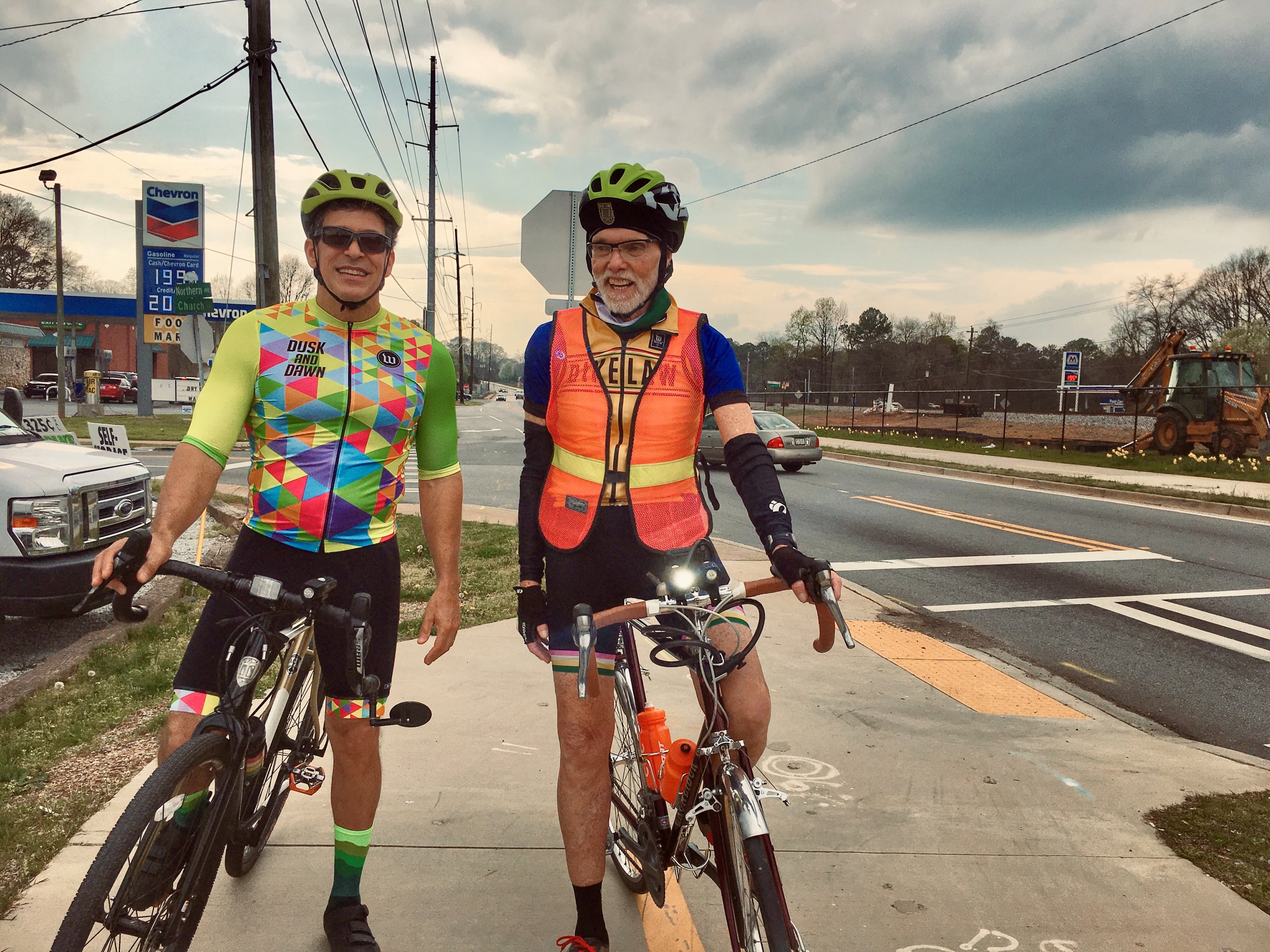
Bruce Hagen makes it his business to know about cycling incidents in metro Atlanta. He is well aware of the Jerry Ross case.
“What you don’t do,” he says, “is what this driver did.”
Ross passed the cyclists at very close range
On a recent afternoon, awaiting trial and prohibited by a judge from driving anywhere but to or from his medical appointments, Ross slid into the passenger seat of a reporter’s car and rode past the place where it happened. When you’re behind a group of cyclists on a two-lane road, you have to pass safely. And if you can’t see what might be coming over the next hill or around the next curve, you probably shouldn’t pass at all.
This is the predicament Ross says he was in. At one point, he says, he veered left to pass but had to swing back to the right when another vehicle appeared.
“So if I go in that lane and pass ‘em, and somebody comes over or somebody comes out of that subdivision, I got to go to my right,” he said. “And I wipe all of ‘em out.”
Ross chose another course of action: Stay more to the right, and try to clear the lane using a combination of his horn and his vehicle.
Was Ross trying to hit the cyclists? Trying, as some of them speculated, to make them fall like bowling pins? He says no, definitely not. (He claims that someone kicked and punched his vehicle as it passed, though no one admits to this and he can’t prove it. His attorney, Jeff Heller, did not return phone calls from the AJC.)
The video shows Ross passing the cyclists at dangerously close range. He did not give them the 3-foot buffer zone required by law. Near the back of the formation was a man in a bright yellow jersey: Scott Hager, 81, a retired dentist. Hager would later say he didn’t really feel the contact. The Pilot’s side mirror appeared to touch him as it went by. The mirror folded in. The Pilot rolled on.
Ross approached another cyclist, a man in a red-and-white jersey. The Pilot’s brush with Richard Collins has been closely analyzed. A Cherokee County grand jury backed prosecutors ahead of a potential trial, charging him with aggravated battery. Some keyboard warriors have sided with Ross, who claims it was not his fault.
“So I didn’t hit ‘im,” Ross said. “He hit me.”
‘Maybe I went a little bit to the left’

Richard Collins is 61, retired and living near Marietta, and he says the fall he took that day on Sugar Pike Road was not his worst. Cycling in Italy in 2024, he suffered three back fractures and broke his jaw. He needed reconstructive maxillofacial surgery. But eventually he got back on the bike.
The indictment of Ross includes an ominous description of an injured cyclist. It says he “did then and there maliciously cause bodily harm to Richard Collins by seriously disfiguring his vertebra.”
Collins is a little more casual about it. He says he could have finished the ride that night, but another cyclist insisted he play it safe. Collins took an Uber. He says he was later diagnosed with a compression fracture in his lower back. He rested and recovered for about six weeks. Now he’s running and cycling again.
As for the incident with Ross, Collins says there are times when cyclists should move to the right and make more room for a passing vehicle. But the blaring horn may have been counterproductive. Any coordinated action from the cyclists became difficult or impossible by the time they could no longer hear each other.
Did Collins look over his shoulder when he heard the horn? The video doesn’t clearly show that, but Collins thinks he might have done it.
“And maybe I went a little bit to the left,” he said.
The road curved to the right, which meant a bicycle going straight would naturally veer toward the centerline. Collins was trapped. On his left was a black SUV that was not giving him the required 3-foot buffer zone. On his right were other cyclists who may or may not have been following the legal directive to ride as near to the right side of the roadway as they could.
Ross had room to go farther left.
The cyclists had room to go farther right.
And in the absence of compromise, it was Collins who paid the price. He and the Pilot converged, still moving forward, and Collins slumped to his left, leaning against the side of the moving vehicle. Ross kept going, getting clear of Collins, who fell to the asphalt as the Pilot drove away.
“We’re on, I believe, Sugar Pike, and we just had a driver purposely run into one of our cyclists out here,” Eaby said on the 911 call. “And I have it on video. And we have his license plate number.”
Ross pulled over and made his own 911 call. From there it was 4 miles to his house. The deputies would head there soon, with their badges and their guns and their probable cause, but Ross had no way of knowing that yet. For a moment the roadway was clear, and he was driving home.