More roundabouts - and even the first traffic peanut - popping up across Georgia


ELLABELL ― At the Hyundai Metaplant test track, newly assembled EVs and hybrids bump over a cobblestone road, turn figure eights on a skid pad and brake squeal through a hairpin turn. The course challenges drivers as well as cars.
Another test, though, lies just off the property on a public road.
That’s where the Georgia Department of Transportation has built five multi-lane roundabouts in a barely half-mile stretch of U.S. 280 at the I-16 interchange. The design includes the state’s first traffic peanut — two roundabouts joined together and shaped like the legume — and has worked wonders for moving traffic between the interstate and the factory at shift change time since opening to cars last year.
But navigating it can be a harrowing experience. Confused motorists randomly switch lanes while tractor trailers bump over the low curbs of the sharp, windy course.
Trucker Jose Herndez was introduced to the road course on a recent Thursday afternoon. He’d pulled off I-16 to fuel up at the Pilot truck center just north of the interchange and said his first stop there might be his last.
“It’s tricky,” he said with a grin. “It could be better.”
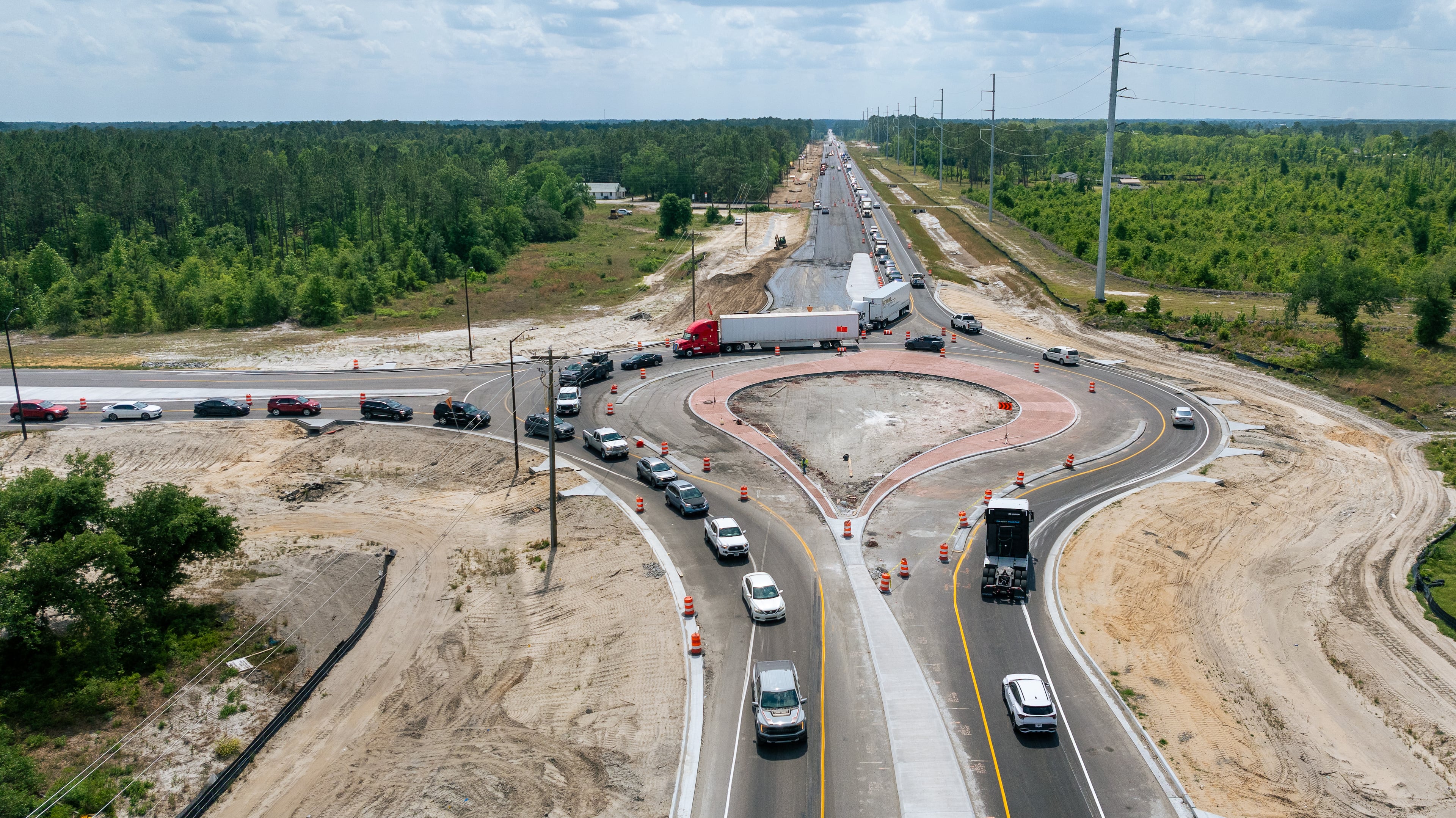
Roundabouts have become the traffic devices of choice at interstate interchanges across Georgia. In areas like coastal Georgia, where growth is turning rural areas into fledgling business and population centers, at least along I-16 and I-95, GDOT has opted for roundabouts rather than stoplights to improve interchanges like the one near Hyundai.
Roundabouts now sit atop on- and off-ramps at four exits on Savannah’s outskirts with plans for traffic circles at two more. Farther south at the can’t-miss-it Buc-ee’s exit near Brunswick along I-95, a three-roundabout design moves motorists to and from the giant gas-and-grub.
Even established urban areas like metro Atlanta are seeing more roundabout construction. One opened at Maynard Terrace, off I-20, late last year, and two are in design along Ponce de Leon Avenue.
All told, there are about 400 roundabouts across Georgia, just under half of which are operated by the state. Another couple hundred are in development or under construction.
*Featured on the “Flagship” podcast*
The best tools to calm traffic
Roundabouts are a popular tool among traffic engineers because they better reduce fatal and serious crashes than almost any other roadway design. Beyond safety, they can also help traffic move faster.
“There’s no silver bullet when it comes to safety in transportation engineering, but the roundabout is about as close as you can get to one,” said Sam Harris, a traffic engineer at GDOT.
Last year, close to 1,400 people died on Georgia roads, down from a high of nearly 2,000 in 2021. Thousands more are seriously injured every year in crashes.
Human behavior — speeding, driving under the influence — is the biggest cause of those crashes. The job of traffic engineers is to mitigate against the worst of drivers’ impulses, Harris said.
A roundabout? That curve is designed to force drivers to slow down.

The layout helps in other ways, too. At a traditional intersection where two roads meet, there are 32 different ways for two drivers to crash into each other. In a roundabout, there are just eight ways.
And those eight ways tend to cause less serious crashes than those at traditional intersections. The conflict points in a roundabout generally come from drivers following too closely and causing fender benders, or drivers failing to yield and sideswiping other vehicles. And the slower speeds in a roundabout also help minimize the severity of a crash.
That’s exactly what happened in Macon after GDOT finished construction on a multi-lane roundabout on the main route to and from Warner Robins, just south of I-75. Traffic jams were long the norm every afternoon when Robins Air Force Base let out.
The intersection along U.S. 41 used to be a particularly deadly one, with 13 fatalities between 2013 and 2024. On average, nearly a third of all crashes at the intersection resulted in at least one injury, according to vehicle crash data from GDOT.
The roundabout opened in January 2025. That year, just 9% of crashes resulted in an injury.
That decrease comes even as the total number of crashes increased, with 70 reported in 2025, up from an average of 30 per year before that. Of those 70 crashes, a majority of which were sideswipes, just 1 serious injury was reported.
There hasn’t been a fatality since the roundabout opened.
Roundabouts ease growth pains
Roundabouts aren’t the only makeovers underway at many of these intersections.
In metro Atlanta, the Maynard Terrace roundabout sits between the Kirkwood and East Atlanta neighborhoods and has seen an influx of housing construction in recent years.
Traffic used to move through the intersection at a crawl, and cars would back up on to I-20. That logjam hasn’t happened since the roundabout opened late last year, Harris said.
At an interchange near the coast, on I-16 close to the Hyundai plant, warehouse parks are rising on the north side of the interstate while an 11,000-home subdivision dominates the south side. Along I-95 near Richmond Hill, a 12,000-acre mixed-use development that includes an industrial park, retail centers, three schools and a 10,000-home subdivision is about a decade into build out.

Then there’s Exit 42 in Glynn County, where Buc-ee’s opened last year. Neighboring real estate is under development and will include a technology park, warehousing, a 2,300-unit subdivision, retail and what the local development authority has labeled a “significant tourism-related project” to be announced this month.
But it’s the traffic pattern around the roundabouts that attracts the notice of Buc-ee’s patrons. There’s a circle at the top of each exit ramp and another at the rear corner of the travel center. In between is a dedicated feeder lane, flanked by high curbs, that steers motorists directly into the Buc-ee’s parking lot.
“It’s crazy,” said Dennis Thumpson, who stopped for gas en route from Florida to his home in Pittsburgh. “You don’t know which lane to be in or if you have the right of way.”
Another traveler, Ken Hammond, said the saving grace is that Buc-ee’s doesn’t allow tractor trailers. He was driving a camper from his home in Bradenton, Florida to visit family in Rhode Island and said he wouldn’t want to try navigating the roundabouts next to big trucks.
GDOT regularly gets pushback on new roundabouts, said Harris, the GDOT engineer. They’re novel enough that many drivers have limited experience navigating them, and that makes people anxious.
At open houses whenever roundabouts are proposed, GDOT staff will literally tape off a roundabout shape on the floor and walk people through the circle to show them how it works, he said.
“It takes some getting used to initially, but people catch on rather quickly,” Harris said. “If people just take a deep breath, and they follow the striping and the signs, then they’re going to be OK.”
Roundabouts go viral
The Hyundai roundabouts are a social media fascination.
A July Facebook post highlighting the project, complete with aerial photos, has drawn more than 500 comments. Posters compare it to everything from a Hot Wheels slot car track to a Rubik’s Cube. Several commenters said the post’s photos must be AI-generated and warned others that looking at them can cause vertigo.
Several noted their nervousness in driving next to the thousands of trucks that pass through the interchange every day going to the Hyundai campus or the Love’s and Pilot travel centers at the exit. Wheels routinely run up on the curbs between the lanes, causing trailers to wobble.
On a recent weekday, a middle Georgia couple exercising their pets at the Love’s dog park laughed off the interstate exit experience. They drive a heavy-duty pickup truck and said they didn’t flinch as they navigated the course.
Even so, they made their take on the roundabouts clear: “Are you working on a story about how it’s poorly designed?”
Data Editor Charles Minshew contributed to this report.