Inside the online realm where the Apalachee school shooter spent his time


The Apalachee High School shooter didn’t have friends and didn’t attend school his entire eighth-grade year, court hearings showed. But online, he found a community that prosecutors said led to him carrying out his attack, which became the deadliest school shooting in Georgia history.
Children, teens and young adults around the world are creating art, videos and other content glorifying mass killers — including the Apalachee shooter — in the “true crime community,” or the TCC.
Their interest in true crime goes far beyond the benign, mainstream consumption of documentaries and podcasts. Researchers embedded in these spaces to monitor for threats of violence say there are signs parents and teachers can watch for to identify those falling into this rabbit hole.
In these dark corners of the internet, users discuss details of the more infamous killers’ lives, obsess over the details of their crimes and study their trial footage. And, in rarer instances, researchers say, they carry out attacks of their own.
The Apalachee school shooter was one such teen, who spent years immersed in this world before killing two teachers and two students at his school in 2024, prosecutors said in his sentencing hearing last month. He left behind a disturbing scavenger hunt of tributes to the killers who came before him, according to evidence laid out by investigators in court.
Researchers and law enforcement professionals say they are hoping to inform more people of the dangers of the TCC, which has only gotten a wider reach as social media use grows.
What is the TCC?
Just like people can obsess over or idolize celebrities, they can be drawn to mass killers, too. They want to dress like them, hang their pictures in their rooms and feel like they relate to them, researchers say.

The Apalachee shooter bought red silk sheets for his bed because the perpetrator of the 2012 movie theater shooting in Aurora, Colo., had posted a photo of himself with red silk sheets, prosecutors presented in court.
He made a “shrine” of the perpetrator of the school shooting in Parkland, Fla., on his wall, and posted photos of himself online posing like other mass shooters he admired, according to evidence in the case.
Because the TCC is a decentralized subculture spanning multiple platforms, from public-facing posts on Instagram and TikTok to chatrooms and forums on Discord and Reddit, it’s difficult for researchers to know how many people are in it at a given time. The content generated online vastly outnumbers the actual acts of violence in the real world.
Katherine Keneally is the U.S. director of threat analysis and prevention at the Institute for Strategic Dialogue, a global nonprofit that researches and seeks to combat hate and extremism. She previously worked for the New York Police Department’s intelligence bureau as an analyst on extremism, and she researches the connection between online activity and real-world crime and violence, she said.
Some go on to develop parasocial relationships with the killers, where they may feel like they are friends, or in love with them, Keneally told The Atlanta Journal-Constitution. The Apalachee shooter wrote messages on his phone expressing his love and admiration for the Parkland shooter, according to evidence shown in court.
“This is not necessarily a new phenomenon. There’s been women mailing letters to serial killers in prison since who knows how long,” she said.
Creating content demonstrating one’s deep knowledge of and attachment to these killers gains the user more fame and admiration, said Ben Popp, a lead threat analyst with the Anti-Defamation League’s Center on Extremism.
“The more harmful your content is, the scarier it is, the more clout gained in these spaces,” he said.
Attackers borne from the TCC are moved to violence not to further an ideological or societal purpose, but “to pay homage to previous mass killers” and gain notoriety, Popp said. That lack of ideology, classified by researchers and law enforcement professionals as “nihilistic violent extremism,” is what sets these crimes apart from other hate-motivated violence, although there is overlap among these extremists online.
“What they’re doing is often violence for violence’s sake while becoming famous,” Keneally said. “They want their face out there and their materials out there so once the attack has happened and they’re gone, they continue to be venerated amongst the community.”
An FBI Atlanta spokesperson said in a statement in response to questions from the AJC that investigators across the country are “investigating more than 500 subjects who are tied to violent online networks.”
“These extremists often emerge from decentralized online networks and subcultures that glorify violence, mass killers, and self-harm,” the agency said. “Regardless of motivation, the FBI takes each case seriously and works with domestic and foreign law enforcement partners to ensure offenders are held accountable.”

From Columbine to today
Although the Columbine massacre in 1999 wasn’t the first school shooting, it was unique in the fascination it generated, particularly with the early internet. The shooters left behind a trove of evidence online, and obsessing over that content led to the creation of a loose online community called “Columbiners.” That fandom evolved into the TCC as it exists today.
“Since then, we’ve seen materials surrounding Columbine continue to be shared online,” Keneally said. Those killers “continue to have this celebrity status, and we’ve sort of seen these waves of shootings inspired by Columbine over the last few decades.”
And content that used to be more fringe and difficult to find is now being circulated by algorithms on social media sites like TikTok, both Popp and Keneally said. Once users interact with those posts, the app shows more and more of it, bringing it closer to mainstream, the experts told the AJC.
The Institute for Strategic Dialogue used “ethnographic monitoring” and reporting to identify 74 violent attacks or plots in the U.S. that they determined were tied to extremist movements or online radicalization, according to its 2025 report. Of those where they could identify a clear motivation, the leading driver was “subcultures of nihilistic violence,” including the true crime community, which made up 22%.
The ADL’s Center on Extremism has counted at least 56 alleged or convicted criminals connected to the TCC, including actual attacks and plots that have been prevented, in 2024 and 2025, according to its website. Since 2024, there have been 23 strikes linked to the TCC globally as identified by the ADL.
The ADL tracks events linked to the TCC by “making determinations from publicly available data like news reports and court records,” and some incidents stem from their own investigations, Popp said.
Popp said he is embedded in the community and monitors it to identify users who may escalate to actual violence. He said some are also making content with AI: one posted actual footage from a prior school shooting but used AI to turn the real gun into a water gun that sprayed water instead of bullets, Popp said.
And it is not solely a U.S. phenomenon. Attacks worldwide have originated in this online subculture, with participants speaking different languages, Keneally said.
The users skew particularly young — children as young as 8 are engaged in the TCC, Keneally said. But most of them are adolescents and teens, which means the Apalachee shooter “fits within exactly what we see,” Popp added.

Identify and stop TCC violence
Children who fall into these dark spaces usually have some vulnerability in their lives, Keneally said. They crave attention, belonging and purpose that they may lack in the real world, researchers say. The Apalachee shooter fit the profile, according to evidence presented in court: he had an unstable, abusive household growing up, witnesses testified in his sentencing hearing.
“We’re not seeing the kid with a healthy home life, who is captain of their baseball or football team, who has a ton of friends, and their life is happy and healthy,” Keneally said. “They ended up in these communities because they feel like they can relate to attackers: for example, a child who is or has been bullied feels like they can relate to an attacker that was bullied.”
For those who do end up escalating to real-world violence, there are often also concerning signs in their real lives, Keneally said.
“They are taking that obsession a step further, where they’re not just wearing the clothes, but they’re acquiring weapons and actually plotting out acts of violence,” Keneally said. “They might say something to someone at school or elsewhere, but online, they’ll show their faces. They’ll show that they’re acquiring weapons. They’ll show that they’re acquiring tactical gear.”
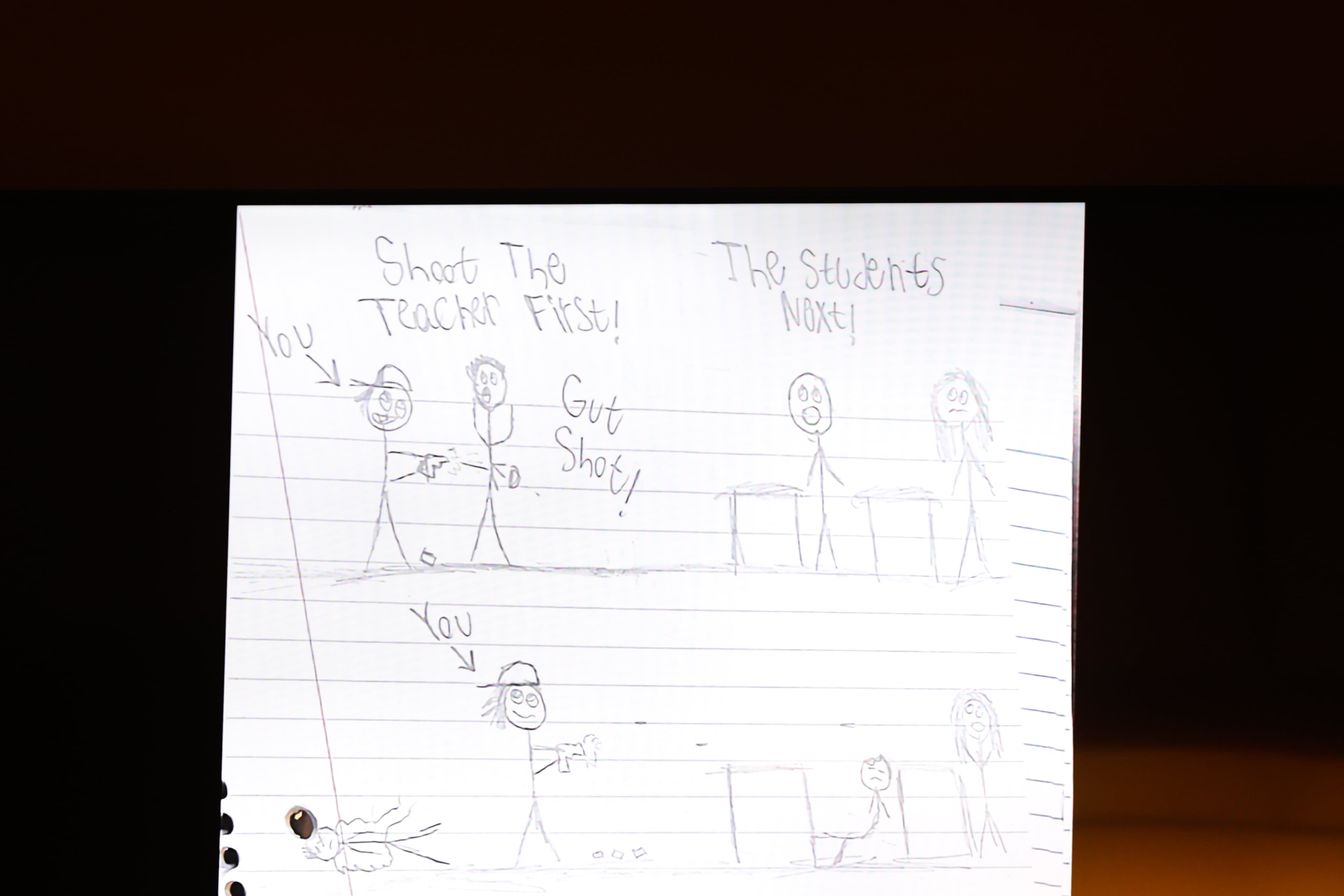
The Apalachee shooter’s notebook included drawings and plans for how to commit the attack, and his messages indicated he had been plotting for over a year, investigators showed in court. His family knew about his obsession with school shooters, prosecutors argued.
Those are the things Popp looks for online, too, he said, when differentiating between a user merely engaging with the content and one who is planning a real attack.
Barrow County District Attorney Brad Smith, after the hearing, urged parents to prevent children from accessing guns and to ask more questions about the people they are admiring.
“We need to pay attention to when these kids start doodling these things on their notebooks,” Smith said. “‘Who is that person you just put on your wall? Why are they on your wall?’ And if you do see your child acting this way or doing these things, please, please, please, make sure they do not have access to firearms.”
The problem law enforcement faces in preventing these shootings is their inability to act before a crime has been committed, said Keneally. It’s hard to tell who’s talking tough and who’s going to go through with it, Keneally said.
The FBI Atlanta spokesperson said in a statement that the agency works with companies “to remove TCC accounts for violating rules related to violent content,” but the “anonymity of the internet and encrypted aspects of some online platforms” makes it challenging to identify actual threats.
In the case of the Apalachee shooter, federal law enforcement did raise concerns about some of his online posts. In May 2023, the FBI flagged his messages, and a local sheriff’s deputy was dispatched to his house.
The deputy questioned him for a few minutes, and he denied making any threats. Prosecutors later showed in court that he had, in fact, said he would commit a mass shooting.
“We don’t have a good system in the United States presently that enables or empowers frontline practitioners to be able to de-radicalize and off-ramp and intervene in these cases where somebody’s clearly radicalizing,” Keneally said. “In an ideal world, we would be intervening much earlier.”
That’s where parents, teachers, and other adults closely involved in these kids’ lives come in. They are on the front lines — literally — in these attacks, and are often the ones close enough to see the warning signs, Keneally said.
Knowing what content children are engaging with online and having open conversations about it is critical, she said.
And if parents don’t act on those warning signs, they, too, could face charges in acts of violence their children carry out, as some prosecutors have signaled.
The Apalachee shooter’s father was convicted of second-degree murder and sentenced to 15 years in prison after giving his son the gun used in the attack. He is the first Georgia parent prosecuted for a mass school shooting committed by their child and the first in the country convicted of murder.
His case is the second of its kind nationally, after the parents of a Michigan school shooter were convicted of involuntary manslaughter and sentenced in 2024 to 10-15 years in prison.
When issuing the father’s sentence, Judge Nicholas Primm pointed out that “the warning lights were flashing brighter and brighter” before the man’s son killed four people.
Educating the public on symbols, phrases and warning signs could go a long way in helping combat violence, Popp said. Even for those in the TCC who may not go on to commit crimes, intervention and access to resources can help them find healthier ways to cope in their lives and work through the struggles they are facing.
“It’s not a bad thing to identify someone who’s engaged in these communities and get them help, regardless of whether they actually condone the violence or not,” Keneally said.